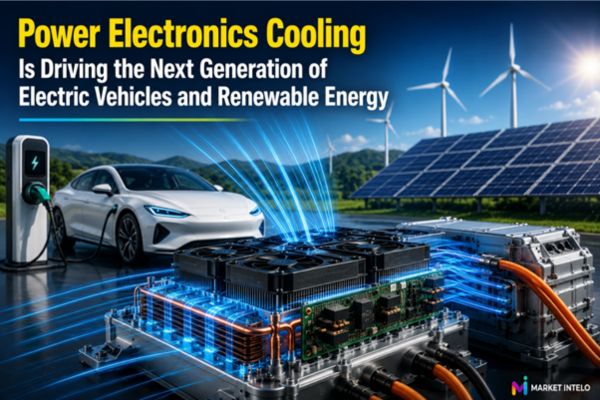
The increase in the electric vehicle (EV) market and renewable energy systems are driving the need for heavier-duty power electronics that can manage difficult tasks such as high-power supply, fast switching speed, and high-power density.
Devices such as inverters, converters, onboard chargers, and others create a lot of heat while in operation. While heating is a normal mode of operation for electric devices, if heat is not controlled, it could lead to efficiency issues, a decreased life cycle of the devices, and damage the reliability of the entire system.
As per Market Intelo, the global power electronics cooling market is worth $4.8 billion in 2025 and will go up to $9.1 billion by 2034, which is a CAGR of 7.8%. This will happen because of the growing usage of electronic cars, solar power systems, and high-power electronic units.
Why Power Electronics Generate More Heat Than Ever
Reasons for Increased Heat Generation by Power Electronics Power electronics convert, regulate, and distribute electrical energy in various ways. Semiconductors made of modern silicon carbide (SiC) and gallium nitride (GaN) enable higher frequency switching and guarantee efficiency, but they generate more heat as well.
Reports suggest that in challenging situations, the temperature of semiconductors can exceed 175°C if air conditioning systems fail. A temperature rise of even 10°C over specified operating temperature may affect the durability of electronic devices.
Growing electrification is increasing thermal challenges across several industries:
- Traction inverters for electric vehicles with operating voltage levels equal to 400V and 800V
- Solar inverters that convert direct electrical current into alternating electrical current that can be fed into the grid
- Wind turbine power converters managing variable electrical loads
- Industrial motor drives operating continuously in demanding environments
- Electric charging stations that provide energy of over 350 kW
As power density increases, advanced cooling solutions become critical for maintaining efficiency.
Cooling Technologies Aiding High-Power Electronics
Innovations in temperature control have led to various cooling options for different power needs and operational settings.
| Cooling Technology | Primary Application | Key Benefit |
| Air Cooling | Consumer electronics, low-power systems | Simple and cost-effective |
| Liquid Cooling | Electric vehicles, data centers | Superior heat removal capability |
| Cold Plate Cooling | Industrial converters | Uniform temperature distribution |
| Heat Pipes | Compact electronic devices | Passive heat transfer with high efficiency |
| Immersion Cooling | High-power electronics | Excellent thermal performance for dense systems |
Liquid cooling technology is increasingly being used in electric cars because its performance in removing heat is better than conventional air-cooling options. Contemporary cooling plates, which are placed inside the battery pack and power modules, allow for regulation of temperature even when there is fast-charging or strenuous driving.
Increasing Efficiency of Electric Vehicles by Improving Their Thermal Management
Electric vehicles have to produce effective power electronics in order to have enough range and be charging quickly. Thermal management is critical for the functionality of the inverter, successful charging of batteries, and reliability of motors.
Studies reveal that EV battery systems are most efficient at the temperatures between 20°C and 40°C. If this range is exceeded, the charging efficiency can decrease, the battery aging can accelerate, and the overall vehicle performance may be compromised.
The proper cooling of power electronics has several advantages:
- Good efficiency of the inverter in the accelerative and regenerative mode
- Higher battery service life due to stable temperature conditions
- Fast charging due to controlled heat generation
- Minimized risk of overheating when working under high load
- Better reliability of the high-voltage power module
The growing sale of electric vehicles on the global market means that the thermal management has become a serious priority in the engineering industry.
Improving The Reliability of Renewable Energy Technologies
Renewable energy systems are subject to changing environmental conditions. Solar energy plants may be exposed to too much sunshine as well as to high temperatures. Wind turbines could be under different electronic load conditions and in various weather conditions.
Power converters used in renewable energy applications may run thousands of hours each year without interruption. Some experts estimate that inverter failures account for a big share of maintenance in the solar utility sector, with one of the primary reasons being high temperatures.
With the help of state-of-the-art cooling solutions, renewable energy facilities can enjoy improved reliability of power converters as the operating temperature stays constant, thus reducing thermal stresses.
Better heat dissipation allows renewable energy facilities even higher conversion rates and efficiency so that more power delivered to the grid without unnecessary losses.
Trends To Expect for the Future of Power Electronics Cooling
The development of electric mobility and renewable energy technologies still continues revolutionizing thermal management practices. Experts are continuously working on compact cooling technologies that allow managing higher power densities without increasing the size and weight of systems.
The key advancements include AI-based thermal monitoring, new types of liquid cooling channels, phases change materials, and 3D printed heat exchangers aimed at boosting the effectiveness of the cooling. The emergence of wide bandgap semiconductors like SiC and GaN contributes to further technologies able to work effectively at higher temperatures while ensuring long-lasting reliability.
Analysts predict that production of electric vehicles and generation of renewable energy will keep increasing over the next ten years, which will result in an increased demand for smart thermal management solutions in transportation, industrial automation, and power grid systems.
Conclusion
Power electronics have turned into the key renown of electrically powered road vehicles, green energy systems and today’s industrial electrification. The advancements in these fields of technology are leading to the development of better operational efficiency and an overall increase in the power density where cooling plays an essential role in ensuring safety and reliability of the processes.
There are many cooling technologies available today ranging from liquid cooled EV inverters to thermally optimized green energy converters. This means that developers do not need to worry about the heat prone failures and inefficiency of the operation.