
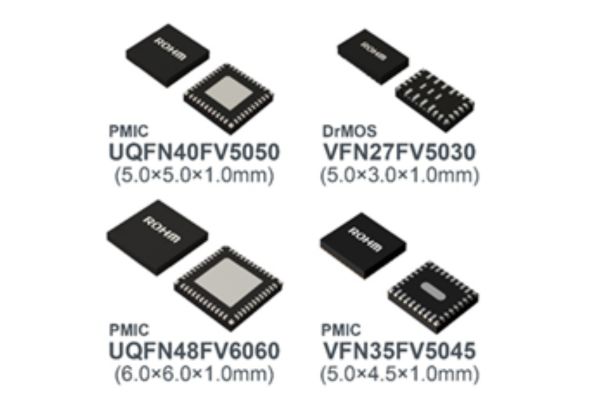
ROHM has developed a configurable power supply solution that combines the PMIC BD968xx‑C Series with the DrMOS BD96340MFF‑C, targeting automotive SoCs used in applications such as ADAS (Advanced Driver Assistance Systems), DMS (Driver Monitoring Systems), and sensing cameras.
In recent years, increasing performance demands for automotive SoCs, due to the evolution of ADAS, enhanced in-vehicle camera functionality, and ECU integration, have accelerated the shift toward domain architectures centered around domain controllers. As a result, power supply designs now require the ability to support low-voltage, high-current operation, along with advanced power sequencing control and high reliability.
Conventional power supply architectures often require significant customization to accommodate differences among SoC manufacturers and generations, frequently leading to redesigns during model rollouts. This increased both development time and verification workload. To address these challenges, ROHM has developed this solution based on a “Configurable” design concept enabling flexible adaptation to a wide range of SoC power requirements.
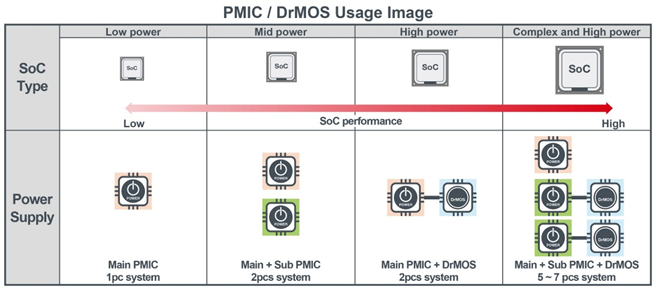
This solution enables scalable power supply designs that support a wide range of SoCs, from low-end to high-end, by flexibly configuring combinations of main configurable PMICs, sub PMICs, and DrMOS devices according to application and performance requirements. This scalable approach reduces development effort during platform expansion while enhancing power efficiency and design reuse.
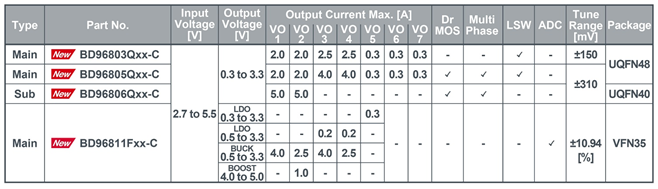
All PMICs are designed for a 2.7 V to 5.5 V input voltage range. BD96803Qxx‑C and BD96811Fxx‑C are optimized for standalone operation with low-end SoCs. BD96805Qxx‑C and BD96806Qxx‑C, when combined with the DrMOS BD96340MFF‑C, can support low-voltage, high-current demands required by high-performance SoCs.
The PMICs are housed in wettable flank QFN packages while the DrMOS is in a flip-chip QFN package. All devices are AEC‑Q100 qualified, ensuring high reliability for in-vehicle applications.
Mass production of these products has already begun. For more information, please contact a sales representative or visit the contact page on ROHM’s website.
PMIC Lineup
Application Examples
High-Power SoCs: ADAS, DMS, Cockpit integration systems, etc.
Mid-Power SoCs: Surround view systems, Parking assist systems, etc.
Low-Power SoCs: Sensing cameras, Body control systems, Various sensor control systems, etc.
Terminology
PMIC (Power Management IC)
An IC that contains multiple power supply systems and functions for power management and sequence control on a single chip. It is becoming more commonplace in applications with multiple power supply systems in both the automotive and consumer sectors by significantly reducing space and development load vs conventional circuit configurations using individual components (i.e. DC-DC converter ICs, LDOs, discretes).
DrMOS (Doctor MOS)
A module that integrates a MOSFET and gate driver IC. The simple configuration is expected to reduce design person-hours along with mounting area and to achieve efficient power conversion. At the same time, the built-in gate driver ensures high reliability by stabilizing MOSFET drive.
SoC (System-on-a-Chip)
A type of integrated circuit that incorporates a CPU (Central Processing Unit), memory, interface, and other elements on a single substrate. Widely used in automotive, consumer, and industrial applications due to its high processing capacity, power efficiency, and space savings.
Configurable PMIC
A power management IC that allows output voltage and power sequencing to be configured according to the application, enabling flexible power supply configurations to accommodate differences in SoC and system specifications.
Domain Architecture
A structure that manages the numerous ECUs (Electronic Control Units) installed in a vehicle by grouping them into functional domains. Within each domain, the higher-level control unit that oversees multiple ECUs is called a domain controller.