
The silicon anode battery market is moving from a promising battery-material innovation toward large-scale commercialization as automakers, electronics manufacturers and energy companies seek higher energy density, faster charging and lighter battery systems. Silicon-based anodes can store substantially more lithium than conventional graphite, making them one of the most closely watched technologies in the next generation of lithium-ion batteries.
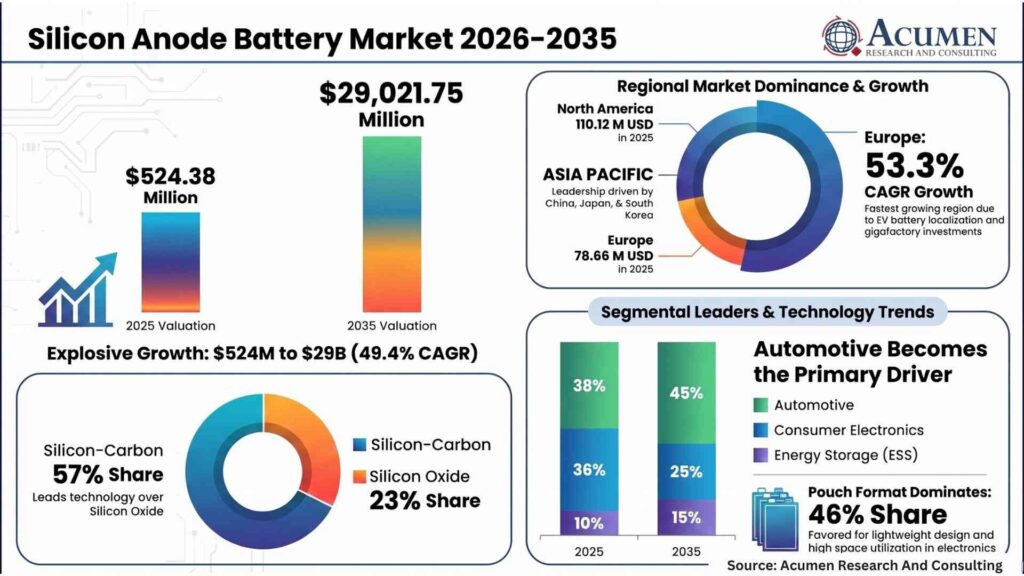
According to Acumen Research and Consulting, the Global Silicon Anode Battery Marketsize was valued at USD 524.38 million in 2025 and is projected to reach USD 29,021.75 million by 2035, expanding at a remarkable 49.4% CAGR from 2026 to 2035.
The acceleration is being driven by electric vehicles (EVs), high-performance smartphones, laptops, drones, aerospace systems and emerging energy-storage applications. At the same time, advances in silicon-carbon composites, silicon oxide, nanostructured silicon and silicon-dominant architectures are helping overcome one of the technology’s biggest historical weaknesses: silicon’s substantial expansion and contraction during charging and discharging.
What Is a Silicon Anode Battery?
A silicon anode battery is generally a lithium-ion battery that uses silicon, either alone or combined with other materials, in the negative electrode instead of relying entirely on conventional graphite.
The appeal of silicon is its extremely high theoretical lithium-storage capacity. Acumen Research and Consulting notes that silicon has a theoretical capacity of approximately 4,200 mAh/g, compared with about 372 mAh/g for graphite. However, theoretical material capacity does not translate directly into equivalent commercial cell-level performance.
In practical battery designs, manufacturers therefore frequently combine silicon with carbon or other structures to balance energy density with cycle life, mechanical stability, manufacturability and cost.
This has made silicon-carbon batteries particularly attractive for near-term commercialization.
Silicon Anode Battery Market Size and Forecast
The global silicon anode battery market reached $524.38 million in 2025 and is forecast to exceed $29.02 billion by 2035. The market is expected to grow at a 49.4% CAGR between 2026 and 2035.
The scale of the projected expansion reflects a major shift in battery technology. Silicon anodes are no longer being evaluated only in laboratories. Battery-material companies are building commercial-scale facilities, cell manufacturers are qualifying new chemistries, and automotive and electronics companies are seeking higher-performance cells.
The growth opportunity is particularly strong because silicon anodes can potentially increase energy stored within a similar physical footprint, allowing manufacturers to improve battery life without proportionally increasing battery size.
Key Silicon Anode Battery Market Statistics
The latest Acumen Research and Consulting analysis highlights several important market indicators:
- Global market size: $524.38 million in 2025.
- Forecast market size: $29.02 billion by 2035.
- Forecast CAGR: 49.4% from 2026 to 2035.
- Asia-Pacific accounted for 53% of the market in 2025.
- Europe represented 15% and is projected to be the fastest-growing region at a 53.3% CAGR.
- Silicon-carbon technology held a 57% market share in 2025.
- Silicon oxide/SiOx accounted for 23%.
- Batteries with 2,500–5,000 mAh capacity held 37% of the market.
- Pouch cells represented 46% of the market.
- Cylindrical cells accounted for 42%.
- Automotive applications led with 38%.
- Consumer electronics represented 36%.
These figures demonstrate that the market is already being shaped by both consumer electronics and automotive applications, while larger battery systems are expected to become increasingly important through 2035.
Why Is Silicon Anode Technology Important for Electric Vehicles?
The EV industry is one of the most important growth engines for the silicon anode battery market.
Electric-vehicle manufacturers are constantly balancing several competing requirements: driving range, battery weight, charging time, cost and usable vehicle space. Higher-energy-density battery chemistry can help address these challenges.
Silicon offers a route to increasing anode capacity while potentially maintaining similar battery-pack dimensions. This can support longer driving ranges or enable manufacturers to reduce battery size for a given range target.
Acumen estimates that the automotive application segment accounted for 38% of the market in 2025 and could increase to 45% by 2035.
This projected increase demonstrates how the market could gradually shift from early adoption in consumer electronics toward larger automotive battery programs.
To know more about this research, request the sample pages of this report.
Why Are Silicon-Carbon Anodes Leading the Market?
The silicon-carbon segment held 57% of the silicon anode battery market in 2025, making it the leading technology category.
The reason is straightforward: pure silicon offers exceptional theoretical capacity, but it also undergoes significant volume changes as it absorbs and releases lithium. Repeated expansion and contraction can damage the electrode structure and contribute to capacity degradation.
Combining silicon with carbon can improve mechanical stability and help manage expansion. This makes silicon-carbon composites a practical bridge between conventional graphite batteries and more silicon-dominant architectures.
The second-largest technology category, silicon oxide/SiOx, accounted for 23% in 2025. SiOx provides a compromise between high capacity and improved cycling behavior compared with pure silicon.
What Is Driving the Silicon Anode Battery Market?
Rising Demand for High Energy Density
The central driver is the demand for more energy from smaller and lighter batteries.
Smartphones need longer battery life without becoming thicker. EV manufacturers want greater range without dramatically increasing battery-pack weight. Drones and aerospace systems require high energy density because every gram matters.
Silicon’s higher theoretical capacity makes it attractive across all these applications.
Growth of Electric Vehicles
The global shift toward vehicle electrification is increasing investment in advanced battery chemistry. Automakers and battery producers are exploring silicon-based anodes to improve range, charging performance and overall battery efficiency.
Demand for Fast Charging
Silicon-based technologies can potentially support faster charging alongside higher energy density. This is especially attractive for EV manufacturers, where charging time remains a major consumer consideration.
Expansion of Premium Consumer Electronics
Consumer electronics is an important early commercialization market because manufacturers can use silicon-based anodes to increase battery capacity without significantly increasing device size.
Acumen estimates that consumer electronics represented 36% of the market in 2025.
Why Are Battery Manufacturers Struggling With Silicon Expansion?
Silicon’s biggest technical disadvantage is also the reason the technology is so challenging to commercialize.
During charging, silicon absorbs lithium and expands; during discharge, it contracts. This repeated change can cause particle cracking, electrode degradation and loss of electrical connectivity.
The result can be reduced cycle life and faster capacity fading than conventional graphite-based cells.
Battery developers are addressing the problem through several approaches, including:
- Silicon-carbon composites
- Nano-engineered silicon structures
- Silicon oxide
- Porous silicon architectures
- Advanced binders
- Improved electrolyte formulations
- Optimized electrode loading
- Protective coatings
- Silicon-dominant rather than pure-silicon designs
The commercial race is therefore not simply about achieving the highest silicon content. It is about finding the best combination of energy density, cycle life, fast charging, safety, cost and manufacturability.
Which Battery Capacity Segment Leads the Silicon Anode Battery Market?
The 2,500–5,000 mAh segment held the largest share at 37% in 2025. It benefits from widespread applications in smartphones, tablets, laptops, wearables and other portable electronics.
The 1,500–2,500 mAh category followed with a 25% share.
However, the market is expected to move toward larger batteries. Acumen projects the above-10,000 mAh segment to rise from 12% in 2025 to 30% by 2035, reflecting the increasing importance of EVs, energy storage, industrial equipment and other high-capacity applications.
This is a significant structural change because larger batteries can generate much greater demand for silicon-anode material per unit.
Why Do Pouch Cells Dominate Silicon Anode Batteries?
Pouch cells held the largest cell-format share at 46% in 2025. Their lightweight construction, high space utilization and flexible form factor make them particularly suitable for early silicon-anode applications.
Consumer electronics manufacturers have been important adopters because pouch cells can be designed around specific device dimensions.
Cylindrical cells followed with a 42% share, supported by standardized manufacturing processes, mechanical durability and their suitability for EVs, drones and aviation applications.
As silicon anodes penetrate automotive markets, cylindrical and prismatic formats are likely to become increasingly important.
Why Is Asia-Pacific the Largest Silicon Anode Battery Market?
Asia-Pacific dominated the silicon anode battery market with a 53% share in 2025.
The region benefits from a powerful combination of battery manufacturing, EV production, consumer electronics, semiconductor manufacturing and materials expertise.
China, Japan and South Korea are particularly important. China has a large domestic lithium-ion battery supply chain and is rapidly expanding silicon-anode production. South Korea combines major battery manufacturers with advanced materials companies, while Japan has deep expertise in automotive, electronics and battery R&D.
Acumen estimates the Asia-Pacific market was worth $277.92 million in 2025 and could exceed $14.22 billion by 2035, representing a 48.1% CAGR.
China is identified as having eight commercial-scale silicon-anode facilities in 2026, while South Korea has six and the United States has three.
Why Could Europe Be the Fastest-Growing Regional Market?
Europe accounted for 15% of the global market in 2025, but Acumen forecasts a remarkable 53.3% CAGR through 2035, making it the fastest-growing regional market.
The region’s opportunity is closely tied to EV-battery localization, gigafactory development, carbon-reduction targets and efforts to strengthen domestic battery supply chains.
Germany and the United Kingdom are particularly important development centers, while European battery manufacturers and technology companies are pursuing advanced anode technologies to improve the competitiveness of locally produced batteries.
The European silicon anode battery market is forecast to increase from $78.66 million in 2025 to $5.51 billion by 2035.
What Investments Are Accelerating Silicon Anode Battery Commercialization?
Investment is rapidly shifting from laboratory development toward manufacturing scale.
Sila is one of the most significant recent examples. In July 2026, the company announced a $300 million private funding round to accelerate U.S. production of its silicon-carbon Titan Silicon anode and support a Phase 2 expansion at its Moses Lake, Washington facility. Sila says the site began operations in 2025 and is designed to scale from an initial 2 GWh capacity toward as much as 250 GWh over five years.
In August 2026, Sila also announced a conditional loan commitment of up to $1.4 billion from the U.S. Department of War’s Office of Strategic Capital to expand silicon-carbon anode manufacturing at Moses Lake and build a lithium-ion battery-cell manufacturing facility.
Group14 Technologies has also been scaling its SCC55 silicon-carbon material. The company says it has raised more than $1 billion in equity and currently has 10 GWh of capacity online. Its material is being used in commercial battery programs with partners including ATL, Molicel, Sionic Energy, InoBat and V4Smart.
These investments show that the market is entering an important phase in which production capacity, supply-chain security and manufacturing economics are becoming as important as laboratory performance.
Who Are the Leading Silicon Anode Battery Companies?
The competitive landscape includes specialized silicon-material companies, battery manufacturers and diversified technology businesses.
Key silicon anode battery market players identified by Acumen include Sila Nanotechnologies, Amprius Technologies, Group14 Technologies, Enovix, NanoGraf, Enevate, Nexeon, Ningbo Shanshan, Hitachi Chemical, Panasonic, Samsung SDI and LG Energy Solution.
Each company is pursuing a somewhat different commercialization strategy.
Amprius Technologies focuses on silicon-nanowire anodes and high-energy-density batteries for aviation, drones, defense and electric mobility. Its 2026 filings state that it had access to annual production exceeding 2 GWh of SiCore batteries across pouch, cylindrical and prismatic formats.
Enovix uses a 100% silicon-anode architecture alongside its 3D cell design and BrakeFlow safety technology, initially targeting smartphones, wearables and IoT applications. Acumen reports that the company unveiled its AI-1 platform in July 2025 with capacity above 7,350 mAh and began supplying samples to smartphone manufacturers.
NanoGraf launched its Onyx EV-ready silicon-anode material in January 2025, positioning the technology for automotive applications.
What Are the Latest Trends in Silicon Anode Battery Technology?
Several trends are shaping the next phase of the industry.
First, manufacturers are moving from silicon additives toward silicon-dominant anodes as materials and electrode engineering improve.
Second, silicon-carbon technology is becoming increasingly commercial because it offers a practical balance between performance and durability.
Third, the market is expanding beyond consumer electronics. EVs, aerospace, drones, robotics, industrial equipment and energy storage are becoming increasingly important.
Fourth, localized manufacturing is becoming a strategic priority. Governments and companies in the United States, Europe and Asia are investing in domestic battery-material production to reduce supply-chain vulnerabilities.
Finally, the industry is increasingly focused on manufacturing-compatible silicon anodes that can integrate with existing lithium-ion production infrastructure instead of requiring entirely new factories.
What Are the Biggest Opportunities in the Silicon Anode Battery Market?
The largest long-term opportunity is the electrification of transportation.
If silicon-based anodes can deliver higher energy density without unacceptable degradation or cost increases, they could become an important component of next-generation EV batteries.
Consumer electronics remains another attractive market because consumers consistently demand thinner devices, longer battery life and faster charging.
Aerospace and defense represent high-value opportunities where energy density can be more important than absolute battery cost. Drones, satellites and advanced autonomous systems can benefit from batteries that deliver more energy without adding substantial weight.
Energy storage is also emerging as an important opportunity. Acumen estimates that ESS accounted for 10% of the market in 2025 and could reach 15% by 2035.
What Are the Challenges Facing the Silicon Anode Battery Market?
The biggest challenge remains cycle-life degradation caused by silicon expansion.
Manufacturers must also reduce production costs and develop consistent, high-volume material processes. Scaling a material from laboratory quantities to thousands of tonnes per year introduces challenges around particle uniformity, coating, electrode processing, yield and quality control.
Another challenge is competition from improving graphite-based batteries and other next-generation chemistries. Silicon anodes must demonstrate a compelling total cost and performance advantage rather than simply a higher theoretical capacity.
Supply-chain development is also critical. China currently has a dominant position in conventional anode manufacturing, creating incentives for the United States, Europe, Japan, South Korea and India to develop localized advanced-anode production.
Frequently Asked Questions About the Silicon Anode Battery Market
How big is the silicon anode battery market?
The global silicon anode battery market size was $524.38 million in 2025 and is projected to surpass $29.02 billion by 2035.
What is the CAGR of the silicon anode battery market?
The global silicon anode battery market is projected to grow at a 49.4% CAGR from 2026 to 2035.
Which region dominates the silicon anode battery market?
Asia-Pacific dominated the market with a 53% share in 2025, supported by strong battery, EV, consumer-electronics and semiconductor manufacturing ecosystems.
Which technology dominates the silicon anode battery market?
Silicon-carbon technology led the market with a 57% share in 2025, followed by silicon oxide/SiOx at 23%. Silicon-carbon composites help address the expansion and cycle-life challenges associated with pure silicon.
Which application leads the silicon anode battery market?
The automotive segment led with a 38% share in 2025 and is projected to reach 45% by 2035 as EV manufacturers seek greater energy density, longer range and faster charging.
What is the difference between a silicon anode and a graphite anode?
Silicon has a much higher theoretical lithium-storage capacity than graphite—approximately 4,200 mAh/g versus 372 mAh/g. However, silicon experiences substantially greater volume changes during cycling, creating challenges for durability and cycle life.
Are silicon anode batteries better than lithium-ion batteries?
Silicon anode batteries are generally an advanced form of lithium-ion battery, rather than a completely separate battery category. Their advantage is that replacing some or much of the graphite anode with silicon can increase energy density and potentially improve charging performance. Commercial performance depends on the specific chemistry and cell design.
Who are the leading silicon anode battery companies?
Leading companies include Sila Nanotechnologies, Amprius Technologies, Group14 Technologies, Enovix, NanoGraf, Enevate, Nexeon, Panasonic, Samsung SDI and LG Energy Solution, among others.
What is the future of silicon anode batteries?
The outlook is highly positive. The market is projected to grow from $524.38 million in 2025 to $29.02 billion by 2035, with EVs expected to become increasingly important alongside consumer electronics, energy storage, aerospace, defense and industrial applications.
Silicon Could Rewrite the Next Generation of Battery Technology
The silicon anode battery market is moving toward a pivotal commercialization phase. The technology offers one of the clearest pathways for increasing lithium-ion battery energy density without completely abandoning established manufacturing platforms.
The projected growth—from $524.38 million in 2025 to $29.02 billion by 2035 at a 49.4% CAGR—illustrates the scale of the opportunity.
Asia-Pacific currently leads the industry, Europe is forecast to grow at the fastest regional rate, and North American companies are making increasingly large investments in domestic silicon-anode manufacturing. Meanwhile, companies such as Sila, Group14, Amprius and Enovix are working to convert high-performance silicon materials into commercially scalable products.
The defining question for the industry is no longer whether silicon can store more lithium than graphite. It can. The bigger question is whether manufacturers can solve expansion, cycle life, cost, safety and manufacturing-scale challenges simultaneously.
Recent investments suggest the industry believes that answer is increasingly becoming yes.
For comprehensive market size, segmentation, regional analysis, competitive landscape, forecasts and industry trends through 2035, explore the complete Silicon Anode Battery Market report. To review the research scope and report coverage before making a purchase decision, readers can request the sample pages of the Silicon Anode Battery Market report