

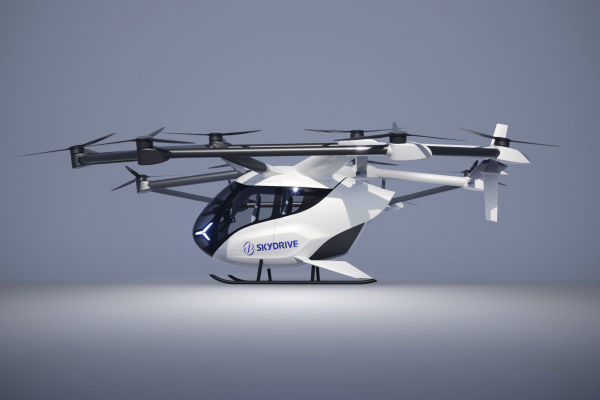
SkyDrive, a leading eVTOL aircraft manufacturer, has reached a general agreement with Taiwan’s 7A Drones, for the purchase of 10 “SKYDRIVE” (Model SD-05) eVTOL aircraft. The agreement establishes pricing, delivery timelines, and a framework for collaboration. As part of the partnership, the companies have proposed an emergency medical evacuation route connecting Magong City on Penghu’s main island with the remote Hujing Island.
Background
SkyDrive’s mission is to “lead the once-in-a-century mobility revolution,” integrating short-hop eVTOL travel into existing transport networks. After successful demonstration flights at Expo 2025 in Osaka, the company is targeting full-scale commercialization by 2028.
7A Drones provides advanced drone services in Taiwan, including operations, consulting, and pilot training. The companies previously signed a partnership and pre-order agreement for up to 10 aircraft, with discussions focused on leveraging eVTOLs for emergency medical transport in the Penghu Islands. The finalized purchase includes delivery of one aircraft in 2028, four in 2029, and five at a later, to-be-determined date.
Proposed Penghu Islands Route
The Penghu archipelago, with 90 islands, faces transport challenges, especially during winter when ferry services are often canceled. Hujing Island, with a population of around 860 and only one basic clinic, relies on transport to Magong City hospitals for critical care. The SKYDRIVE aircraft aim to complement ferries and helicopters, providing a reliable emergency medical transport option in difficult sea conditions.
Quotes
Tomohiro Fukuzawa, Founder & CEO, SkyDrive
“We are delighted that 7A Drones, our business partner in Taiwan, has signed this Letter of Intent for the purchase of SKYDRIVE aircraft. As our first Letter of Intent in the Asian market, this agreement marks a significant milestone in the expansion of SkyDrive’s overseas businesses.
We are particularly pleased to announce a first concrete expansion into the medical sector with joint proposals for emergency medical routes in the Penghu Islands. By leveraging the fast response and stable operation of eVTOL aircraft to address the transport challenges faced by island communities, we can help build a more robust medical infrastructure. We are proud to contribute towards this worthy goal.
As we work towards the commercialization of our eVTOL services in 2028, we will further strengthen our partnership with 7A Drones and ITRI. We are accelerating our aircraft development and building the infrastructure required to make travelling by eVTOL a regular part of everyday life. Together, our goal is to deliver safe and convenient air mobility to the people of Taiwan as soon as we possibly can.”
Hsin-Sheng Hsu, CEO of 7A Drones
“We are pleased to announce that 7A Drones has entered into a Letter of Intent (LOI) with SkyDrive regarding the potential purchase of aircraft. We consider this agreement to be a highly meaningful milestone. This LOI represents an important starting point for 7A Drones to explore the potential for cooperation with SkyDrive and other Japanese companies in the field of next-generation air mobility.
In particular, the concept of utilizing advanced air mobility solutions for emergency medical transportation in the Penghu Islands has drawn our strong interest, as it may serve as one possible approach to addressing the challenges faced by remote island communities, including transportation constraints and equitable access to medical services.
We believe it is essential to engage in careful and constructive dialogue with all relevant stakeholders to explore how new forms of mobility, such as so-called “eVTOL,” can contribute to local communities in a practical and socially meaningful manner. Going forward, 7A Drones will work closely with SkyDrive and other related partners, while sharing information and perspectives, to thoroughly examine the technical, operational, and regulatory aspects required to realize this initiative.
Through this project, we hope to further strengthen substantive private-sector cooperation and dialogue between Taiwan and Japan, and to contribute to the long-term development of cross-border collaboration in advanced mobility.”











 eVTOL aircraft.)