
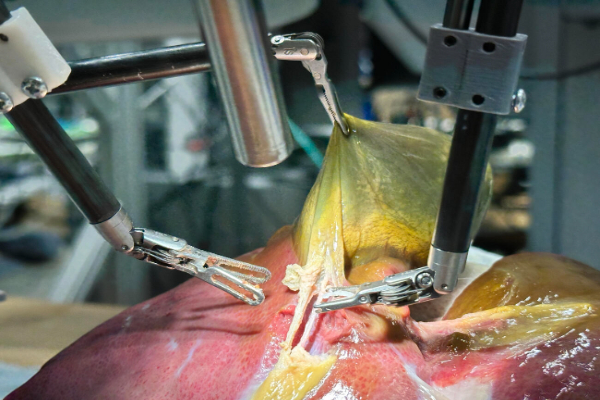
Surgical robots combine precision electronics, motion-control systems, imaging hardware and specialized software to help surgeons perform complex procedures. Behind every robotic movement, multiple data streams capture instrument position, motor activity, visual information and system status.
Managing these streams requires a carefully designed data architecture. The system must process time-sensitive information locally while recording and organizing data for performance analysis, maintenance and research. This makes surgical robotics an important application of embedded computing, real-time data processing and healthcare analytics.
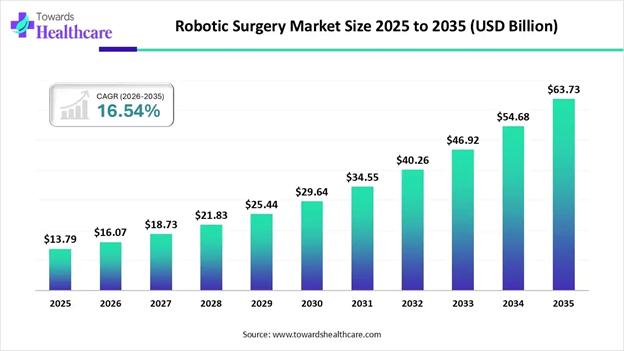
The global robotic surgery market size is calculated at USD 13.79 billion in 2025, grew to USD 16.07 billion in 2026, and is projected to reach around USD 63.73 billion by 2035. The market is expanding at a CAGR of 16.54% between 2026 and 2035, according to Towards Healthcare Research and Consulting.
How Does Surgical Robot Data Architecture Work?
A surgical robot typically includes a surgeon console, a patient-side robotic system, imaging equipment, motion sensors, motor controllers and computing hardware. These components generate different types of data that must be processed and synchronized.
The architecture can be divided into five layers:
- Data acquisition: Encoders, force sensors, motor-current sensors and cameras collect measurements.
- Embedded processing: Microcontrollers, processors and FPGAs process sensor signals and video.
- Real-time control: Dedicated controllers use feedback data to regulate robotic movement.
- Data recording: Storage systems capture telemetry, video, timestamps, alarms and system events.
- Analytics infrastructure: Local workstations or approved cloud platforms analyze recorded data for research, performance monitoring and maintenance.
These layers serve different purposes. Real-time control must respond within validated timing limits, whereas historical analytics can process large datasets after the relevant events have occurred.
Electronic Components Behind Surgical Robot Data
The quality of robotic data depends on the sensors, signal-conditioning circuits, processors and communication interfaces built into the system.
| Component | Function in the data architecture |
| Rotary and linear encoders | Measure joint position and instrument movement |
| Force and torque sensors | Measure mechanical interaction forces where supported |
| Motor-current sensors | Monitor electrical load and support fault detection |
| CMOS image sensors | Capture surgical video through endoscopic cameras |
| ADCs and signal-conditioning circuits | Convert analog measurements into digital data |
| Microcontrollers and real-time processors | Execute embedded control and monitoring tasks |
| FPGAs and image processors | Accelerate selected signal-processing and video operations |
| SSDs and other storage systems | Record video, telemetry and system events |
Encoder measurements help the controller estimate joint positions and velocities. Force sensors can provide information about instrument interaction, while motor-current measurements may reveal changes in mechanical load.
These signals are not useful simply because they are collected. They must be calibrated, checked for errors and interpreted in the context of the robot’s mechanical design and operating conditions.
Real-Time Processing of Motion and Video Data
Surgical robots generate data with different timing and bandwidth requirements.
Motion-control systems process encoder readings and other feedback signals to calculate the next control action. Depending on the design, this involves motor-control algorithms, kinematic calculations, trajectory generation and safety checks.
The controller must complete its work within a defined deadline. Excessive latency or unpredictable processing delays can affect system performance. Therefore, safety-critical control functions generally run on dedicated local computing hardware rather than depending on a remote cloud connection.
Video processing has a different workload. Endoscopic cameras can produce continuous high-resolution image streams that require substantial processing and memory bandwidth. Image processors may perform correction, enhancement, encoding and display preparation before the video reaches the surgeon’s monitor.
The architecture must keep these workloads from interfering with critical control tasks.
Synchronizing Multiple Data Streams
One major engineering challenge is ensuring that measurements from different components correspond to the same moment in time.
For example, a recorded video frame may show an instrument moving while an encoder records its joint position and a force sensor measures mechanical interaction. If their timestamps are inconsistent, engineers may struggle to reconstruct the sequence of events accurately.
A synchronized data pipeline can combine:
- Encoder positions and motor states
- Force and torque measurements
- Video frames and frame timestamps
- Controller commands and system responses
- Alarm events, faults and operating status
Hardware timestamps, synchronized clocks, bounded communication delays and carefully designed buffers can improve data alignment. Missing samples, clock drift and dropped video frames must also be detected and documented.
How Big Data Analytics Improves Surgical Robot Monitoring
Once the data is recorded, analytics platforms can examine patterns that are difficult to identify from individual events.
Performance analytics: Engineers can compare instrument movement, procedure duration, system response and equipment utilization across recorded sessions.
Fault detection: Unusual motor-current patterns, repeated communication errors or changes in sensor readings may help identify conditions that require technical investigation.
Predictive maintenance: Historical telemetry can help engineers investigate component wear and estimate maintenance needs. Reliable predictions require representative data and validation against actual equipment failures.
Video and motion analysis: Computer vision and data-processing algorithms can examine recorded instrument movement and procedural events for approved research or system-development purposes.
Fleet analytics: Manufacturers can aggregate suitable operational records from deployed robots to identify recurring technical problems and compare equipment performance across sites.
These applications depend on the quality of the underlying data. Analytics can support engineering decisions, but findings must be validated before they are used to influence clinical workflows or device safety.
The Role of Cloud Computing
Cloud platforms can provide scalable storage and computing resources for large collections of surgical video, device logs and telemetry. They can also support research datasets, software testing, fleet dashboards and analysis across multiple facilities.
However, transferring every data stream to the cloud is neither necessary nor appropriate for every application. High-bandwidth video can be expensive to transfer and store, while sensitive clinical data requires access controls, encryption, retention policies and appropriate authorization.
A practical architecture processes time-critical information locally, stores selected records securely and transfers approved datasets for offline analytics. Cloud connectivity must not become a dependency for essential robotic control or safety functions.
Key Challenges and Opportunities
Surgical robot data architecture faces several technical challenges:
- High data volumes: Continuous video and sensor recordings create substantial storage and bandwidth requirements.
- Timing accuracy: Unsynchronized measurements can reduce the value of motion and video analysis.
- Processing isolation: Analytics workloads must not disrupt time-critical control operations.
- Data integrity: Missing, corrupted or incorrectly labeled records can lead to misleading conclusions.
- Cybersecurity and privacy: Connected systems need robust protections for device software, networks and recorded clinical information.
Future development will likely focus on more efficient onboard processing, automated data-quality checks, advanced video analytics and better integration between robotic equipment and healthcare data platforms.
Source: https://www.towardshealthcare.com/insights/robotic-surgery-market-sizing
About Author
Payal Rabde is a Healthcare Market Research Analyst at Towards Healthcare Research & Consulting with over 4+ years of experience in pharmaceutical, biotechnology, medical device, and healthcare market research. She holds an MBA in Pharmaceutical-Biotechnology Management and a B.Pharm, specializing in market analysis, forecasting, competitive intelligence, and strategic healthcare insights.
About Towards Healthcare Research and Consulting
Towards Healthcare Research & Consulting is a global strategy consulting firm with a presence in both Canada and India. We provide innovative solutions customized to the healthcare sector, helping business leaders overcome challenges and accelerate growth. We specialize in delivering advanced technological solutions, clinical research services, and powerful data analytics. Our focus is on building meaningful partnerships that foster innovation and deliver actionable insights to drive success in healthcare.