Overview
A medical IoT device may have an accurate sensor, a powerful microcontroller, and an efficient battery, but it can still fail if its wireless connection is unreliable.
The antenna is the part of the device responsible for sending and receiving radio-frequency signals. In medical IoT, however, antenna design is more complicated because the device often operates directly on, inside, or very close to the human body.
Human tissue can absorb and detune radio signals. The position of a wearable can change the antenna’s performance, while the small size of medical devices leaves very little room for RF components. As a result, designing a wireless medical device is not simply about adding an antenna to a circuit board.
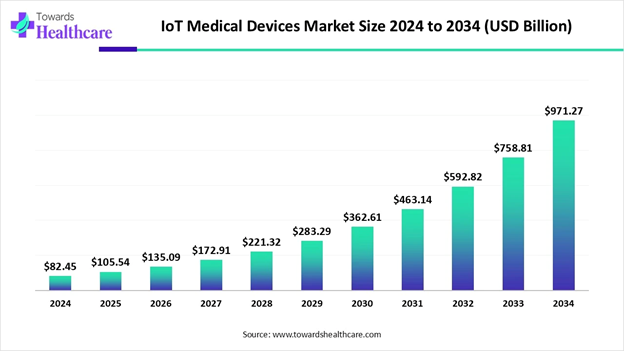
According to Towards Healthcare, the global IoT medical devices market size is calculated at US$ 82.45 in 2024, grew to US$ 105.54 billion in 2025, and is projected to reach around US$ 971.27 billion by 2034. The market is expanding at a CAGR of 28% between 2025 and 2034.
Why the Human Body Creates an Antenna Challenge
An antenna is designed to operate at a particular frequency and within specific electrical conditions. The human body changes those conditions.
Body tissues contain water and have different electrical properties from air. When an antenna is placed close to skin, muscle, or other tissue, its electromagnetic field interacts with the surrounding material.
This interaction can change the antenna’s resonant frequency, impedance, efficiency, and radiation pattern.
For example, a wearable sensor may perform well during laboratory testing but behave differently when it is attached to an arm, chest, wrist, or head.
Movement creates another challenge. The distance and angle between the antenna and the body can continuously change during normal use.
How Wireless Signals Move Through Medical IoT Devices
A simplified wireless architecture looks like this:
Sensor → Signal Conditioning → Microcontroller → RF Transceiver → Matching Network → Antenna → Wireless Network
The sensor collects physiological information such as temperature, heart rate, oxygen saturation, or motion. The microcontroller processes that information before sending it to an RF transceiver. The transceiver generates and receives the wireless signal, while the antenna converts electrical signals into electromagnetic waves and receives incoming signals.
A matching network sits between the RF circuit and antenna. Its purpose is to help transfer RF energy efficiently by managing impedance.
Even a small mismatch can reduce the amount of power radiated by the antenna.
Technologies Used
- Bluetooth Low Energy (BLE): Common in wearable medical sensors because it supports low-power short-range communication.
- Wi-Fi: Used where medical devices need higher data throughput and access to local networks.
- 5G and Cellular IoT: Supports wide-area connectivity for remote monitoring and mobile healthcare devices.
- NFC: Uses very short-range communication and can be useful for identification, configuration, and some battery-free medical electronics.
- UWB: Provides precise ranging and positioning capabilities for applications requiring accurate location information.
- RFID: Enables wireless identification and tracking using tags and readers.
- Flexible Antennas: Can be integrated into patches, textiles, and curved wearable devices.
- Ceramic and Chip Antennas: Useful where PCB space is limited.
- Printed Antennas: Allow conductive patterns to be integrated directly onto flexible or compact substrates.
Designing an Antenna Around the Body
Medical IoT designers have to consider the antenna and the device enclosure as one system.
The available PCB area, battery, display, sensors, cables, shielding, and other components can all influence RF performance. The antenna also needs sufficient clearance from conductive components and other sources of electromagnetic interference.
Wearable devices introduce another consideration: orientation.
An antenna positioned on the wrist may have a different radiation pattern from one positioned on the chest. Designers therefore evaluate performance under different body positions and operating conditions.
For flexible medical electronics, the antenna may also need to bend with the skin without significantly changing its electrical characteristics.
Why Antenna Efficiency Matters
A small medical IoT device usually has limited battery capacity. Poor antenna efficiency means more transmit power may be required to achieve the same communication range.
This can increase energy consumption and reduce battery life.
For wearable and continuously monitoring devices, the problem becomes particularly important. The antenna needs to maintain a reliable connection while using as little power as possible.
This creates a three-way engineering challenge involving antenna efficiency, communication reliability, and power consumption.
Challenges
- Human tissue absorption and detuning
- Limited space inside compact medical devices
- Changing antenna performance during movement
- Body position and orientation effects
- Impedance mismatch
- Electromagnetic interference
- Limited battery capacity
- Signal attenuation around the body
- Device enclosure effects
- Maintaining reliable communication at low transmit power
Opportunities
Better antenna engineering is opening new possibilities for connected medical electronics.
Flexible and stretchable antennas can support wearable patches and textile-based sensors. Multi-band antennas can allow one device to support different wireless technologies. Advanced RF modules can combine multiple connectivity options while intelligent power management reduces unnecessary transmission.
Antenna design can also become part of the wearable itself, using conductive textiles, printed conductors, flexible substrates, or compact embedded structures.
What Comes Next?
Future medical IoT devices will require antennas that are smaller, more flexible, more power-efficient, and less sensitive to changes in body position.
Advanced simulation, flexible materials, adaptive impedance matching, multi-band designs, and compact RF modules can help engineers maintain wireless performance under real-world conditions.
The antenna may be one of the smallest components in a medical IoT device, but it has an outsized role in determining whether the device can reliably communicate.
Conclusion
Medical IoT depends on more than sensors and software. The wireless connection itself must work reliably in one of the most difficult RF environments: the human body.
As healthcare devices become smaller, wearable, implantable, and continuously connected, antenna engineering will become increasingly important. The challenge is not simply to make an antenna fit inside a medical device, but to design the entire wireless system around how that device interacts with the human body.
Source: https://www.towardshealthcare.com/insights/iot-medical-devices-market-sizing
About Author
Payal Rabde is a Healthcare Market Research Analyst at Towards Healthcare Research & Consulting with over 4+ years of experience in pharmaceutical, biotechnology, medical device, and healthcare market research. She holds an MBA in Pharmaceutical-Biotechnology Management and a B.Pharm, specializing in market analysis, forecasting, competitive intelligence, and strategic healthcare insights.
About Towards Healthcare Research and Consulting
Towards Healthcare Research & Consulting is a global strategy consulting firm with a presence in both Canada and India. We provide innovative solutions customized to the healthcare sector, helping business leaders overcome challenges and accelerate growth. We specialize in delivering advanced technological solutions, clinical research services, and powerful data analytics. Our focus is on building meaningful partnerships that foster innovation and deliver actionable insights to drive success in healthcare.