

Overview
A connected medical device can measure a patient’s heart rate, temperature, oxygen saturation, or movement, but the readings become harder to interpret when their timestamps do not match.
In medical IoT systems, multiple sensors may collect data simultaneously and transmit it through different wireless or wired connections. If each device uses its own clock, even measurements taken at the same moment can appear to have happened at different times.
Time synchronization helps connected devices maintain a shared timeline. It allows monitoring systems to align measurements, compare events, and understand how a patient’s physiological signals change over time. Behind this capability are electronic clocks, oscillators, microcontrollers, timestamping circuits, and network protocols designed to reduce timing errors.
Why Do Medical IoT Devices Need Accurate Clocks?
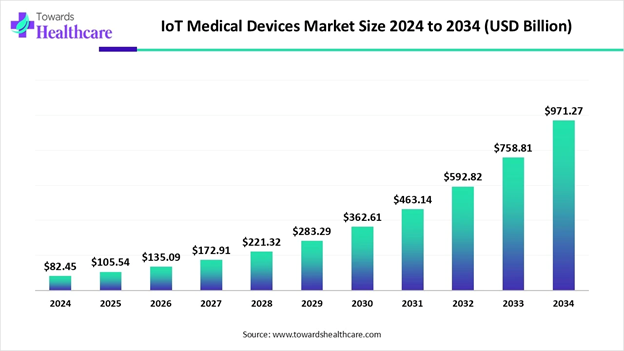
According to Towards Healthcare, the global IoT medical devices market size is calculated at US$ 82.45 in 2024, grew to US$ 105.54 billion in 2025, and is projected to reach around US$ 971.27 billion by 2034. The market is expanding at a CAGR of 28% between 2025 and 2034.
Consider a wearable ECG sensor and a separate movement sensor monitoring the same patient. The ECG records electrical activity from the heart, while the movement sensor tracks physical activity.
If their clocks are not synchronized, the system may incorrectly associate a change in heart activity with a movement that occurred earlier or later. Similar timing mismatches can affect data collected from multiple sensors, bedside monitors, and connected diagnostic devices.
Accurate timestamps are also important when reviewing monitoring records, correlating measurements from different devices, and reconstructing the sequence of events.
The required accuracy depends on the application. Aligning long-term temperature records may tolerate greater timing differences than combining high-speed physiological signals or coordinating time-sensitive equipment.
How Time Synchronization Works
Every connected electronic device has a local clock. At the hardware level, this usually depends on an oscillator that generates a regular electrical signal. A counter or timer uses these oscillations to measure elapsed time.
However, separate oscillators never operate with exactly the same frequency. Small manufacturing variations, temperature changes, aging, and power conditions can cause their clocks to drift apart.
A synchronization system periodically compares device clocks with a shared time reference and corrects the difference.
A simplified architecture looks like this:
Reference Clock → Network Time Messages → Device Clock → Timestamping → Data Alignment
The reference clock provides the common timing source. Network messages carry timing information to connected devices, and local clock hardware or software adjusts each device’s time.
When a sensor records a measurement, its timestamp indicates when the event occurred, rather than merely when the data reached the monitoring application. This distinction is important because network delays can vary.
Technologies Used
- Real-Time Clocks (RTCs): Maintain time within embedded devices, often using a dedicated low-power clock circuit.
- Crystal Oscillators: Generate the stable electrical reference used by timers and digital systems.
- Microcontroller Timers: Count clock cycles and capture the timing of sensor events.
- Network Time Protocol (NTP): Synchronizes clocks over IP networks and is suitable for many general-purpose monitoring applications.
- Precision Time Protocol (PTP): Defined by IEEE 1588, PTP enables precise synchronization across networked devices, particularly when hardware timestamping and suitable network support are available.
- Hardware Timestamping: Records packet timing close to the network interface, reducing errors introduced by software processing delays.
- Ethernet and Network Switches: Can support precise time distribution when the network infrastructure is designed for it.
- Wireless Connectivity: Wi-Fi, Bluetooth, and cellular networks carry sensor data and may support timing mechanisms, but achievable synchronization accuracy depends on the technology and implementation.
What Makes Accurate Synchronization Difficult?
Network latency is one of the main challenges. A timing message takes time to travel from one device to another, and congestion or retransmissions can introduce variable delays.
Clock drift creates another problem. Two devices may initially share the same time but gradually diverge because their oscillators run at slightly different rates.
Wireless medical IoT devices face additional constraints, including limited battery capacity, intermittent connectivity, and differences between device hardware. A wearable sensor may also enter a sleep state to conserve power, making continuous synchronization impractical.
Designers must therefore balance timing accuracy, communication overhead, power consumption, and system complexity.
Challenges and Opportunities
Challenges
- Clock drift caused by oscillator variation and temperature.
- Variable network delays and packet loss.
- Limited hardware timestamping support in compact devices.
- Battery consumption from frequent synchronization messages.
- Different timing capabilities across connected devices.
- Incorrect timestamps caused by software delays or inconsistent clock handling.
- Maintaining reliable time during network outages or device restarts.
Opportunities
- Better alignment of data from multiple physiological sensors.
- More accurate event timelines in remote patient monitoring.
- Improved correlation between ECG, movement, and other measurements.
- More reliable analysis of time-dependent physiological patterns.
- Better coordination between connected diagnostic and monitoring systems.
- More consistent timestamps for clinical data review and device logs.
What Comes Next?
Medical IoT designs can combine stable oscillators, hardware timestamping, improved network timing, and efficient synchronization algorithms to maintain more consistent clocks.
IEEE 1588 Precision Time Protocol is especially relevant when a system needs precise timing across supported networked devices. Its actual performance depends on the clocks, timestamping hardware, network components, and configuration. Less demanding applications may operate effectively with simpler time-synchronization methods.
Future embedded systems will increasingly need to treat timing as part of the device architecture, alongside sensing, processing, connectivity, and power management.
Source: https://www.towardshealthcare.com/insights/iot-medical-devices-market-sizing
About Author
Payal Rabde is a Healthcare Market Research Analyst at Towards Healthcare Research & Consulting with over 4+ years of experience in pharmaceutical, biotechnology, medical device, and healthcare market research. She holds an MBA in Pharmaceutical-Biotechnology Management and a B.Pharm, specializing in market analysis, forecasting, competitive intelligence, and strategic healthcare insights.
About Towards Healthcare Research and Consulting
Towards Healthcare Research & Consulting is a global strategy consulting firm with a presence in both Canada and India. We provide innovative solutions customized to the healthcare sector, helping business leaders overcome challenges and accelerate growth. We specialize in delivering advanced technological solutions, clinical research services, and powerful data analytics. Our focus is on building meaningful partnerships that foster innovation and deliver actionable insights to drive success in healthcare.