
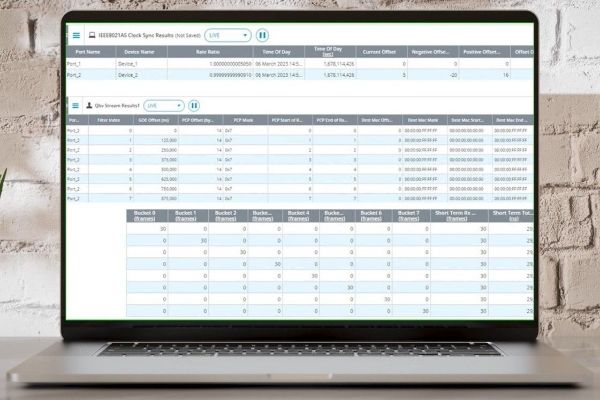
VIAVI Solutions has announced that its TTworkbench gPTP test suite and TestCenter M1 Appliance have been approved as an IEEE 802.1AS Avnu Certification Test Tool (CTT) under the Avnu Alliance Time-Sensitive Networking (TSN) Component Certification Program. The solution will be demonstrated at the Avnu Alliance Plugfest held from April 20–24 in London.
This recognition broadens VIAVI’s range of Avnu-certified test tools available to device makers, silicon vendors, and authorized test labs for validating TSN protocol compliance. The CTT helps ensure products meet Avnu test requirements and supports interoperability across complex, multi-vendor TSN environments.
VIAVI’s CTT helps customers streamline component certification within the Avnu Alliance ecosystem by consolidating validation into a single, integrated workflow. The solution reduces complexity, accelerates certification timelines and enables more efficient multi-vendor interoperability testing as certification needs evolve.
“This recognition underscores the strength of VIAVI’s unified approach to TSN validation,” said Aniket Khosla, Vice President of Product Management, Lab and Production, VIAVI. “By combining automated TSN conformance testing with high‑precision traffic generation and timing analysis, our solution enables customers to accelerate certification cycles while gaining greater confidence in multi-vendor interoperability.”
“The Avnu Alliance Component Certification Program is designed to grow industry confidence in interoperable, standards-based TSN implementations,” said Jeremy Rover, Co-Chair Certification Working Group, Avnu Alliance. “By adding VIAVI’s CTT solution to the program, we are expanding access to trusted tools that support efficient certification workflows and help device manufacturers and test labs accurately reflect product conformance to Avnu test plans with confidence.”
The Avnu Alliance Component Certification Program supports standardized conformance validation and interoperability assurance across TSN-enabled devices, helping reduce ecosystem fragmentation as adoption grows in automotive, industrial, professional audio, aerospace and defense, and other time-sensitive networking applications.