

Wireless implantable medical devices are becoming an important area of modern healthcare electronics. These small devices are placed inside the body to monitor health conditions, support organ function, or deliver treatment. When these implants are connected to the Internet of Things (IoT), they can communicate with external devices and healthcare platforms, creating a more connected approach to patient monitoring.
Traditional devices such as pacemakers, cochlear implants, and neurostimulators have been used for years. Newer generations are becoming smaller, more intelligent, and more connected because of advances in miniaturized sensors, wireless communication, low-power electronics, artificial intelligence (AI), and cloud computing.
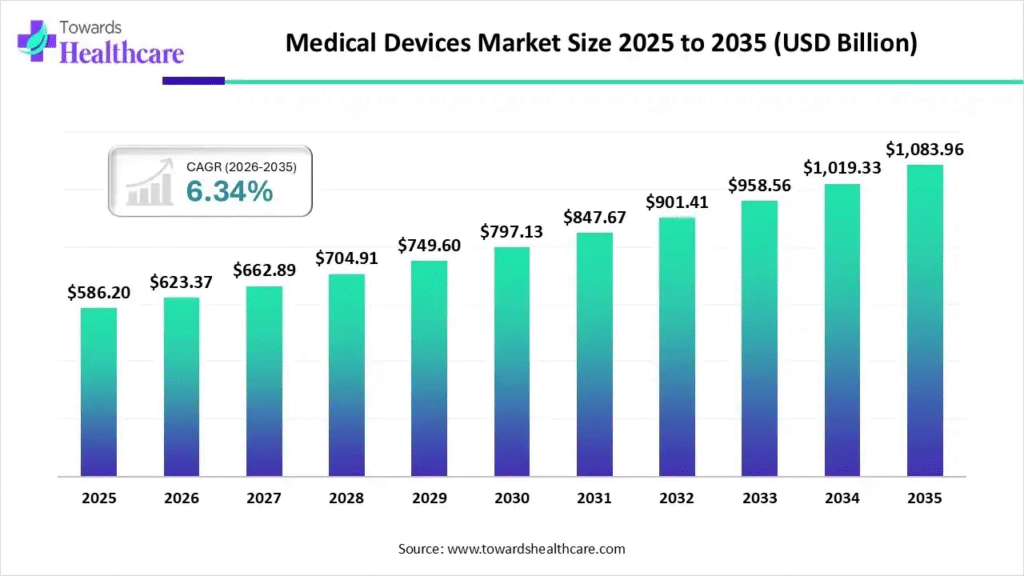
According to Towards Healthcare Research and Consulting, the global medical devices market size is calculated at USD 586.20 billion in 2025, grew to USD 623.37 billion in 2026, and is projected to reach around USD 1083.96 billion by 2035. The market is expanding at a CAGR of 6.34% between 2026 and 2035.
How Do Wireless Implantable Medical Devices Work?
A wireless implant generally contains electronic components such as sensors, a microcontroller, a communication module, and a power source.
The device collects physiological information such as heart rate, pressure, temperature, glucose-related measurements, or neural signals. Depending on the design, this information can be transmitted to a nearby external receiver, wearable device, smartphone, or medical monitoring system.
The basic process is:
Implant → Wireless Connection → External Device → Cloud/Healthcare Platform → Healthcare Professional
This connected model can help doctors access patient information beyond periodic hospital appointments.
Key Technologies Used
Several technologies are helping advance wireless implantable devices:
- Bluetooth Low Energy (BLE): Enables low-power communication between implants or external receivers and nearby connected devices.
- Near-Field Communication (NFC): Useful for short-range communication and, in some designs, wireless powering or data transfer.
- RF Wireless Communication: Radio-frequency systems can transmit information between an implant and an external device.
- IoT Platforms: Connect medical-device data with software systems where information can be stored, monitored, and analyzed.
- Miniaturized Sensors: Measure physiological parameters while taking up very little space.
- Low-Power Electronics: Help reduce energy consumption and extend device operating life.
- AI and Machine Learning: Can analyze collected data to identify patterns and potentially support earlier clinical intervention.
- Cloud Computing: Provides a platform for storing and processing large volumes of health data.
- Energy Harvesting: Emerging approaches can generate small amounts of energy from sources such as body movement or heat, potentially reducing dependence on conventional batteries.
Advantages of Wireless Implantable Devices
- Continuous Monitoring: Devices can collect health information over extended periods rather than relying only on occasional hospital measurements.
- Remote Patient Monitoring: Data can potentially be reviewed remotely, which may reduce the need for some routine visits.
- Earlier Detection: Continuous data may help identify changes in physiological conditions sooner.
- Personalized Treatment: Long-term patient data can help physicians better understand individual responses to treatment.
- Better Patient Convenience: Remote data transfer can reduce the burden of frequent monitoring for some patients.
- Real-Time Insights: Connected systems can provide faster access to important information when abnormal patterns are detected.
Disadvantages and Challenges
- Battery Limitations: Many implants require reliable long-term power, and replacing a battery can require an additional medical procedure.
- Cybersecurity Risks: Wireless connectivity creates potential risks of unauthorized access to sensitive health information.
- Biocompatibility: Materials must be carefully selected to minimize unwanted reactions inside the body.
- Signal Interference: Wireless signals may be affected by the human body or surrounding electronic systems.
- High Development Costs: Designing, testing, and gaining regulatory approval for implantable electronics can be expensive and complex.
- Data Privacy: Connected implants can generate highly sensitive medical information that must be securely managed.
- Surgical Risks: Implantation itself may involve risks such as infection, tissue damage, or complications.
The next generation of wireless implantable medical devices is likely to focus on smaller electronics, longer operating life, better sensors, stronger cybersecurity, and smarter data analysis. AI could help transform raw implant data into clinically useful insights, while IoT infrastructure could connect implants with wearables, smartphones, hospitals, and remote-care platforms.
The combination of implantable devices, IoT, AI, wireless communication, and advanced sensors could therefore play a major role in the future of remote monitoring and personalized healthcare.