

The Physical AI Market is emerging as one of the most dynamic and transformative segments of the artificial intelligence ecosystem, combining machine cognition with real-world action to create systems capable of perceiving, reasoning, and responding within physical environments. Unlike traditional AI solutions that operate solely in data or digital spaces, Physical AI enables autonomous machines to interact with the physical world — sensing, adapting, and performing tasks with minimal human intervention.
This shift represents a profound evolution in automation, extending beyond algorithms and software to merge AI cognition with mechanical embodiment, enabling robots, autonomous vehicles, intelligent drones, and other physical agents to solve complex tasks in healthcare, manufacturing, logistics, and beyond.
According to a comprehensive Physical AI Market Report by Acumen Research and Consulting, the Physical AI Market Size was USD 3,137.5 million in 2025 and is forecast to reach approximately USD 83,642.5 million by 2035, expanding at a remarkable CAGR of 34.4% from 2026 to 2035.
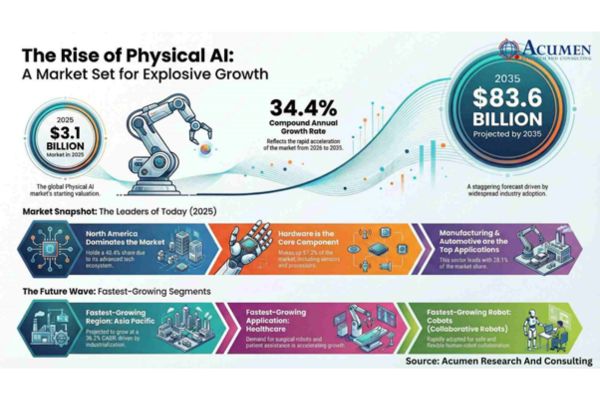
These figures underscore the accelerating pace at which industries are adopting physically intelligent systems to enhance productivity, efficiency, and safety while reducing operational costs.
Understanding Physical AI Technology
Physical AI refers to the development of machine intelligence that not only performs cognitive functions but also interacts with the physical environment — enabling robots, autonomous systems, and smart machines to perceive their surroundings, make decisions, and execute actions in real time.
As noted in industry discussions, Physical AI systems integrate sensing modalities such as vision, LiDAR, tactile perception, and reinforcement learning mechanisms to enable real-world interaction. This synthesis of AI reasoning with physical execution distinguishes Physical AI from conventional digital AI, opening new application horizons across sectors.
In manufacturing, for example, Physical AI enables autonomous mobile robots (AMRs) to weave through warehouse aisles, detect obstacles, and execute logistics tasks with human-like adaptability. In healthcare, robotic surgical systems leverage Physical AI to enhance precision and reduce procedural errors. Across defense and security, autonomous drones deploy Physical AI capabilities for surveillance and reconnaissance.
Physical AI Market Size and Growth Forecast
The rapid expansion of the Physical AI Market is backed by robust projections and multi-industry adoption trends:
- Market Size (2025): USD 3,137.5 million
- Forecast (2035): USD 83,642.5 million
- CAGR (2026–2035): 34.4%
These projections reflect a growing recognition of Physical AI as a foundational technology for the future of automated systems. The convergence of advanced sensors, edge computing, computer vision, and autonomous control is fuelling unprecedented demand across robotics and intelligent systems.
Importantly, the Physical AI Market Share is broadening not only in industrial robotics but also in collaborative robots (cobots), service robots, humanoids, and autonomous vehicles. This diversification of physical intelligent systems underscores the widespread utility of Physical AI technologies in solving adaptive challenges in complex environments.
Drivers of Physical AI Market Growth
Several key forces are powering the rapid expansion of the Physical AI Market:
1. Rising Demand for Automation and Intelligent Robotics
As industries grapple with labor shortages, rising costs, and the push toward zero-defect operations, automation powered by Physical AI offers an optimal solution. Robots equipped with advanced perception and decision-making capabilities are increasingly deployed in manufacturing assembly lines, logistics hubs, and quality inspection applications.
2. Technological Innovation in Sensors and Edge AI
The integration of high-performance sensors, advanced algorithms, and edge computing has significantly enhanced the capabilities of physically intelligent machines. By processing data locally, robots can make real-time decisions essential for safety-critical environments such as healthcare and autonomous transportation.
3. Expansion of Industry 4.0 and Smart Infrastructure
The ongoing shift toward Industry 4.0 and the proliferation of smart factories and connected warehouses are creating fertile ground for Physical AI adoption. Intelligent machines operating in tandem with digital twins, cloud systems, and IoT networks are redefining how enterprises manage operations, maintenance, and predictive analytics.
4. Growing Investment and Government Support
Venture capital inflows, private-public partnerships, and government incentives are accelerating R&D and commercialization of advanced robotic and Physical AI solutions. As such, the market is attracting both large established players and innovative startups seeking to scale intelligent systems globally.
Physical AI Market Trends Shaping the Future
The Physical AI Market Trends reveal broad structural shifts with implications for multiple industries:
AI-Driven Perception and Control Systems
Technological advancements in computer vision, reinforcement learning, and control systems are enhancing robotic perception and action capabilities. For instance, computer vision — accounting for the largest technology segment in the Physical AI market — enables machines to interpret visual inputs with high accuracy for navigation and task execution.
Cloud and On-Device AI Deployments
Physical AI solutions are increasingly designed with hybrid deployment models. On-device AI provides low-latency decision-making for critical operations, while cloud-based AI supports scalable model updates, remote fleet management, and centralized learning.
Robotic Collaboration and Human-Robot Interaction (HRI)
Collaborative robots (cobots) are gaining traction as they work alongside humans in production lines, warehouses, and healthcare facilities, offering augmented productivity without compromising safety. The rapid growth of cobots highlights the Physical AI Market’s shift toward synergy between human operators and intelligent machines.
Diverse Application Expansion
While manufacturing and automotive remain dominant segments, emerging applications are driving further growth. Physical AI systems are now pivotal in logistics & warehousing, retail & hospitality, agriculture, and defense & security sectors — highlighting the technology’s adaptability across varied operational environments.
Physical AI Market Regional Dynamics: Who’s Leading Adoption?
The Physical AI Market Analysis reveals distinct regional leadership patterns:
North America
North America holds approximately 40.4% of the global Physical AI Market Share in 2025, reflecting strong innovation ecosystems, widespread adoption of AI and robotics, and robust industrial infrastructure.
Asia-Pacific
Asia-Pacific accounts for about 31% market share and is one of the fastest growing regions in physical AI market, fueled by rapid industrialization, government initiatives, and increasing adoption of smart manufacturing and automation in countries like China, Japan, South Korea, and Singapore.
Europe, Latin America, and the Middle East & Africa are also increasingly investing in robotics and Physical AI solutions as part of broader digital transformation initiatives.
Physical AI Market Share by Segments
The Physical AI Market Report categorizes the industry into subsegments that highlight its breadth:
- By Component: Hardware dominates (57.2%) while software (30.8%) is the fastest growing segment as advanced algorithms and AI models become crucial.
- By Deployment: On-device AI is essential for low-latency operations, while cloud-based systems support federated learning and remote optimization.
- By Technology: Computer vision leads, followed by reinforcement learning & control systems that enable autonomous adaptation in dynamic environments.
- By Robot Type: Industrial robots dominate due to extensive use in manufacturing, while cobots and service robots exhibit rapid growth.
- By Application: Manufacturing & automotive remain key, but healthcare and logistics industries are emerging as high-growth verticals.
Challenges and Market Barriers
Despite the strong growth trajectory, the Physical AI Market faces obstacles that require strategic attention:
High Deployment Costs
Developing and deploying advanced Physical AI systems — especially hardware and integration services — necessitates significant capital, which can limit adoption among SMEs.
Safety, Liability & Ethical Issues
As machines gain autonomy, concerns around safety, regulatory standards, liability, and workforce displacement require careful consideration and policy frameworks to build trust and acceptance.
Integration Complexity
Standardizing solutions across diverse industrial ecosystems and legacy infrastructure remains technically challenging, requiring robust software platforms and cross-industry collaboration.
Physical AI Market at the Heart of the Intelligent Automation Revolution
The Physical AI Market stands at the nexus of AI evolution and physical autonomy, propelling a new generation of intelligent machines that interact seamlessly with the real world. With projections pointing to a market size exceeding USD 83.64 billion by 2035 and strong CAGR of 34.4%, the adoption of Physical AI technologies is reshaping industries from manufacturing to healthcare and beyond.
As advancements in robotics, sensors, and AI capabilities continue, the opportunities within this rapidly expanding ecosystem are vast — offering significant potential for innovation, economic growth, and enhanced productivity across sectors.
To gain deeper strategic insights, technology segmentation, regional adoption patterns, and forecast data, request full Sample pages of Physical AI Market Report by Acumen Research and Consulting.