
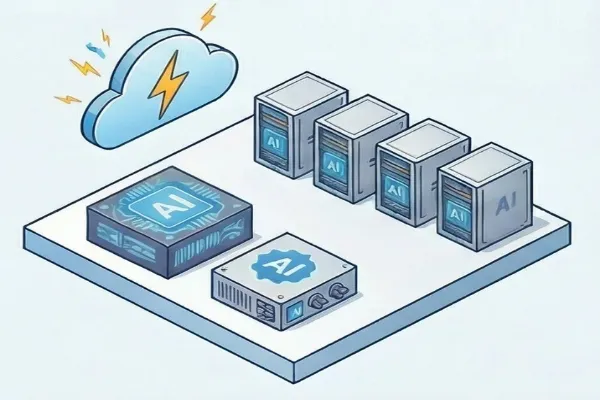
As the demand for high power density and energy efficiency in AI Servers rapidly escalates, the 800V HVDC architecture has emerged as the mainstream design for next-generation data centers and high-end server power systems.
In high-voltage DC architectures, bus capacitors store a large amount of energy. To ensure personnel safety after system shutdown and to protect downstream circuit components, the bleeder resistor plays a critical role, safely discharging residual high voltage within a specified time and preventing risks associated with remaining capacitor voltage.
800V HVDC Design Requirements & Technical Considerations
When designing bleeder resistors for 800V HVDC systems, several key factors must be evaluated:
- Bus capacitance (µF)
- Target discharge time (seconds)
- Maximum instantaneous pulse energy (Joules)
- Resistor voltage withstand capability
- Long-term stability and reliability
Case Study: (800V Bleeder Conditions)
Design Tip:
Capacitance and discharge time are the core parameters for selecting resistance values and determining series/parallel configurations. The design must simultaneously satisfy safety discharge windows and the energy-handling capacity of individual resistors.
Discharge Energy Calculation and Selection Criteria
Capacitor Stored Energy Calculation Formula:
Example: 800V / 60µF:
For a typical system using 800V / 60µF as an example: To ensure optimal energy distribution and reliability, Firstohm recommends a series configuration of 4 units of SRM301 (3W).
- Energy Distribution: Each resistor bears approximately 5J of pulse energy.
- Safety Margin: This configuration effectively disperses voltage and instantaneous thermal stress, significantly improving the system’s safety margin
Recommended Product: SRM301 Surge Resistant MELF Resistor
- Model: SRM301 (3W)
- Dimensions: 4.0 × 10.5 mm
- Resistance: 1.5KΩ ±5% (Typical for 4-pcs series configuration)
Key Advantages of the SRM series:
- High Pulse Endurance: Specifically designed for instantaneous discharge applications.
- Safety Certified: Passed the German VDE safety certification.
- MELF Structure: The cylindrical MELF design provides superior heat dissipation and higher reliability compared to standard flat chips.
- Compact Design: Ideal for modular designs and high-density PCB layouts
Empirical Validation & Test Results
To verify reliability, the SRM301 underwent rigorous high-voltage pulse testing:
- Test Setup: 4 units in series, placed at the capacitor backend
- Charge/Discharge Voltage: 800VDC.
- Capacitance: 60µF.
- Cycle: 5s Charge / 1s Discharge for 100 cycles.
- Result: Resistance change ΔR = 0.035% (PASS)
The results demonstrate that the SRM301 maintains exceptional stability and reliability even under extreme high-voltage pulse discharge conditions.
Typical Application Scenarios
- AI Server Power Modules (800V HVDC Architecture)
- Data Center: Bus Capacitor Discharge Modules
- High-Voltage AC/DC Power Supplies
- Energy Storage Systems (ESS) and Battery Backup Units (BBU)
Firstohm – Surge Resistant MELF Resistors Specifications
Why Choose Firstohm?
In 800V HVDC high-voltage applications, component reliability and safety are far more critical than cost. Firstohm’s SRM series provides a trustworthy solution for AI and data center power systems through superior pulse-handling capabilities and long-term stability.