

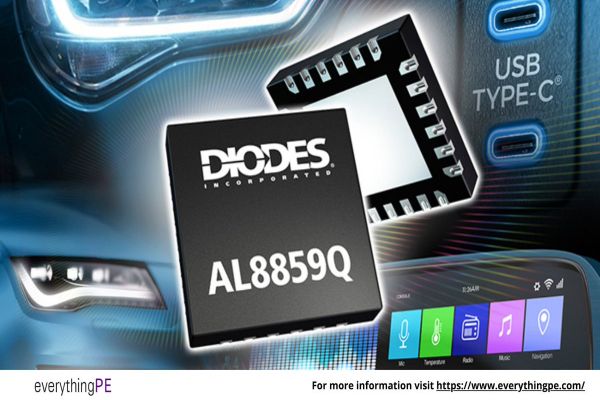
Diodes Incorporated has released the AL8859Q, an automotive-grade multi-phase boost controller designed to manage power in modern vehicle lighting systems. It is primarily used as a constant-voltage pre-regulator in adaptive front lighting setups that combine functions such as high and low beams, daytime running lights, indicators, fog lamps, and cornering lights.
The controller uses a current-mode multi-phase boost design and operates across a wide 4.5 V to 60 V input range, making it suitable for 5 V, 12 V, 24 V, and 48 V automotive systems. It also allows designers to adjust output voltage behavior during load-dump and transient conditions through programmable settings, helping ensure stable operation in demanding automotive environments.
A single device can run in a two-phase configuration, while multiple units can be synchronized for three- or four-phase operation in higher-power applications. This scalability supports power levels from about 100 W to 400 W, while spreading heat more evenly and minimizing ripple current. When paired with automotive-grade components like MOSFETs, SBR rectifiers, and TVS diodes, the system can achieve efficiencies of around 95%.
The AL8859Q features an SPI interface, enabling software-based adjustment of key parameters such as output voltage, switching frequency, current limits, and protection settings. This flexibility allows manufacturers to use one hardware design across different vehicle models and lighting configurations.
Integrated one-time programmable memory enables configuration during manufacturing and allows the controller to operate independently of the main microcontroller if required. Diagnostic functions include thermal warning and shutdown, overvoltage and undervoltage protection, current limiting, SPI error detection, and VDRIVE supply monitoring.
To support automotive electromagnetic compatibility requirements, the controller incorporates spread-spectrum frequency modulation to help meet CISPR 25 Class 5 limits while reducing the need for additional filtering components.
The device provides a typical output-voltage accuracy of ±0.5% at 50 V, ensuring stable supply conditions for downstream LED drivers. The AL8859Q is packaged in a 4 mm × 4 mm wettable-flank V-QFN4040-24 package that supports automated optical inspection during manufacturing.
A non-automotive version, the AL8859, is also available for industrial and consumer applications.










