
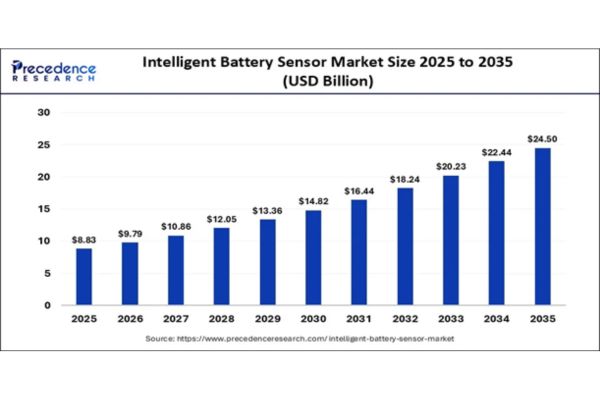
The global intelligent battery sensor market size was valued at USD 8.83 billion in 2025 and is expected to grow from USD 9.79 billion in 2026 to approximately USD 24.50 billion by 2035, registering a CAGR of 10.74% during the forecast period from 2026 to 2035. The market growth is primarily driven by the increasing demand for smart and data-driven energy management solutions across the automotive and energy sectors.
Key Takeaways
- In terms of revenue, the intelligent battery sensor market is valued at $8.83 billion in 2025.
- It is projected to reach $24.50 billion by 2035.
- The market is expected to grow at a CAGR of 10.74% from 2026 to 2035.
- Asia Pacific accounted for the major revenue share of 33% in 2025.
- North America is expected to expand at a CAGR of 10.1% from 2026 to 2035.
- By sensor type, the integrated sensors segment held the largest revenue share of 42% in 2025.
- By sensor type, the voltage sensors segment is expected to grow at a remarkable CAGR between 2026 and 2035.
- By sales channel, the OEM segment dominated the intelligent battery sensor market in 2025.
- By sales channel, the aftermarket segment is expected to grow at the fastest CAGR from 2026 to 2035.
Market Overview
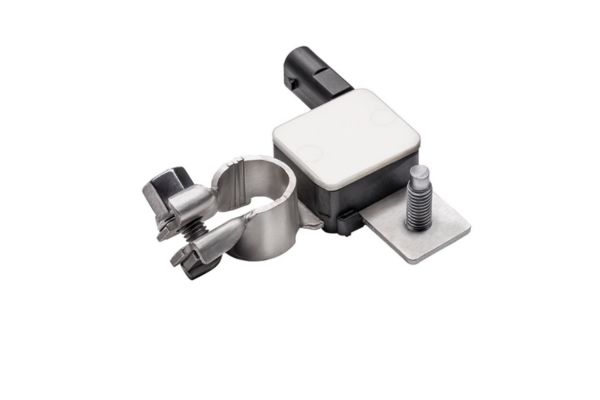
The intelligent battery sensors market is experiencing significant growth due to the rapid adoption of vehicle electrification, energy-efficient technologies, and smart automotive systems. Intelligent battery sensor (IBS) devices play a crucial role in modern vehicles, particularly in electric vehicles (EVs), plug-in hybrid electric vehicles (PHEVs), and start-stop systems, where accurate battery monitoring is essential for safety, efficiency, and long-term performance.
The increasing demand for real-time battery diagnostics, enhanced fuel efficiency, and reduced vehicle emissions is encouraging automotive manufacturers to integrate intelligent battery sensors into both conventional and electrified powertrains. These advanced sensors continuously monitor battery voltage, current, and temperature, helping optimize battery usage, extend battery lifespan, and improve overall vehicle reliability. Furthermore, stringent environmental regulations and growing sustainability initiatives are accelerating the adoption of advanced battery technologies supported by intelligent sensing systems and AI-powered analytics.
How is AI Revolutionizing the Intelligent Battery Sensor Market?
Artificial intelligence (AI) is transforming the intelligent battery sensor market by enabling predictive analytics, real-time diagnostics, and adaptive energy management capabilities. Through AI integration, intelligent battery sensors can accurately predict battery failures, optimize charging cycles, and automatically regulate energy output based on usage behavior and environmental conditions.
AI-powered intelligent battery systems also support vehicle-to-cloud communication, allowing manufacturers and fleet operators to remotely monitor battery health, minimize downtime, and improve operational safety and battery lifespan. The combination of AI technologies with advanced sensor intelligence is driving innovation in electrified mobility, connected vehicles, and smart energy management ecosystems.
Regional Outlook of the Intelligent Battery Sensor Market
What Made Asia-Pacific the Dominant Region in the Intelligent Battery Sensor Market?
Asia-Pacific dominated the intelligent battery sensor market with the largest revenue share of 33% in 2025, driven by the region’s strong focus on electric mobility, advanced manufacturing technologies, and innovative energy solutions. Countries such as China, Japan, South Korea, and India are leading the way in electric vehicle (EV) production and battery technology innovation.
Additionally, these countries are making substantial investments in industrial automation and smart manufacturing systems, which increasingly depend on intelligent sensing technologies for efficient energy monitoring and management. The rapid expansion of EV infrastructure, growing adoption of connected vehicles, and supportive government initiatives are further contributing to the region’s market growth.
What Factors Drive the Growth of the Intelligent Battery Sensor Market Within North America?
North America is expected to expand at a notable CAGR of 10.1% from 2025 to 2034, driven by increasing investments in electric vehicles (EVs), renewable energy infrastructure, and advanced AI-powered automotive technologies. The growing adoption of connected vehicles and the electrification of commercial fleets in United States and Canada is creating strong demand for intelligent battery sensor solutions across the region.
Leading automotive manufacturers and technology companies are increasingly integrating predictive battery monitoring systems and AI-based energy diagnostics into modern vehicles to improve battery efficiency, operational safety, and overall battery lifespan. These advancements are accelerating the adoption of intelligent battery sensor technologies while supporting the region’s transition toward sustainable and smart mobility solutions.
Intelligent Battery Sensor Market Companies
Robert Bosch GmbH is a leading player in the intelligent battery sensor market, offering advanced battery monitoring solutions for automotive applications that enhance vehicle energy efficiency and battery lifespan. The company focuses on integrating smart sensing technologies with vehicle electrification systems, supporting the growing demand for connected and fuel-efficient vehicles.
Continental AG develops intelligent battery sensor solutions that help optimize battery performance, improve vehicle safety, and reduce emissions in modern automobiles. Its strong emphasis on automotive electronics and energy management systems has strengthened its position in the global intelligent battery sensor market.
Midtronics, specializes in battery management and diagnostic technologies, providing intelligent battery sensors that ensure accurate battery health monitoring and predictive maintenance. The company’s innovative solutions are widely adopted in automotive and industrial sectors to improve battery reliability and operational efficiency.
Valence Technology, is recognized for its advanced lithium battery technologies and intelligent energy storage solutions that support efficient battery monitoring and management. The company contributes to the intelligent battery sensor market by delivering technologies that enhance battery safety, durability, and performance across multiple applications.
Texas Instruments Inc. provides semiconductor and sensing technologies that play a vital role in intelligent battery sensor systems for automotive and industrial applications. Its advanced analog and embedded processing solutions enable accurate battery data analysis, improving energy management and system reliability.
DENSO Corporation is a major automotive technology provider offering intelligent battery sensor solutions designed to support vehicle electrification and efficient power management. The company continuously invests in smart automotive electronics to improve battery monitoring capabilities and enhance overall vehicle performance.
Analog Devices, develops high-performance sensing and signal processing technologies used in intelligent battery monitoring systems for electric and hybrid vehicles. Its innovative semiconductor solutions help optimize battery efficiency, safety, and real-time diagnostics, supporting the expansion of advanced battery management systems.
Segmental Insights of the Intelligent Battery Sensor Market
Sensor Type Insights
The integrated sensors segment dominated the market by holding more than 42% of revenue share in 2025. Integrated sensors have become the cornerstone of the IBS (Intelligent Battery System), thanks to their capacity for comprehensive multi-parameter monitoring. These sensors adeptly track crucial metrics such as voltage, current, and temperature, all within a streamlined, cost-effective module. This innovative design not only simplifies the installation process but also minimizes wiring complexity, leading to a more efficient systems architecture. Furthermore, they facilitate real-time battery diagnostics, which are essential for optimizing the performance of modern automotive systems. Their remarkable versatility across various vehicle platforms positions them as the preferred choice among original equipment manufacturers (OEMs) who prioritize both system efficiency and safety in their developments.
Sales Channel Insights
The OEM segment dominated the intelligent battery sensor market with the largest share in 2025. Original Equipment Manufacturers (OEMs) are at the forefront of integrated battery systems (IBS) sales, strategically embedding advanced intelligent sensors within the design of new vehicles. This innovative approach not only enhances the vehicles’ energy efficiency but also significantly boosts system reliability and ensures compliance with stringent emission standards. As a result, IBS has become a pivotal and standardized component in the evolution of next-generation automotive platforms, driving the industry toward a more sustainable and technologically advanced future.
Application Insights
The battery management system segment dominated the intelligent battery sensor market in 2025. The Battery Management System (BMS) serves as the critical backbone for intelligent battery systems (IBS). This sophisticated system incorporates various sensors that meticulously monitor the condition of the battery, ensuring precise tracking of key metrics such as voltage, temperature, and charge state. By facilitating real-time control over charge and discharge cycles, the BMS plays a pivotal role in preventing overcharging, which can lead to diminished battery performance or even failure. Additionally, it actively works to maximize battery lifespan, a crucial factor in both internal combustion engine (ICE) vehicles and electric vehicles. This advanced monitoring and management not only enhances the efficiency of energy use but also contributes significantly to the overall reliability and sustainability of modern automotive technologies.
End Use Insights
The automotive manufacturers segment dominated the market with the largest share in 2025. This is mainly due to the increased production volumes of passenger vehicles and consumer demand for fuel efficiency, enhanced safety features, and advanced smart diagnostics. Innovations such as start-stop systems, connected vehicle technologies, and improved vehicle electrification have transformed intelligent battery monitoring into an essential feature sought after in both luxury and mass-market cars. As automakers prioritize these advancements, the integration of sophisticated battery management becomes crucial for delivering a superior driving experience.