
The global shift toward electric mobility is reshaping every layer of automotive engineering, from chassis design to the smallest passive components tucked inside power electronics. Among these components, low-loss film capacitors have emerged as a critical enabler of electric vehicles performance. It is powering inverters, DC-DC converters, on-board chargers, and battery management systems with the reliability and efficiency that modern EV demand. As EV adoption accelerates worldwide, the role of these unassuming passive components is gaining attention from engineers, procurement managers, and investors alike.
The EV Market: A Surging Opportunity Landscape
Before explaining the ever-increasing demand for low-loss film capacitors, one has to understand the magnitude of the EV revolution. global electric vehicle market is expected to grow to USD 1,422.35 billion by 2034, according to Polaris Market Research, owing to government incentives and stricter emission norms which are further facilitated by the ongoing rapid strides in battery chemistry. It is placing enormous demand on the entire EV supply chain, including its passive electronic components.
The surge in EV adoption is propelling significant growth in the automotive electronics market. The surge in EV adoption drives the growth of the automotive electronics market. The automotive industry is rapidly adopting EVs and hybrid vehicles. This creates a need for electronic components and electronics, particularly for advanced electronics such as low loss film capacitors. Within this electronics market, capacitors, as passive components, occupy the center position of EV power electronics.
What Are Low-Loss Film Capacitors?
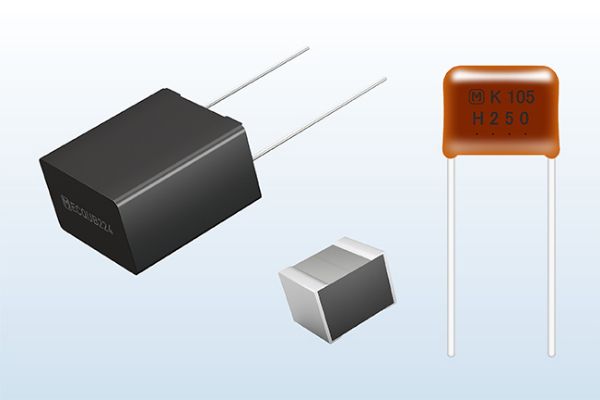
A film capacitor is a type of passive electronic component that uses thin plastic films—typically polypropylene (PP) or polyester as the dielectric material—between conductive electrodes. In the context of the component’s electric behavior, the term low loss refers to the component’s very low equivalent series resistance (ESR) and dissipation factor. It directly translates to minimal energy waste in high-frequency switching applications.
Where Film Capacitors are Used in EVs?
- Traction Inverters: The traction inverter is considered perhaps the most demanding application for film capacitors in an EV. Inverters convert DC battery power into AC for the electric motor. The DC bus capacitor located inside the inverter must experience large ripple currents, fast switching transients, and thermal cycling all at once. Low-loss polypropylene film capacitors are the best-suited to meet this mission. They provide stable capacitance across temperature extremes and efficiently absorb voltage spikes without degradation. With the shift toward 800V battery architectures in platforms like the Porsche Taycan and Hyundai IONIQ 6, the voltage requirements for DC bus capacitors are increasing sharply. It is differentiating polypropylene film capacitors from lower-voltage ceramic or electrolytic alternatives.
- On-Board Chargers (OBC): On-board chargers convert AC grid power to DC for battery charging. Film capacitors serve in both the input EMI filter stage and the output filter stage of the OBC. Their low losses at high frequencies enable efficient power factor correction and smooth DC output. It directly influences charging speed and energy efficiency. As automakers push toward 11 kW and 22 kW on-board chargers for faster AC charging, film capacitor specifications are being pushed accordingly.
- DC-DC Converters: Modern EVs operate multiple voltage domains simultaneously, typically a high-voltage traction battery (400V–800V) alongside a 12V or 48V auxiliary network powering lighting, HVAC, and infotainment systems. DC-DC converters bridge these voltage domains. Film capacitors in these circuits maintain output stability, suppress switching noise, and protect downstream components. Their robustness against humidity and thermal cycling makes them preferred over ceramic capacitors in these safety-critical converters.
- Battery Management Systems (BMS): While the BMS uses a broader array of components, film capacitors contribute to voltage sensing accuracy, cell balancing circuits, and fault-protection networks within the battery pack. The long operational lifetime of film capacitors (often exceeding 100,000 hours) is valued in BMS applications, where component replacement within a sealed battery pack is impractical and costly.
Market Context: Automotive Electronics and Passive Component Connection
The broader passive components market is riding the EV wave alongside active electronics. According to Polaris Market Research, the growing complexity of automotive parts, along with rising automotive sales, is boosting the market demand.
On the passive side, the interplay between EV adoption and component demand is direct and structural. A modern battery electric vehicle contains thousands of passive components across its power electronics and control modules. Every inverter, charger, and converter incorporates multiple film capacitors whose combined reliability determines vehicle uptime and efficiency. EV architectures are becoming more complex. It is incorporating bidirectional charging, vehicle-to-grid (V2G) capability, and multi-domain power management. Thus, the number of high-quality passive components required per vehicle is increasing.
The EV-driven demand is reshaping the competitive landscape for film capacitor manufacturers. Companies that previously focused on industrial or renewable energy markets are pivoting toward automotive-grade qualifications. They are investing in new winding technologies, metallized film processes, and automated testing systems capable of handling automotive volume and quality requirements. Automotive-qualified production lines, capable of delivering components that meet PPAP (Production Part Approval Process) and IATF 16949 standards, have become a key competitive differentiator.
Challenges and Emerging Technology Directions
Despite their advantages, low-loss film capacitors face several engineering and commercial challenges in EV applications. Size is a persistent concern. Polypropylene capacitors are inherently larger than ceramic MLCC (multi-layer ceramic capacitors) at equivalent capacitance values. As EV inverter packages shrink under pressure from automakers seeking lighter, more compact powertrain designs, capacitor manufacturers are working to increase volumetric efficiency through advanced winding geometries, thinner film substrates, and new housing materials.
Thermal management is another active area of development. While polypropylene film capacitors perform reliably up to 105°C–125°C, next-generation 800V+ inverters operating in thermally constrained environments push the upper boundaries of this range. Research into hybrid dielectric structures that combine polypropylene with ceramic-reinforced layers is ongoing, as is work on integrating active cooling into capacitor modules.
There is growing interest in dry-film metalized capacitor designs that eliminate liquid impregnants, thereby reducing the risk of electrolyte leakage in vehicle cabin environments and enabling operation across extreme temperature range.
From a supply chain perspective, geopolitical considerations are shaping sourcing strategies. Key companies such as Toyota and QuantumScape are investing heavily in solid-state battery development, promising increased energy density, safety, and lifespan. The changes, in turn, will alter the voltage and current profiles that film capacitors must handle, requiring continued collaboration between battery and capacitor engineers.
Outlook: Film Capacitors as Foundational EV Infrastructure
The trajectory of the global EV market makes a compelling case for continued investments in low-loss film capacitor technology. Every vehicle requires power electronics. Every power electronics system requires passive components. And in the high-voltage, high-frequency, thermally demanding world of EV power conversion, low-loss polypropylene film capacitors remain the most proven, reliable, and scalable solution available today.
For component manufacturers, EV OEM supply chain teams, and investors tracking the electrification value chain, low-loss film capacitors represent not just a passive component but an active opportunity, one that sits quietly at the heart of the clean mobility transition.