


EV Semiconductor Market Overview
The EV Semiconductor Market is experiencing sustained growth as electric vehicles become increasingly central to the future of transportation. Semiconductors form the foundation of modern EV architectures by enabling efficient power conversion, battery management, electric drivetrain control, vehicle connectivity, advanced safety systems, and intelligent in-vehicle computing.
According to Acumen Research and Consulting, the Global EV Semiconductor Market was valued at USD 25.80 Billion in 2025 and is expected to reach USD 67.71 Billion by 2035, registering a compound annual growth rate (CAGR) of 10.1% during the forecast period from 2026 to 2035.
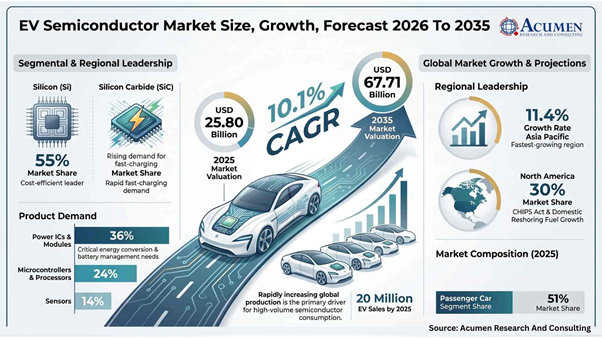
EV Semiconductor Market Highlights
- Market Size (2025): USD 25.80 Billion
- Projected Market Value (2035): USD 67.71 Billion
- CAGR (2026–2035): 10.1%
- Fastest-Growing Region: Asia Pacific
- Leading Vehicle Type: Battery Electric Vehicles (BEVs)
- Largest Product Segment: Power ICs & Modules
Growing investments in vehicle electrification, rising demand for battery electric vehicles (BEVs), rapid advancements in power electronics, and increasing integration of advanced driver assistance systems (ADAS) are among the primary factors accelerating market expansion. As automakers continue transitioning toward software-defined and connected vehicles, semiconductor content per vehicle is expected to increase significantly, reinforcing long-term demand across the global automotive industry.
What Is the EV Semiconductor Market?
The EV Semiconductor Market encompasses integrated circuits and electronic components specifically designed for electric vehicles. These semiconductors perform essential functions across multiple vehicle systems, including:
- Battery management systems (BMS)
- Powertrain control
- Motor drive systems
- On-board chargers
- DC-DC converters
- Inverters
- Infotainment platforms
- Vehicle connectivity
- Advanced driver assistance systems (ADAS)
- Autonomous driving technologies
Unlike conventional internal combustion engine vehicles, electric vehicles rely extensively on electronic control systems, making semiconductor technology a critical enabler of vehicle performance, energy efficiency, charging capability, and safety.
Key Takeaways
- The market is projected to add more than USD 40 billion in new revenue between 2025 and 2035.
- Rising EV production continues to increase semiconductor demand across passenger and commercial vehicle segments.
- Silicon remains the dominant semiconductor material, while silicon carbide (SiC) is gaining traction because of its superior power efficiency.
- Battery electric vehicles represent the largest application segment owing to their higher semiconductor content.
- Asia Pacific maintains its leadership position through strong automotive manufacturing capabilities, semiconductor production, and supportive government initiatives.
- The increasing adoption of AI-enabled vehicles, connected mobility, and autonomous driving technologies will further elevate semiconductor demand throughout the forecast period.
Why the EV Semiconductor Market Is Expanding
The rapid shift toward electrified transportation is transforming the automotive industry. Governments worldwide are encouraging EV adoption through emission regulations, tax incentives, and investments in charging infrastructure. At the same time, consumers are increasingly choosing electric vehicles because of lower operating costs, improved driving range, and growing environmental awareness.
Modern electric vehicles contain significantly more semiconductor components than conventional automobiles. Every major subsystem—including propulsion, battery management, charging, thermal management, connectivity, and safety—depends on sophisticated semiconductor devices capable of delivering high performance and energy efficiency.
As manufacturers introduce more intelligent vehicle platforms featuring AI-powered computing, over-the-air software updates, and enhanced driver assistance capabilities, semiconductor demand continues to rise. This technological evolution is expected to remain one of the strongest long-term growth drivers for the global EV Semiconductor Market.
EV Semiconductor Market Size and Forecast
The EV Semiconductor Market is positioned for robust expansion over the next decade. Continuous innovation in semiconductor materials, coupled with increasing EV production, is creating favorable conditions for sustained market growth.
Automotive manufacturers are integrating more electronic content into vehicles to improve efficiency, reliability, and user experience. This trend is driving demand for advanced microcontrollers, power devices, sensors, memory components, analog integrated circuits, and communication chips.
In addition, investments in semiconductor manufacturing capacity and supply chain resilience are expected to support long-term market development, helping manufacturers address rising demand while reducing supply constraints.
Market Dynamics
Market Driver: Accelerating Global EV Adoption
One of the strongest growth catalysts for the EV Semiconductor Market is the rapid increase in electric vehicle adoption across developed and emerging economies.
Governments continue introducing stricter emissions regulations while providing incentives to accelerate the transition toward cleaner transportation. As a result, automotive manufacturers are expanding their electric vehicle portfolios, increasing production capacity, and investing heavily in next-generation EV platforms.
Every new electric vehicle requires a wide range of semiconductor devices to support efficient battery charging, energy conversion, electric propulsion, intelligent braking systems, and vehicle connectivity. Consequently, semiconductor demand grows alongside EV production volumes.
Market Driver: Rising Demand for Advanced Power Electronics
Power electronics play a fundamental role in electric vehicle performance by enabling efficient energy conversion between the battery, electric motor, and charging system.
Advanced semiconductor technologies improve:
- Energy efficiency
- Thermal management
- Charging speed
- Battery performance
- Driving range
- Overall vehicle reliability
The growing adoption of high-voltage EV architectures is further increasing demand for high-performance semiconductor devices capable of handling greater power densities with lower energy losses.
Market Driver: Expansion of ADAS and Connected Vehicle Technologies
Automotive manufacturers are rapidly integrating intelligent safety and connectivity features into electric vehicles.
These include:
- Adaptive cruise control
- Lane departure warning
- Automatic emergency braking
- Blind spot monitoring
- Parking assistance
- Vehicle-to-everything (V2X) communication
- Digital cockpits
- AI-assisted driving
Each of these systems relies on sophisticated semiconductor solutions, including sensors, processors, communication chips, memory devices, and microcontrollers.
As autonomous driving capabilities continue to evolve, semiconductor content per vehicle is expected to increase substantially.
Market Restraint: Semiconductor Supply Chain Constraints
Despite favorable growth prospects, semiconductor manufacturing remains highly capital intensive and technologically complex.
Supply chain disruptions, geopolitical uncertainties, extended fabrication cycles, and increasing production costs continue to present challenges for automotive manufacturers. Temporary shortages of automotive-grade chips may affect production schedules and vehicle deliveries, particularly during periods of elevated demand.
Manufacturers are responding by investing in domestic semiconductor production, diversifying supplier networks, and strengthening long-term strategic partnerships to improve supply chain resilience.
Market Opportunity: Silicon Carbide (SiC) and Gallium Nitride (GaN)
Wide-bandgap semiconductor materials such as silicon carbide (SiC) and gallium nitride (GaN) are reshaping electric vehicle power electronics.
Compared with traditional silicon devices, these materials offer:
- Higher switching frequencies
- Lower energy losses
- Improved thermal conductivity
- Faster charging capabilities
- Greater power density
- Enhanced vehicle efficiency
As EV manufacturers pursue longer driving ranges and shorter charging times, adoption of SiC- and GaN-based components is expected to accelerate, creating significant opportunities for semiconductor suppliers.
Market Opportunity: Software-Defined Vehicles
The automotive industry is transitioning from hardware-centric vehicles to software-defined platforms.
This evolution requires increasingly powerful semiconductor architectures capable of supporting:
- Centralized vehicle computing
- Artificial intelligence
- Over-the-air software updates
- Cybersecurity
- High-speed networking
- Real-time data processing
The growing complexity of vehicle electronics is expected to increase semiconductor value per vehicle, supporting sustained market expansion over the forecast period.
Emerging Trends Shaping the EV Semiconductor Market
Several transformative trends are influencing the competitive landscape:
- Greater use of silicon carbide power semiconductors
- Increasing adoption of high-voltage (800V+) EV platforms
- AI-powered automotive processors
- Expansion of autonomous driving technologies
- Vehicle-to-Everything (V2X) communication
- Smart battery management systems
- Integrated domain controllers
- Software-defined vehicle architectures
- Advanced thermal management technologies
- Increased investment in semiconductor manufacturing capacity
These trends are expected to redefine vehicle design while driving continuous innovation across the global EV semiconductor ecosystem.
EV Semiconductor Market Segmentation Analysis
A detailed segmentation analysis helps stakeholders identify the most lucrative opportunities across the EV semiconductor value chain. The market can be segmented by material, product, vehicle type, vehicle class, and application. Increasing semiconductor integration across electric vehicle platforms is driving growth across all segments, although adoption rates vary depending on technological maturity and vehicle architecture.
By Material
Silicon
Silicon accounted for the largest share of the EV Semiconductor Market in 2025 due to its well-established manufacturing ecosystem, cost-effectiveness, and extensive use in automotive electronics. It remains the preferred material for many integrated circuits, microcontrollers, analog chips, and standard power devices used in electric vehicles.
Silicon Carbide (SiC)
Silicon carbide is projected to register the fastest growth during the forecast period. Compared with conventional silicon, SiC devices operate at higher voltages and temperatures while reducing switching losses. These characteristics make them particularly suitable for traction inverters, onboard chargers, DC-DC converters, and fast-charging systems. As manufacturers introduce 800V EV platforms and prioritize greater energy efficiency, SiC adoption is expected to accelerate.
Gallium Nitride (GaN)
Gallium nitride is gaining attention for high-frequency switching applications and compact power electronics. Although its current market share is smaller than silicon and SiC, ongoing innovation is expected to expand its role in next-generation electric vehicle architectures.
By Product
Power ICs & Modules
Power ICs and modules represented the largest product segment in 2025, accounting for approximately 36% of market revenue according to the Acumen Research and Consulting report. These devices regulate power flow between the battery, inverter, electric motor, and charging systems, directly influencing vehicle efficiency and performance.
Microcontrollers & Processors
Microcontrollers coordinate numerous vehicle functions, including battery management, motor control, climate systems, infotainment, and safety features. As software-defined vehicles become more common, demand for high-performance automotive processors is expected to rise steadily.
Sensors
Modern electric vehicles rely on a wide range of sensors to monitor battery temperature, motor speed, pressure, current, and vehicle surroundings. The integration of advanced driver assistance systems (ADAS) and autonomous driving capabilities is increasing the number of sensors installed per vehicle.
Memory Devices
Memory components support real-time data storage for infotainment systems, navigation platforms, connected vehicle services, and autonomous driving applications. Higher processing requirements continue to drive demand for automotive-grade memory solutions.
Analog Integrated Circuits
Analog ICs play a crucial role in signal processing, voltage regulation, battery monitoring, and communication between vehicle subsystems. Their importance continues to grow alongside increasing electronic complexity.
By Vehicle Type
Battery Electric Vehicles (BEVs)
Battery Electric Vehicles (BEVs) accounted for approximately 49% of the global market in 2025, making them the leading vehicle segment. BEVs require extensive semiconductor integration to manage propulsion systems, battery charging, regenerative braking, thermal management, and digital connectivity.
Plug-in Hybrid Electric Vehicles (PHEVs)
PHEVs combine electric propulsion with internal combustion engines, requiring sophisticated semiconductor solutions to coordinate dual power systems while maximizing efficiency.
Hybrid Electric Vehicles (HEVs)
Hybrid vehicles continue to generate stable semiconductor demand as manufacturers improve fuel efficiency and reduce emissions through advanced power management technologies.
Fuel Cell Electric Vehicles (FCEVs)
Although representing a smaller portion of the market today, fuel cell electric vehicles are expected to experience notable growth as hydrogen infrastructure expands and investment in zero-emission transportation increases.
By Vehicle Class
Passenger Vehicles
Passenger vehicles generated the highest revenue share in 2025 due to strong global consumer demand for electric cars. Increased availability of affordable EV models, supportive government incentives, and expanding charging infrastructure continue to support growth in this segment.
Commercial Vehicles
Electrification of buses, delivery vans, trucks, and fleet vehicles is creating new opportunities for semiconductor manufacturers. Commercial EVs typically require higher-capacity power electronics and more sophisticated battery management systems, increasing semiconductor content per vehicle.
Regional Analysis
Asia Pacific
Asia Pacific held the largest share of the EV Semiconductor Market in 2025, accounting for approximately 35% of global revenue. The region benefits from a well-developed automotive manufacturing ecosystem, large-scale semiconductor production, and significant investments in battery manufacturing.
China remains the world’s largest producer and consumer of electric vehicles, while Japan and South Korea continue to lead in semiconductor innovation. India is also emerging as a significant market, supported by government initiatives that encourage EV adoption and domestic electronics manufacturing.
Strong demand for passenger electric vehicles, investments in charging infrastructure, and expanding production capacity are expected to sustain the region’s leadership throughout the forecast period.
North America
North America continues to witness substantial growth due to increasing investments in domestic semiconductor manufacturing and electric vehicle production. Government programs aimed at strengthening semiconductor supply chains and promoting clean transportation are encouraging both automotive manufacturers and semiconductor companies to expand operations across the region.
Growing consumer interest in connected vehicles, advanced safety technologies, and autonomous driving features is also contributing to rising semiconductor demand.
Europe
Europe remains a key market owing to ambitious emissions reduction targets and widespread adoption of electric mobility. Major automotive manufacturers continue investing in electrification strategies while expanding local semiconductor partnerships to improve supply chain resilience.
Stringent environmental regulations and government incentives are expected to sustain long-term demand for automotive semiconductors across the region.
Latin America
The Latin American market is gradually expanding as governments promote sustainable transportation and automotive manufacturers increase regional production capabilities. Continued investment in charging infrastructure is expected to support future market growth.
Middle East & Africa
The Middle East and Africa represent an emerging opportunity for semiconductor suppliers as electric vehicle adoption accelerates across selected countries. Government sustainability initiatives and diversification of transportation infrastructure are expected to create additional demand over the coming years.
Competitive Landscape
The EV Semiconductor Market is characterized by rapid technological innovation, strategic collaborations, and substantial investment in research and development. Companies are focusing on improving semiconductor efficiency, reducing power losses, and developing advanced solutions for autonomous and connected vehicles.
Key competitive strategies include:
- Development of next-generation silicon carbide (SiC) products
- Expansion of automotive-grade semiconductor portfolios
- Long-term supply agreements with automotive OEMs
- Capacity expansion to address growing global demand
- Strategic mergers, acquisitions, and technology partnerships
- Investment in AI-enabled automotive processors
- Enhanced cybersecurity solutions for software-defined vehicles
Leading companies continue to differentiate themselves through product innovation, manufacturing capabilities, and close collaboration with vehicle manufacturers.
Major Market Participants
The report identifies several leading companies active in the Global EV Semiconductor Market, including:
- Infineon Technologies AG
- NXP Semiconductors
- STMicroelectronics
- Texas Instruments Incorporated
- Renesas Electronics Corporation
- onsemi
- Qualcomm Incorporated
- NVIDIA Corporation
- ROHM Co., Ltd.
- Mitsubishi Electric Corporation
These organizations are investing in advanced power semiconductors, automotive processors, and intelligent vehicle platforms to meet the evolving needs of the electric mobility industry.
Recent Industry Trends
The competitive landscape continues to evolve as manufacturers respond to increasing demand for more efficient and intelligent electric vehicles. Notable trends include:
- Expansion of silicon carbide production capacity
- Growing use of 800V vehicle architectures
- Increased semiconductor integration in battery management systems
- Greater adoption of centralized vehicle computing
- Higher investment in automotive AI processors
- Integration of over-the-air software update capabilities
- Development of advanced automotive cybersecurity solutions
- Strengthening of semiconductor supply chains through regional manufacturing investments
These developments reflect the industry’s focus on enhancing vehicle performance, reducing energy consumption, and supporting the transition toward connected and autonomous mobility.
Strategic Opportunities
The long-term outlook for the EV Semiconductor Market remains highly favorable. Several strategic opportunities are expected to shape future growth:
- Rising semiconductor content per electric vehicle
- Expansion of autonomous driving technologies
- Continued electrification of commercial vehicle fleets
- Growth in fast-charging infrastructure
- Adoption of software-defined vehicle platforms
- Increasing use of AI-enabled vehicle control systems
- Advancements in wide-bandgap semiconductor materials
- Investments in resilient semiconductor manufacturing ecosystems
Companies that prioritize innovation, production scalability, and strategic partnerships will be well positioned to capitalize on these opportunities over the forecast period.
Future Outlook of the EV Semiconductor Market
The outlook for the global EV Semiconductor Market remains highly positive as vehicle electrification, digital transformation, and intelligent mobility continue to reshape the automotive industry. Semiconductor technologies are expected to play an increasingly important role in improving vehicle efficiency, enabling advanced safety systems, supporting autonomous driving, and delivering enhanced user experiences.
Growing demand for battery electric vehicles, combined with the rapid evolution of software-defined vehicles, will increase semiconductor content across every major vehicle subsystem. As manufacturers adopt high-voltage architectures, artificial intelligence, advanced connectivity, and over-the-air software capabilities, the need for high-performance automotive semiconductors will continue to expand.
Investment in semiconductor manufacturing capacity, supply chain resilience, and research into next-generation materials such as silicon carbide (SiC) and gallium nitride (GaN) is expected to further strengthen market growth throughout the forecast period. Organizations that prioritize technological innovation, strategic partnerships, and scalable manufacturing capabilities are likely to remain at the forefront of this evolving industry.
Why the EV Semiconductor Market Matters
Semiconductors are fundamental to the operation of modern electric vehicles. They enable efficient power conversion, intelligent battery management, precise motor control, vehicle connectivity, and advanced safety technologies. As electric vehicles become increasingly sophisticated, semiconductor content per vehicle continues to rise, making the EV Semiconductor Market a critical component of the broader automotive value chain.
This growing reliance on semiconductor technologies highlights the market’s long-term strategic importance for automotive manufacturers, technology providers, and investors seeking opportunities in the transition toward sustainable mobility.
Frequently Asked Questions
What is the EV Semiconductor Market?
The EV Semiconductor Market comprises semiconductor devices and integrated circuits designed specifically for electric vehicles. These components support key functions such as battery management, power conversion, motor control, charging systems, infotainment, connectivity, and advanced driver assistance systems.
What is the current size of the EV Semiconductor Market?
According to Acumen Research and Consulting, the global EV Semiconductor Market was valued at USD 25.80 Billion in 2025 and is projected to reach USD 67.71 Billion by 2035, growing at a CAGR of 10.1% during the forecast period.
What factors are driving the growth of the EV Semiconductor Market?
Key growth drivers include:
- Increasing adoption of electric vehicles
- Rising investment in vehicle electrification
- Expansion of charging infrastructure
- Growing deployment of advanced driver assistance systems (ADAS)
- Demand for intelligent and connected vehicles
- Adoption of silicon carbide (SiC) power semiconductors
- Government initiatives supporting sustainable transportation
Which semiconductor material is expected to witness the highest growth?
Silicon carbide (SiC) is expected to experience the fastest growth due to its superior thermal performance, higher efficiency, lower switching losses, and suitability for high-voltage electric vehicle architectures.
Which vehicle segment dominates the EV Semiconductor Market?
Battery Electric Vehicles (BEVs) accounted for the largest market share in 2025 because they require extensive semiconductor integration for battery management, propulsion systems, charging, safety, and connectivity.
Which region leads the EV Semiconductor Market?
Asia Pacific held the largest share of the global market in 2025, supported by large-scale electric vehicle production, semiconductor manufacturing capabilities, battery manufacturing, and government initiatives promoting EV adoption.
What are the major applications of EV semiconductors?
EV semiconductors are widely used in:
- Battery Management Systems (BMS)
- Traction Inverters
- On-board Chargers
- DC-DC Converters
- Electric Power Steering
- Infotainment Systems
- Vehicle Connectivity
- Advanced Driver Assistance Systems (ADAS)
- Autonomous Driving Platforms
- Thermal Management Systems
Who are the leading companies in the EV Semiconductor Market?
Major companies include:
- Infineon Technologies AG
- NXP Semiconductors
- STMicroelectronics
- Texas Instruments Incorporated
- Renesas Electronics Corporation
- onsemi
- NVIDIA Corporation
- Qualcomm Incorporated
- ROHM Co., Ltd.
- Mitsubishi Electric Corporation
What opportunities are emerging in the EV Semiconductor Market?
The market offers significant opportunities through:
- Expansion of software-defined vehicles
- AI-enabled automotive computing
- Silicon carbide and gallium nitride technologies
- High-voltage EV platforms
- Connected vehicle ecosystems
- Vehicle-to-Everything (V2X) communication
- Electrification of commercial vehicle fleets
What challenges could affect market growth?
Potential challenges include semiconductor supply chain disruptions, high manufacturing costs, geopolitical uncertainties, and the complexity of scaling advanced semiconductor production to meet increasing automotive demand.
The global EV Semiconductor Market is poised for sustained expansion over the coming decade as electric mobility becomes increasingly mainstream. The combination of vehicle electrification, intelligent transportation systems, connected mobility, and advances in power electronics is creating substantial demand for innovative semiconductor technologies.
According to Acumen Research and Consulting, strong market fundamentals—including rising electric vehicle production, increasing semiconductor content per vehicle, and continued investment in advanced materials such as silicon carbide—are expected to support long-term growth. Stakeholders across the automotive and semiconductor industries are well positioned to benefit from these trends by focusing on innovation, strategic collaboration, and scalable manufacturing capabilities.