
The convergence of miniaturized electronics, advanced sensors, and artificial intelligence (AI) rewrites the rules of healthcare delivery. Wearable and medical-grade embedded boards are at the core of this transformation. They rarely make headlines but power virtually every breakthrough in connected health. These purpose-built computing platforms are the silent engines behind ECG patches, continuous glucose monitors, remote patient monitoring systems, and a growing ecosystem of clinical-grade devices. Their evolution is one of the most consequential stories in the semiconductor and healthcare industries.
Understanding Medical-Grade Embedded Boards
Not all embedded boards are created equal. A standard single-board computer may suffice for a hobbyist’s robotics project. A medical-grade embedded board must meet an entirely different set of requirements. These include regulatory compliance with standards such as IEC 60601-1, biocompatibility for skin-contact applications, and ultra-low power consumption. They enable multi-day battery operation, high electromagnetic compatibility, and clinical-level data accuracy. The performance gap between standard consumer electronics and medical-grade hardware is closing. However, the regulatory and engineering bar remains formidable.
There are rising advancements from basic wearable sensors, as motion detectors, to the integration of pressure, gyroscope, temperature, humidity, and advanced heart rate sensors. The innovations enable a more comprehensive understanding of the wearer’s health. Beyond conventional motion sensing, the use of advanced MEMS sensor technology, optical heart rate monitoring via photoplethysmography (PPG), ECG modules, SpO₂, and bioimpedance sensors has significantly increased data accuracy and the scope of medical-grade monitoring.
This sensor sophistication demands embedded boards capable of fusing multiple data streams in real time, filtering noise at the hardware level, and transmitting clean clinical signals to cloud or edge infrastructure, all while drawing minimal current from a miniaturized battery.
Market Landscape: A Multi-Billion Dollar Opportunity
The commercial opportunity surrounding wearable and medical-grade embedded hardware is staggering and growing rapidly. According to Polaris Market Research, the global wearable medical devices market was valued at USD 41.30 billion in 2025 and is expected to record a CAGR of 15.0% from 2026 to 2034. The market growth is driven by rising health awareness and technological advancements in health monitoring.
The broader smart health devices ecosystem mirrors this trajectory. According to the Polaris Market Research report on the Smart Health Devices market will reach USD 109.62 billion by 2034, reflecting an impressive CAGR of 23.1%. The market encompasses wearables, remote patient monitoring systems, diagnostic tools, and therapeutic devices. Embedded boards are not isolated products. They are the enabling layer that ties this entire ecosystem together. Every smartwatch, every biosensor patch, and every ambulatory cardiac monitor relies on a core embedded computing platform. The platform is used to execute signal acquisition, run firmware algorithms, manage wireless communications, and ensure data integrity.
The IoT and Connectivity Layer
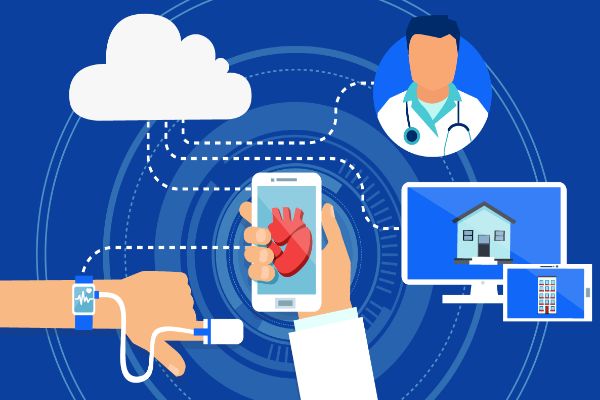
Medical-grade embedded boards do not operate in isolation. They are nodes in a broader Internet of Medical Things (IoMT) infrastructure that connects patients, devices, and clinicians in real time. Cellular connectivity has emerged as the dominant technology. It enables real-time data collection and distribution to medical specialists over long distances.
The embedded board is the critical hardware interface in this chain. It must support Bluetooth Low Energy, Wi-Fi, cellular (including emerging NB-IoT and LTE-M protocols), or a combination. The board must maintain certification for medical-band radio frequencies and HIPAA-compliant data transmission. Power management integrated circuits (PMICs) embedded on these boards must scale radio activity. It helps preserve battery life and ensures continuous physiological monitoring.
Edge Computing: Processing at the Point of Care
One of the most significant trends reshaping medical embedded board design is the shift toward edge computing. Edge computing can process and analyze data locally rather than sending raw signals to the cloud. The proliferation of IoT devices in healthcare, including wearables and medical sensors, is rising. This transformation mandates edge computing to efficiently process the immense data generated by these devices.
For embedded board designers, this shift means integrating neural processing units (NPUs) or dedicated AI accelerators directly onto compact form-factor hardware. For example, a wearable ECG board can run arrhythmia-detection algorithms locally. It can also generate alerts before symptoms appear. The board only transmits clinically relevant events to a physician’s dashboard. It dramatically reduces latency, bandwidth requirements, and privacy exposure.
Clinical vs. Consumer Grade: A Converging Divide
The market is bifurcated between consumer-grade and clinical-grade wearable hardware. Medical device manufacturers emphasize improving sensor accuracy. Thus, the performance gap between non-medical-grade and medical wearables is narrowing. This is fueling the growth of numerous wearable device categories. The capabilities of embedded sensors are generally the determining factors in the usefulness and reliability of a wearable product.
Medical wearables can sense irregularities before patients experience symptoms. It facilitates early diagnosis of arrhythmia, sleep apnea, or complications due to diabetes. Clinical validation is expanding to cover consumer-adjacent platforms. Thus, the embedded boards in devices such as smartwatches and biosensor rings must increasingly meet the precision standards traditionally reserved for hospital-grade instruments.
Role of System-on-Chip Architecture
Modern medical-grade embedded boards are increasingly built around System-on-Chip (SoC) architectures. This architecture integrates processor cores, analog front-ends, wireless transceivers, and security modules into a single die. According to Polaris Market Research, future SoCs are being developed to integrate dedicated AI cores to handle machine-learning tasks more efficiently. This is enabling more advancements in smart devices. For wearable health applications, this integration is not merely a convenience. It is a necessity driven by the tight space constraints of body-worn form factors.
Conclusion
Wearable and medical-grade embedded boards occupy a uniquely consequential position at the intersection of semiconductor engineering, regulatory science, and clinical medicine. There is a growing demand for continuous, accurate, and connected health monitoring. The demand is fueled by an aging global population, rising chronic disease burden, and the normalization of remote patient care. Thus, the embedded hardware that makes all of this possible will be among the most strategically important products in the technology industry. The companies that design these boards with medical-grade precision, power efficiency, and regulatory foresight will form the foundation of healthcare’s next chapter.