
The Next Humanoid Robot Breakthrough May Come From Battery Technology
Humanoid robots are becoming more intelligent, more agile and increasingly capable of performing tasks that once required human intervention.
Artificial intelligence is helping robots understand instructions, recognize objects, navigate unfamiliar environments and perform complex physical movements.
Yet one of the biggest challenges facing commercial humanoid robotics has relatively little to do with AI.
It is the battery
A humanoid robot may possess sophisticated vision systems, advanced actuators and powerful AI processors. But its commercial usefulness ultimately depends on how long those systems can operate before the robot must stop for charging or battery replacement.
Unlike stationary industrial robots, humanoids must carry their energy supply while powering motors, sensors, computing systems, communication hardware and continuous balance control.
This creates a fundamental engineering challenge: delivering enough energy for productive operation without making the robot excessively heavy.
The challenge is also creating a significant commercial opportunity.
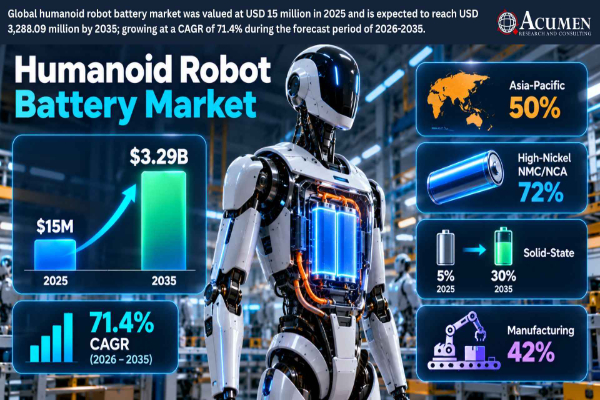
According to Acumen Research and Consulting, the global Humanoid Robot Battery Market was valued at USD 15 million in 2025 and is projected to reach USD 3,288.09 million by 2035, expanding at a 71.4% CAGR during 2026–2035.
The Humanoid Robot Battery Market’s projected expansion reflects the transition of humanoid robotics from research and demonstration toward industrial manufacturing, logistics and other commercial applications.
However, the opportunity extends beyond supplying conventional lithium-ion cells.
It includes high-energy-density chemistries, lightweight battery packaging, intelligent battery management systems, advanced thermal management and modular charging architectures.
As physical AI progresses, battery technology could become one of the most important determinants of humanoid robot productivity.
Humanoid Robot Battery Market Could Exceed USD 3.28 Billion by 2035
The projected growth of the Humanoid Robot Battery Market is exceptional even compared with other emerging robotics technologies.
Acumen Research and Consulting estimates that the humanoid robot battery market will expand from USD 15 million in 2025 to approximately USD 3.29 billion by 2035.
This forecast reflects expectations of rapid commercialization from a very small initial market base.
Three developments are particularly important.
First, humanoid robots are progressing toward real-world applications in factories and warehouses.
Second, physical AI is increasing the complexity of robotic tasks, creating greater demand for onboard computing and mechanical movement.
Third, battery manufacturers are developing chemistries and packaging architectures better suited to mobile robotic platforms.
Unlike conventional industrial automation equipment, humanoid robots require batteries capable of handling frequent acceleration, deceleration, lifting and balancing.
These dynamic requirements create demand for batteries that combine high energy density with strong power delivery.
The result is an emerging energy-storage market with requirements that differ substantially from conventional consumer electronics and electric vehicles.
Why Batteries Are Becoming the Biggest Constraint on Humanoid Robot Commercialization
The most important performance indicator for a commercial humanoid robot may not be how many tasks it can perform.
It may be how many productive hours it can deliver.
Consider a humanoid robot deployed in a warehouse.
The robot may be capable of picking objects, transporting materials and performing repetitive handling operations.
But if it must frequently stop to recharge, its productive utilization declines.
That affects the economics of deployment.
Battery endurance therefore influences:
- Productive operating hours
- Charging interruptions
- Robot fleet availability
- Maintenance requirements
- Energy consumption
- Total cost of ownership
A January 2026 TrendForce assessment indicated that many humanoid robots offered approximately two to four hours of runtime, making energy storage a significant limitation for extended industrial operation.
This highlights the difference between demonstrating robotic capability and deploying robots commercially.
A successful demonstration proves that a robot can complete a task.
A commercially viable system must complete that task reliably, repeatedly and economically over extended periods.
Battery technology connects robotic capability with operational productivity.
The Battery Weight–Runtime Trade-Off
Humanoid robot battery engineering involves a difficult relationship between energy capacity and physical weight.
Adding battery capacity can extend operating time.
But additional battery weight increases the energy required for walking, balancing and moving the robot.
A larger battery therefore does not necessarily produce a proportional increase in runtime.
The challenge becomes more complicated when robots carry external loads.
A robot transporting materials requires additional actuator power.
Dynamic movements can also produce substantial fluctuations in electrical demand.
Battery systems must accommodate these conditions while maintaining stable voltage and safe operating temperatures.
This makes gravimetric energy density, measured in watt-hours per kilogram, an important performance consideration.
Volumetric energy density is equally relevant because the internal space available for battery installation is limited.
A humanoid robot must accommodate motors, actuators, structural components, sensors, processors, wiring and cooling systems.
Battery manufacturers must therefore optimize energy storage within strict weight and packaging constraints.
High-Nickel NMC/NCA Batteries Lead With 72% Market Share
High-nickel nickel-manganese-cobalt and nickel-cobalt-aluminum battery chemistries accounted for approximately 72% of Humanoid Robot Battery Market revenue in 2025.
Their leading position reflects the importance of energy density in humanoid robotics.
High-nickel chemistries can store substantial energy relative to their weight, making them attractive for mobile platforms where every additional kilogram affects mechanical performance.
They also benefit from manufacturing capabilities developed for electric vehicles and other advanced lithium-ion applications.
However, high energy density alone is not sufficient.
Humanoid batteries must also deliver reliable power under rapidly changing loads, withstand repeated cycling and maintain safe thermal conditions.
Lithium iron phosphate batteries remain relevant for applications prioritizing cost, durability and thermal stability over maximum energy density.
The optimal chemistry will therefore depend on robot size, operating requirements, duty cycle and commercial objectives.
Solid-State Batteries Could Reshape Humanoid Robotics
One of the most significant developments in the Humanoid Robot Battery Market is the potential transition toward solid-state and semi-solid-state batteries.
According to Acumen Research and Consulting, these technologies represented approximately 5% of the Humanoid Robot Battery Market in 2025, but their share is projected to increase to 30% by 2035.
The attraction is straightforward.
Humanoid robots need more energy without substantially increasing battery weight or volume.
Solid-state battery technologies offer the potential for improved energy density, enhanced safety and alternative packaging architectures.
These characteristics could help address some of the limitations associated with conventional liquid-electrolyte lithium-ion systems.
In January 2026, TrendForce identified humanoid robotics as an emerging opportunity for solid-state batteries, highlighting the industry’s need to move beyond limited operating endurance.
Research published in Advanced Science in July 2026 similarly examined next-generation batteries for humanoid robotics, emphasizing the substantial improvements in energy-storage performance required for sustained commercial deployment.
Nevertheless, solid-state batteries face commercialization challenges involving manufacturing scale, cost, cycle life, interfaces and consistent performance.
Their projected market-share growth should therefore be understood as a technology-adoption forecast rather than evidence that conventional lithium-ion batteries will disappear.
Humanoid Robots Could Become an Important New Market for Battery Manufacturers
The relationship between battery manufacturing and humanoid robotics is particularly interesting.
Electric vehicles require large battery packs, frequently measured in tens of kilowatt-hours.
Humanoid robots typically use much smaller packs.
However, widespread robot deployment could create substantial aggregate battery demand.
More importantly, commercial robots may require multiple batteries over their operating lives.
A robot operating across extended industrial shifts could depend on battery swapping, rapid charging or scheduled pack replacement.
This creates opportunities beyond the original battery installed in the robot.
Battery manufacturers may eventually generate demand from:
- Original equipment manufacturing
- Replacement battery packs
- Modular battery systems
- Charging and battery-swapping infrastructure
- Battery management electronics
- Thermal management components
The long-term opportunity therefore depends not only on humanoid robot shipments but also on operating intensity and battery replacement requirements.
Cylindrical Cells Dominate Today, but Pouch Cells Are Gaining Ground
Battery cell form factor is another important area of innovation.
Cylindrical cells accounted for 42% of the Humanoid Robot Battery Market in 2025.
Their dominance reflects mature manufacturing infrastructure, established quality-control processes and well-developed supply chains.
Cylindrical cells are widely used across electric vehicles and consumer electronics, providing robot manufacturers with access to established technologies.
However, pouch cells are becoming increasingly attractive.
Acumen projects that pouch-cell market share will increase from 38% in 2025 to 44% by 2035.
Pouch cells can offer lightweight packaging and greater flexibility when designing battery modules for irregular spaces.
This matters because humanoid robots do not have the same battery-pack geometry as electric vehicles.
Their batteries must fit around mechanical and electronic systems within a compact body.
The growing importance of pouch cells therefore reflects a broader trend toward battery systems engineered specifically for robotic applications.
Battery Capacity Is Moving Toward Longer Operating Endurance
The 1–2.5 kWh battery-capacity segment accounted for 58% of the Humanoid Robot Battery Market in 2025, making it the largest capacity category.
This range offers a practical balance between available energy, battery weight and physical dimensions for many emerging humanoid platforms.
However, the market is gradually shifting toward larger battery capacities.
The 2.5–5 kWh segment represented 24% in 2025 and is projected to reach 38% by 2035.
Meanwhile, the above-5-kWh category is forecast to record particularly strong growth.
This transition reflects increasing demand for longer operating periods and more demanding industrial applications.
But capacity should not be confused with runtime.
A robot with a larger battery may still operate for fewer hours if its motors, computing hardware and workload consume significantly more power.
The relationship depends on usable battery energy, average power consumption and operating conditions.
For robot manufacturers, optimizing overall system efficiency may therefore be just as important as increasing battery capacity.
Battery Management Systems Could Become a Strategic Differentiator
Battery cells represented approximately 68% of the Humanoid Robot Battery Market by component in 2025.
Battery management systems accounted for another 12%.
Although cells dominate market value, battery management technology plays an essential role in system performance.
A humanoid robot experiences highly variable electrical loads.
Walking, lifting, balancing and accelerating can cause rapid changes in power demand.
An advanced battery management system monitors voltage, current, temperature, state of charge and battery health.
It can help manage charging, protect the battery from unsafe operating conditions and estimate remaining usable energy.
Future humanoid BMS platforms may increasingly incorporate predictive analytics to estimate battery degradation and support maintenance planning.
This could become particularly valuable for commercial robot fleets.
Instead of treating batteries as isolated components, fleet operators may manage battery health and charging schedules across multiple robots.
The result could be a growing market for intelligent battery-management software alongside physical battery hardware.
Thermal Management Is Critical for High-Performance Humanoid Batteries
Thermal performance is another important engineering challenge.
Humanoid robots combine high-power mechanical movement with compact electronics.
Battery packs must deliver electricity to actuators and processors while operating inside tightly constrained spaces.
Heat generated during high-current discharge and charging can affect efficiency, battery life and safety.
Thermal-management systems must therefore maintain appropriate operating conditions without adding excessive weight or volume.
The challenge becomes more significant as robot manufacturers pursue higher power density and faster charging.
Advanced thermal materials, improved cell arrangements and compact cooling architectures could become important areas of supplier differentiation.
Battery safety is particularly relevant for humanoid robots intended to work near people.
As commercial deployments expand, manufacturers will need to demonstrate consistent reliability under realistic operating conditions.
Battery Swapping and Fast Charging Could Improve Robot Fleet Utilization
Increasing battery energy density is not the only way to improve humanoid robot availability.
Charging strategy also matters.
A robot operating for several hours before requiring a lengthy charging interruption may be less productive than one equipped with an efficient battery-swapping system.
Modular battery architectures can potentially reduce downtime by allowing depleted packs to be replaced with charged units.
Automated docking and charging systems offer another approach.
These technologies do not increase the energy stored in an individual battery.
Instead, they improve the proportion of time a robot can remain available for productive tasks.
This distinction is commercially important.
For a warehouse or manufacturing facility, the key performance indicator may be productive operating hours per robot per day, rather than maximum runtime from a single charge.
Battery manufacturers capable of supporting modular charging and fleet-level energy management could therefore gain an advantage as humanoid deployments scale.
Physical AI Is Increasing Demand for High-Performance Batteries
Physical AI is becoming a major driver of humanoid robotics.
Unlike AI systems operating exclusively in digital environments, physical AI connects intelligence with machines capable of sensing and interacting with the real world.
Humanoid robots combine computer vision, motion planning, perception, language models, control algorithms and physical manipulation.
These capabilities require substantial computing and electrical power.
As robots become more intelligent, they may also perform more complex movements and operate in less structured environments.
That can increase the demands placed on onboard energy systems.
The relationship creates an important technology dependency:
Advanced Physical AI → More Capable Humanoid Robots → Greater Power Requirements → Advanced Battery Systems
Battery technology therefore becomes part of the broader physical AI infrastructure.
The growth of humanoid intelligence and the growth of humanoid energy storage are closely connected.
Manufacturing Accounts for 42% of Humanoid Robot Battery Demand
Industrial and manufacturing applications accounted for 42% of the Humanoid Robot Battery Market in 2025.
Manufacturing is an attractive early deployment environment because many tasks are repetitive and occur within relatively structured facilities.
Potential applications include material handling, machine tending, assembly support, inspection and internal logistics.
Humanoid robots may be particularly useful where existing infrastructure has been designed around human movement and interaction.
However, commercial success will depend on more than robotic capability.
Manufacturers will evaluate reliability, task completion, safety, operating costs and productive utilization.
Battery endurance directly influences several of these metrics.
A robot that can complete tasks consistently with manageable charging interruptions may be more commercially attractive than one requiring frequent intervention.
This is why manufacturing is likely to remain a major proving ground for advanced humanoid battery systems.
Logistics and Warehousing Represent 28% of the Humanoid Robot Battery Market
Logistics and warehousing accounted for approximately 28% of market revenue in 2025, making the sector the second-largest application category.
Warehouse environments offer potential opportunities in picking, sorting, loading, unloading and material transportation.
These tasks can require frequent walking, lifting and gripping.
Power demand may fluctuate considerably depending on the robot’s workload.
Battery systems must therefore combine energy capacity with the ability to deliver short periods of relatively high power.
Charging and fleet coordination are also important.
Large facilities may eventually operate multiple humanoid robots simultaneously.
Coordinating battery charging, maintenance and replacement could become an important operational requirement.
This creates opportunities for battery suppliers to offer integrated energy-management solutions rather than cells alone.
Asia-Pacific Leads With 50% Market Share
Asia-Pacific accounted for 50% of the global Humanoid Robot Battery Market in 2025, making it the largest regional market.
Its leadership reflects the concentration of battery manufacturing, electronics production, robotics development and industrial automation across the region.
China plays a particularly important role.
The country has extensive lithium-ion battery manufacturing capacity, established battery supply chains and a rapidly expanding robotics ecosystem.
Japan and South Korea also contribute through advanced materials, battery technology, electronics and industrial robotics.
This concentration creates an advantage for manufacturers seeking to integrate battery technology into emerging humanoid platforms.
As robotics commercialization expands, proximity between battery suppliers and robot manufacturers could become increasingly valuable.
North America Holds 37% of the Humanoid Robot Battery Market
North America accounted for approximately 37% of global market revenue in 2025, making it the second-largest region.
The region benefits from investment in artificial intelligence, advanced robotics, autonomous systems and industrial automation.
Companies developing humanoid platforms are creating demand for advanced energy-storage solutions capable of supporting complex robotic workloads.
However, battery supply-chain localization remains strategically important.
Humanoid robot manufacturers may increasingly seek dependable sources of battery cells, modules, management systems and associated components.
The market could therefore create opportunities for collaboration between robotics developers, battery manufacturers and advanced-materials companies.
Battery Suppliers Could Become Key Partners in Humanoid Robot Development
The humanoid battery industry is likely to evolve differently from a conventional commodity battery market.
Robot manufacturers require batteries tailored to specific mechanical and electrical architectures.
A battery designed for one humanoid platform may not be directly suitable for another.
Differences in body geometry, actuator requirements, voltage architecture, power consumption and cooling design can influence battery specifications.
This creates opportunities for closer collaboration between robot developers and battery suppliers.
Battery manufacturers may increasingly participate earlier in product development.
Rather than supplying standardized cells after a robot has been designed, they may help optimize battery placement, module design, thermal performance and power delivery.
This could create stronger commercial relationships and opportunities for differentiated battery technology.
What Will Determine the Commercial Success of Humanoid Batteries?
Several challenges could influence market development through 2035.
Energy density: Batteries must provide more usable energy without creating excessive weight.
Power delivery: Robotic actuators require reliable performance under rapidly changing electrical loads.
Battery life: Commercial robots may experience frequent charging and discharging cycles.
Safety: Batteries must operate reliably in environments shared with people.
Charging: Fast charging and battery swapping can improve fleet availability.
Cost: Advanced battery systems must remain economically viable as humanoid production scales.
Manufacturing scale: Emerging chemistries must demonstrate repeatable quality and dependable supply.
These challenges also create opportunities for innovation.
Suppliers capable of improving several performance metrics simultaneously may be well positioned as the industry develops.
The Investment Opportunity Extends Beyond Battery Cells
The Humanoid Robot Battery Market offers opportunities across a broader value chain.
Battery-cell manufacturers could benefit from increasing demand for high-energy-density chemistries.
Advanced-materials companies could supply next-generation electrodes, electrolytes and thermal materials.
Battery-pack manufacturers could develop lightweight modules designed around humanoid body structures.
Electronics suppliers could provide battery management systems and power-control components.
Charging technology providers could support automated docking and battery-swapping systems.
Software companies could develop predictive battery-health monitoring and fleet-level energy management.
The opportunity is therefore not limited to one battery chemistry or component category.
It encompasses the complete energy-storage ecosystem required to support increasingly capable humanoid robots.
What Comes Next for the Humanoid Robot Battery Market?
The next decade could bring several important transitions.
First: Conventional lithium-ion toward advanced battery chemistries.
High-nickel NMC/NCA batteries dominate today, but solid-state and semi-solid-state technologies are projected to gain substantial market share.
Second: Standardized battery cells toward robot-specific packaging.
Pouch cells and customized modules could become increasingly attractive as manufacturers optimize weight and internal space.
Third: Smaller battery packs toward longer operating endurance.
The 2.5–5 kWh segment is projected to increase its share as robots are designed for more demanding commercial tasks.
Fourth: Basic battery monitoring toward intelligent energy management.
Advanced BMS technology could help manufacturers improve reliability, charging efficiency and battery life.
Fifth: Individual battery performance toward fleet-level productivity.
Battery swapping, charging infrastructure and energy-management software could become important determinants of robot utilization.
Together, these developments explain why the Humanoid Robot Battery Market is projected to expand from USD 15 million in 2025 to USD 3,288.09 million by 2035.
The commercial future of humanoid robotics will not be determined by artificial intelligence alone.
It will also depend on whether robots can operate long enough, reliably enough and economically enough to deliver measurable value.
In the emerging physical AI economy, batteries may become as strategically important as processors, actuators and AI models.
Humanoid Robot Battery Market: Key Statistics
| Metric | Market statistics |
| Humanoid Robot Battery Market size, 2025 | USD 15 million |
| Humanoid Robot Battery Market forecast, 2035 | USD 3,288.09 million |
| Humanoid Robot Battery Market CAGR, 2026–2035 | 71.4% |
| Asia-Pacific share, 2025 | 50% |
| North America share, 2025 | 37% |
| High-Nickel NMC/NCA share, 2025 | 72% |
| Solid-State/Semi-Solid-State share | 5% (2025) → 30% (2035) |
| Cylindrical cell share, 2025 | 42% |
| Pouch cell share | 38% (2025) → 44% (2035) |
| 1–2.5 kWh capacity share, 2025 | 58% |
| 2.5–5 kWh capacity share | 24% (2025) → 38% (2035) |
| Battery cells share, 2025 | 68% |
| Industrial/Manufacturing share, 2025 | 42% |
| Logistics & Warehousing share, 2025 | 28% |
Source: Acumen Research and Consulting, Humanoid Robot Battery Market, September 2026. Forecasts are estimates, not guaranteed outcomes.
Frequently Asked Questions
What is the Humanoid Robot Battery Market?
The Humanoid Robot Battery Market includes battery cells, modules, battery management systems, thermal-management components and associated energy-storage technologies used to power humanoid robots.
How big is the Humanoid Robot Battery Market?
The global Humanoid Robot Battery Market was valued at USD 15 million in 2025 and is projected to reach USD 3,288.09 million by 2035, expanding at a 71.4% CAGR during 2026–2035.
Which battery chemistry dominates humanoid robotics?
High-nickel NMC/NCA batteries accounted for approximately 72% of the Humanoid Robot Battery market in 2025, supported by their relatively high energy density.
Why are solid-state batteries important for humanoid robots?
Solid-state batteries offer the potential for higher energy density, improved safety and alternative packaging options. These characteristics could help address weight, runtime and space constraints.
What battery capacity is commonly used in humanoid robots?
The 1–2.5 kWh category represented the largest market segment in 2025, with a 58% share. Actual battery capacity varies by robot design and application.
How long can a humanoid robot operate on one charge?
Runtime varies significantly according to battery capacity, robot weight, actuator efficiency, movement intensity and workload. Many emerging humanoid platforms have reported operating periods of only a few hours, although charging and battery-swapping strategies can extend daily availability.
Which region dominates the Humanoid Robot Battery Market?
Asia-Pacific led the market with approximately 50% share in 2025, followed by North America with 37%.
Which industries are driving humanoid battery demand?
Industrial manufacturing and logistics are the leading applications, accounting for approximately 42% and 28% of the Humanoid Robot Battery market, respectively, in 2025.