

Industrial AI Is Moving Closer to the Machines
For much of the cloud-computing era, the prevailing technology model was relatively straightforward: collect data at the edge, send it to centralized infrastructure, process it, and return the result.
Industrial environments are challenging that model.
Modern factories, energy facilities, warehouses, mines and other industrial sites continuously generate data from sensors, programmable logic controllers, machine-vision cameras, robots, production equipment and connected assets.
Increasingly, some of that data cannot wait for a round trip to a distant cloud.
A machine-vision system inspecting products moving along a production line may need an immediate decision. A robot needs local intelligence. Predictive-maintenance systems need continuous equipment information. Industrial control environments may need to continue functioning even when external connectivity is interrupted.
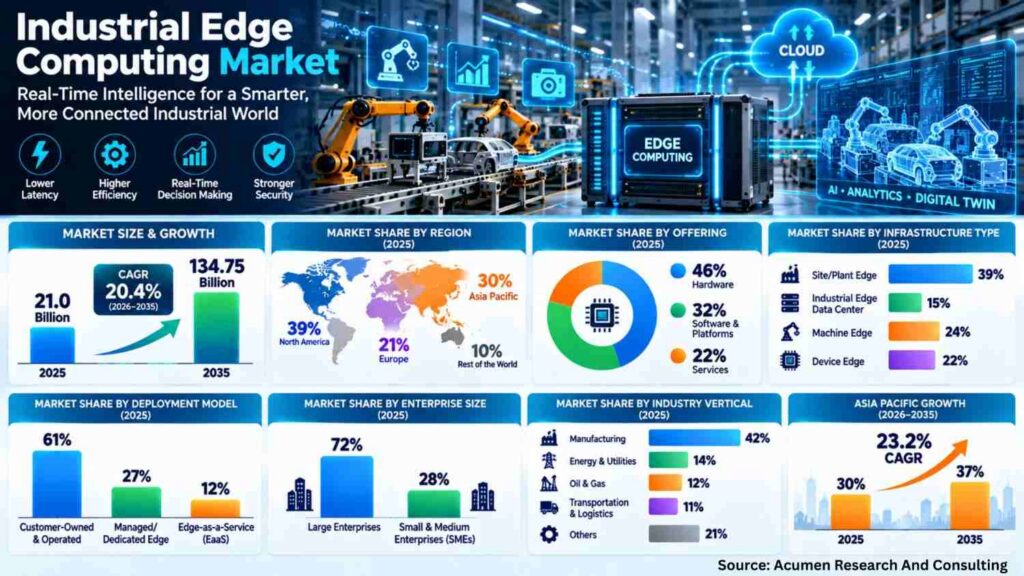
This is creating a larger role for industrial edge computing. The global industrial edge computing market was valued at USD 21.0 billion in 2025 and is projected to reach USD 134.75 billion by 2035, expanding at a 20.4% CAGR during 2026–2035, according to Acumen Research and Consulting.
But the bigger transformation is architectural.
Industrial edge infrastructure is moving beyond localized computing toward becoming an execution layer for industrial AI, machine vision, digital twins, robotics, real-time analytics and increasingly autonomous operations.
What Is Industrial Edge Computing?
Industrial edge computing places computing, storage, analytics and increasingly AI capabilities close to the industrial equipment and operational systems generating data.
Rather than sending every sensor reading, image or machine event to a centralized cloud, an edge system can process selected information locally.
The architecture can exist at several levels:
Device Edge → Equipment/Machine Edge → Site/Plant Edge → Industrial Edge Data Center → Cloud
These layers serve different purposes.
A machine-level edge computer may run an AI inference model directly beside production equipment.
A plant-level edge environment can aggregate information from hundreds of machines and support applications such as production analytics, quality management and digital twins.
An industrial edge data center can provide substantially greater localized computing and storage capacity while maintaining proximity to the production environment.
The cloud remains important for model training, enterprise analytics, fleet-wide management and long-term data storage.
The emerging architecture is therefore not edge versus cloud.
It is edge plus cloud, with workloads placed according to latency, bandwidth, security, computing and operational requirements.
Industrial Edge Computing Market Could Reach $134.75 Billion by 2035
The industrial edge computing market is projected to expand more than sixfold from USD 21.0 billion in 2025 to USD 134.75 billion by 2035. That represents a 20.4% CAGR between 2026 and 2035.
The expansion is being supported by the convergence of technologies that were previously treated as separate industrial investments.
Factories are installing more connected sensors.
Robotics deployment is expanding.
Machine vision is becoming AI-driven.
Private wireless networks are improving industrial connectivity.
Digital twins require continuous operational data.
AI models increasingly need to interact with physical systems.
As these technologies converge, industrial companies require computing infrastructure capable of operating close to production assets.
This changes the purpose of the edge.
The industrial edge is no longer simply a gateway connecting operational technology with IT infrastructure.
It is increasingly becoming the place where industrial data is contextualized, AI models execute, applications run and time-sensitive decisions are made.
Edge AI Is Becoming the Market’s Biggest Technology Catalyst
Artificial intelligence represents one of the strongest catalysts for industrial edge computing.
AI applications can require enormous quantities of data.
Sending every machine-vision image, sensor stream or robot telemetry feed continuously to a remote data center can create bandwidth, latency and data-governance challenges.
Processing selected workloads locally changes that equation.
NVIDIA describes edge AI as processing data close to its source, helping enable real-time AI while reducing latency and improving adaptability and data security. Manufacturing is among the industries where this architecture is increasingly relevant.
In industrial environments, the model can look like this:
Machine data → Local edge processing → AI inference → Immediate action → Selected data sent to cloud
The AI model itself may still be trained using centralized computing infrastructure.
But once trained, inference can occur close to the machine.
That distinction is becoming increasingly important.
The cloud can remain the training and coordination layer, while the industrial edge increasingly becomes the inference and execution layer.
Siemens Is Turning Industrial Edge Into an AI Platform
A clear example of this transition emerged at Hannover Messe 2026.
Siemens announced the general availability of its Industrial AI Suite based on Siemens Industrial Edge. The platform is designed to support deployment and scaling of industrial AI models across production locations while incorporating edge infrastructure, AI model management and industrial applications.
The architecture illustrates how industrial edge computing is evolving.
A manufacturer may develop or train an AI model using centralized infrastructure but deploy that model to individual factories or production lines.
Siemens’ AI Inference Server allows AI models to run directly at the edge, close to machines, enabling local processing and decision-making without relying continuously on cloud connectivity.
This creates a repeatable industrial AI lifecycle:
Develop model → Validate model → Deploy to edge → Run inference locally → Monitor performance → Update model → Scale across factories
The ability to manage that lifecycle across numerous sites is why software is becoming increasingly important to the industrial edge computing market.
Hardware Leads With 46%—But Software Is Set to Take Over
Hardware represented 46% of the industrial edge computing market in 2025, making it the largest offering category.
Software and platforms represented 32%, while services accounted for 22%.
Hardware leadership reflects the physical infrastructure required to establish industrial edge environments.
Factories need industrial computers, gateways, acceleration hardware, networking equipment and storage systems capable of operating under demanding production conditions.
But the Industrial Edge Computing Market is projected to change significantly.
Software and platforms are expected to increase from 32% of market revenue in 2025 to 39% by 2035, becoming the largest offering category.
This transition reveals an important maturation of the market.
Once edge hardware is installed, organizations face a different problem: how do they manage hundreds or thousands of distributed computing nodes?
They need software for:
AI model deployment, application orchestration, device management, analytics, cybersecurity, workload monitoring, software updates and lifecycle management.
Industrial edge computing is therefore gradually transitioning from an infrastructure build-out market toward a software-defined distributed-computing market.
Machine Vision Shows Why AI Needs the Industrial Edge
Machine vision provides one of the clearest examples of why edge computing matters.
Traditional machine-vision systems frequently performed predefined inspection tasks.
AI is expanding what these systems can recognize.
Manufacturers can use AI-driven vision for surface-defect inspection, assembly verification, dimensional checks, anomaly detection and other quality-control processes.
But industrial machine vision can generate enormous volumes of image data.
A 2026 Cisco and Cognex analysis notes that scaling AI-powered machine vision introduces requirements around deterministic behavior, bandwidth, time synchronization, edge-compute utilization, security and protection of image data.
That makes localized processing attractive.
Instead of continuously sending high-resolution video streams to a remote cloud, an edge system can analyze images beside the production line and transmit only relevant events, results or selected data.
The architecture reduces unnecessary network traffic while supporting faster responses.
As industrial computer vision expands, machine vision could therefore become one of the most important workloads driving industrial edge investment.
Site and Plant Edge Holds 39% of the Industrial Edge Computing Market
Site/plant edge infrastructure accounted for 39% of the industrial edge computing market in 2025, making it the largest infrastructure category.
Its leadership reflects a practical compromise.
Placing powerful computing beside every machine can become expensive and difficult to manage.
Sending every workload to the cloud may introduce latency, connectivity or data-governance concerns.
A plant-level edge environment creates a middle layer.
It can aggregate information from multiple production assets while retaining computing resources inside or close to the industrial facility.
This makes site edge infrastructure suitable for production analytics, AI inference, digital twins, machine vision and operational applications requiring low latency.
The segment is projected to retain approximately 38% share in 2035, remaining the largest infrastructure category even as other edge architectures expand.
Industrial Edge Data Centers Are Emerging as an AI Infrastructure Layer
The fastest-changing infrastructure opportunity may be industrial edge data centers.
Their share is projected to increase from 15% in 2025 to 19% by 2035.
The reason is computing intensity.
Basic sensor processing can occur on relatively lightweight devices.
Industrial AI is different.
Computer vision, digital twins, advanced analytics and increasingly sophisticated AI models can require substantial compute acceleration and storage.
Industrial edge data centers provide greater local capacity than individual machines while preserving the advantages of proximity.
This could become particularly important as factories move toward increasingly complex AI workloads.
Instead of treating the edge as a small gateway between the factory and cloud, manufacturers may increasingly deploy localized AI computing clusters inside industrial facilities.
The resulting architecture begins to resemble a distributed AI infrastructure:
Cloud AI infrastructure → Regional infrastructure → Industrial edge data center → Plant edge → Machine edge
Each layer handles workloads appropriate to its location.
Digital Twins Need the Industrial Edge
Industrial edge computing also has a strong relationship with digital twins.
A digital twin depends on information from the physical system it represents.
For a manufacturing twin, that can include machine states, sensor readings, production rates, robot activity, quality data and environmental conditions.
Sending every raw industrial data stream continuously to centralized infrastructure can be inefficient.
Edge computing can filter, aggregate and contextualize information before it reaches higher-level digital twin platforms.
This creates a natural relationship:
Physical equipment → Industrial edge → Operational data → Digital twin → Simulation/AI → Optimized decision
Industrial edge data centers are specifically gaining relevance as localized capacity is required for digital twins, machine vision, AI and real-time analytics.
This also explains why industrial edge computing and digital twins should not be treated as competing technologies.
The edge can become part of the computing foundation that allows increasingly sophisticated twins to operate.
Edge-to-Cloud Architecture Is Replacing the Edge-versus-Cloud Debate
The idea that industrial edge computing will replace cloud computing misunderstands how the technologies increasingly work together.
Cloud infrastructure remains highly valuable for large-scale analytics, AI model development, enterprise applications and long-term data management.
The edge provides different advantages.
It can process time-sensitive workloads close to the physical system and determine which information actually needs to travel upstream.
This creates an edge-to-cloud continuum.
Siemens demonstrated this approach in June 2026 through integrations involving Industrial Edge, FFT DataBridge and Databricks, designed to connect shop-floor and plant data directly with enterprise AI and analytics environments.
Siemens also partnered with HighByte to connect and contextualize OT and IT data for industrial AI models, agents and applications.
These developments show that the value of industrial edge computing increasingly lies in connecting the physical and digital worlds rather than isolating them.
Private 5G Can Expand the Reach of Industrial Edge Computing
Connectivity is another important piece of the industrial edge architecture.
Factories historically relied heavily on wired industrial networks and Wi-Fi.
Private 5G creates another option for connecting machines, mobile robots, cameras and industrial devices.
The combination is strategically important because private wireless connectivity can transport operational data while edge infrastructure processes that information locally.
The architecture can support applications involving mobile equipment, autonomous systems and production environments where wired connectivity is difficult.
The broader market is therefore increasingly shaped by the convergence of:
Industrial Edge + Private 5G + IIoT + AI + Automation
Acumen identifies this convergence as an important driver of industrial edge investment, while government-backed initiatives across the United States, Europe, China, India and the United Kingdom are supporting industrial 5G, edge infrastructure and related innovation.
Edge-as-a-Service Could Change the Economics of Deployment
One of the most interesting commercial developments is occurring in deployment models.
Customer-owned and operated infrastructure dominated the Industrial Edge Computing Market with 61% share in 2025.
Managed or dedicated edge represented 27%, while Edge-as-a-Service accounted for only 12%.
But those shares are projected to change substantially.
By 2035, customer-owned infrastructure is projected to fall to 45%, managed/dedicated edge to reach 32%, and Edge-as-a-Service to rise to 23%.
Edge-as-a-Service is projected to record a 29.4% CAGR during 2026–2035, making it the fastest-growing deployment model.
The economics are straightforward.
Building industrial edge infrastructure internally requires hardware procurement, installation, cybersecurity, software updates, device management and specialist IT/OT expertise.
A service model can shift portions of those responsibilities to an external provider.
That may be particularly important for smaller industrial companies.
SMEs Could Become a Bigger Part of the Market
Large enterprises accounted for 72% of industrial edge computing revenue in 2025, compared with 28% for small and medium-sized enterprises.
Large organizations have natural advantages in early adoption.
They operate more factories, generate more operational data and can justify larger investments in automation, AI and edge infrastructure.
But Edge-as-a-Service and managed-edge models could gradually lower the barrier for SMEs.
A smaller manufacturer may not need to build a sophisticated internal edge-management organization.
Instead, it could deploy preconfigured infrastructure and applications while relying on external providers for security, maintenance and lifecycle management.
This could create a similar transition to cloud computing: infrastructure that was initially easier for large enterprises to deploy becomes accessible to smaller organizations as consumption-based models mature.
Manufacturing Accounts for 42% of Industrial Edge Demand
Manufacturing represented 42% of the industrial edge computing market in 2025, making it by far the largest end-use industry.
The sector combines nearly every technology driving edge adoption:
Connected machines, robots, sensors, PLCs, industrial cameras, automated production systems and digital twins.
Edge infrastructure allows manufacturers to process information locally for machine vision, predictive maintenance, process optimization, anomaly detection, robotics and production monitoring.
Energy and utilities represented another 14%, followed by oil and gas at 12% and transportation and logistics at 11%.
These industries share an important characteristic.
Their assets are distributed across physical environments where operational decisions often cannot depend entirely on distant centralized infrastructure.
That makes edge computing relevant well beyond the factory floor.
North America Leads With 39% Market Share
North America accounted for 39% of global industrial edge computing revenue in 2025, equivalent to approximately USD 8.19 billion.
The region benefits from mature industrial automation, cloud-edge infrastructure, private wireless deployments, cybersecurity capabilities and a large technology-provider ecosystem.
The increasing adoption of AI could further reinforce demand.
Cisco’s 2026 manufacturing research, based on more than 350 manufacturing professionals across 19 countries, indicates manufacturers are actively considering how industrial networks must evolve to support AI workloads.
That infrastructure requirement is important.
Deploying AI in an office environment and deploying AI inside a production facility are different problems.
Factories need reliability, deterministic communications, cybersecurity and integration with operational technology that may have been installed decades ago.
Industrial edge computing sits directly inside that transition.
Asia-Pacific Could Rise From 30% to 37% of the Global Industrial Edge Computing Market
Asia-Pacific represented 30% of industrial edge computing revenue in 2025 but is projected to reach 37% by 2035.
The regional market is projected to grow at a 23.2% CAGR during 2026–2035, reaching approximately USD 49.86 billion by 2035.
The region’s opportunity is closely tied to its manufacturing scale.
China, Japan, South Korea, India and other Asian economies contain extensive automotive, electronics, machinery, semiconductor and industrial-production ecosystems.
As these factories deploy more robotics, machine vision, industrial IoT and AI, they require greater computing capacity close to production.
This creates an important relationship between industrial automation intensity and edge-computing demand.
Factories with more connected equipment generate more data.
More data creates more opportunities for AI.
More AI increases the need for localized computing.
That reinforcing cycle could make Asia-Pacific one of the most important industrial edge markets during the next decade.
Cybersecurity Becomes More Complex When Computing Is Distributed
Industrial edge computing solves some infrastructure problems while creating others.
Centralized systems can be easier to manage because computing resources are concentrated in relatively few locations.
Edge architectures distribute computing across factories, machines and remote industrial sites.
Every additional node potentially requires software updates, identity management, monitoring, access control and security protection.
Industrial environments also face a difficult constraint: systems cannot simply be taken offline whenever an update is required.
Production continuity matters.
Siemens’ 2026 Industrial Edge expansion reflects this issue, incorporating enhanced cybersecurity capabilities and support for air-gapped operation for critical environments.
Security therefore cannot be added after industrial edge infrastructure has been deployed.
It must become part of the architecture itself.
Legacy OT Integration Remains a Major Barrier
The second major challenge is integration.
Factories rarely consist entirely of new equipment.
A production environment can contain modern AI-enabled machines beside equipment installed many years earlier.
Different PLCs, industrial protocols, operating systems and networking technologies may coexist.
Edge infrastructure must connect these systems without disrupting production.
That makes industrial edge computing as much an integration problem as a computing problem.
Acumen identifies deployment complexity, cybersecurity and integration with heterogeneous legacy operational technology as major restraints on market adoption.
This is also why software platforms and services are gaining importance.
The industry does not simply need more computing power at the edge.
It needs ways to manage heterogeneous industrial environments at scale.
Industrial Edge Could Become the Execution Layer for Autonomous Manufacturing
The most significant long-term opportunity emerges when industrial edge computing is combined with AI, digital twins and robotics.
Consider a future production system.
Machine-vision cameras inspect products.
Edge AI identifies an emerging quality problem.
A digital twin evaluates potential process changes.
An AI system recommends an adjustment.
The local edge infrastructure communicates the validated instruction to the relevant production systems.
The process is monitored continuously.
This creates a closed operational loop:
Sense → Process → Understand → Simulate → Decide → Act
The cloud can still provide large-scale AI training and enterprise coordination.
But the factory edge provides the proximity necessary to interact with physical production.
That makes industrial edge computing a potential execution layer for physical AI and increasingly autonomous industrial systems.
The edge is therefore not merely where industrial data is stored.
It is increasingly where digital intelligence meets physical operations.
What Comes Next for the Industrial Edge Computing Market?
The next stage of industrial edge computing will likely be defined by three transitions.
The first is hardware to software.
Hardware leads today, but software and platforms are projected to become the largest offering category by 2035 as distributed infrastructure requires orchestration, AI management, analytics and cybersecurity.
The second is owned infrastructure to consumption models.
Edge-as-a-Service is projected to expand at 29.4% CAGR as enterprises seek the benefits of localized computing without managing every infrastructure layer internally.
The third—and potentially most important—is data processing to AI execution.
Factories increasingly need infrastructure capable not only of collecting information but of running AI models close to machines.
The projected expansion of the industrial edge computing market from USD 21.0 billion in 2025 to USD 134.75 billion by 2035 reflects all three transitions.
Industrial edge computing began as a solution to the physical distance between machines and centralized computing.
Its next role could be considerably larger.
As AI moves from digital applications into factories, robots, energy infrastructure and other physical systems, the industrial edge could become the computing layer that allows intelligence to operate where the physical work actually happens.
Key Takeaways
- The global industrial edge computing market is projected to grow from USD 21.0 billion in 2025 to USD 134.75 billion by 2035, representing a 20.4% CAGR during 2026–2035.
- North America led with 39% market share in 2025, while Asia-Pacific is projected to increase from 30% to 37% by 2035 at a 23.2% CAGR.
- Hardware accounted for 46% of 2025 revenue, but software & platforms are projected to rise from 32% to 39% and become the largest offering by 2035.
- Site/plant edge led infrastructure types with 39% share, while industrial edge data centers are projected to increase from 15% to 19%.
- Customer-owned infrastructure represented 61% of the market, but Edge-as-a-Service is projected to grow at 29.4% CAGR and increase from 12% share in 2025 to 23% by 2035.
- Large enterprises accounted for 72%, while managed and service-based edge architectures could gradually improve accessibility for SMEs.
- Manufacturing represented 42% of market revenue, reflecting strong demand from machine vision, robotics, predictive maintenance, digital twins and real-time production analytics.
- Industrial edge computing is increasingly becoming the local AI inference and execution layer connecting cloud intelligence with physical industrial operations.
Frequently Asked Questions
What is industrial edge computing?
Industrial edge computing places computing, storage, analytics and AI capabilities close to industrial machines, sensors and operational systems. It allows time-sensitive data to be processed locally rather than sending every workload to centralized cloud infrastructure.
How big is the industrial edge computing market?
The global industrial edge computing market was valued at USD 21.0 billion in 2025 and is projected to reach USD 134.75 billion by 2035, growing at a 20.4% CAGR during 2026–2035.
Why is AI driving industrial edge computing?
Industrial AI applications such as machine vision, robotics, predictive maintenance and quality inspection can require low latency and generate large volumes of data. Edge infrastructure allows AI inference and selected processing to occur close to the physical equipment.
Will edge computing replace cloud computing in manufacturing?
No. Industrial environments are increasingly adopting edge-to-cloud architectures. Cloud infrastructure remains valuable for AI training, enterprise analytics and long-term storage, while edge infrastructure handles local, latency-sensitive and operational workloads.
Which industry uses industrial edge computing the most?
Manufacturing accounted for approximately 42% of the market in 2025, making it the largest end-use sector.
What is Edge-as-a-Service?
Edge-as-a-Service provides access to managed edge computing infrastructure and related software without requiring an industrial organization to purchase and operate the entire infrastructure internally. The segment is projected to grow at 29.4% CAGR from 2026 to 2035.
How are digital twins related to industrial edge computing?
Digital twins require operational information from physical equipment. Industrial edge infrastructure can collect, process and contextualize that information locally before feeding higher-level digital twin, analytics and AI platforms.