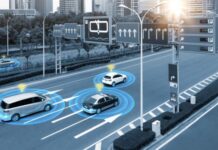


The digital world is witnessing a quiet revolution with the merging of two powerful forces: Artificial Intelligence (AI) and the Internet of Things (IoT). AI in IoT is now a reality. It is changing factories, hospitals, cities, and homes. AIoT is transforming simple sensor networks into smart ecosystems that can make decisions on their own. Industries are competing to gain value from the massive amount of data produced by billions of connected devices. In this scenario, AIoT has emerged as the technological backbone of the next industrial era.
What Is AIoT?
AIoT combines IoT infrastructure with AI capabilities such as machine learning, deep learning, natural language processing, and computer vision. IoT devices create large amounts of raw data. AI helps analyze this data and identify irregularities. It is used to predict outcomes and initiate smart responses, often without human intervention.
The result is a shift from reactive to proactive systems. A conventional temperature sensor in a manufacturing plant alerts an operator when conditions go out of range. An AIoT-enabled sensor learns what “normal” looks like. It anticipates deviations hours before they occur. The technology also initiates corrective action autonomously.
The data by Polaris Market Research & Consulting tells a compelling story. The global IoT technology market is projected to reach USD 2,004.62 billion by 2034. Meanwhile, the AI market is expected to register a CAGR of 31.3% through 2034. It is a trajectory that reflects the growing demand for intelligent automation across every sector.
Edge AI: The Engine Powering Real-Time Intelligence
Edge AI is a key enabler for AIoT, ensuring AI algorithms are executed on edge devices, without relying on cloud computing. This proves beneficial for real-world scenarios where privacy, bandwidth, and latency are critical aspects. Edge AI applications comprise remote healthcare diagnostics, smart manufacturing lines, and autonomous vehicles. All of these demand real-time, device-level decision-making that cloud-dependent systems simply cannot support. Powering this shift is a new generation of specialized hardware. Edge AI allows IoT devices like smart cameras, industrial sensors, and autonomous robots to run complex ML models on their own. They don’t need to send computations to a data center.
AI Sensors: From Reactive to Predictive
Perhaps the most tangible expression of AIoT is in the rapid evolution of sensors. Traditional sensors measure and report. AI sensors interpret and predict. The global AI sensor market is witnessing one of the fastest growth rates in the entire technology ecosystem.
AI sensors are being deployed across smart city infrastructure. The sensors and used for traffic optimization and energy management. They are also adopted in agriculture for precision irrigation. In healthcare, AI sensors help with continuous patient monitoring. The devices are used in industrial settings to track equipment health. Improved AI algorithms allow sensors to recognize patterns and identify irregularities. They also help respond to changing environments.
Transforming Cities and Infrastructure
Nowhere is the impact of AIoT more visually evident than in the development of smart cities. The global smart cities market is representing one of the most ambitious infrastructure transformations in human history. AI and IoT together enable cities to manage traffic in real time and detect public safety incidents. AIoT optimizes energy consumption across grids. The technology provides citizen services more efficiently. Governments are making AIoT infrastructure a national priority. A few examples include Singapore’s Smart Nation 2.0 and India’s USD 3.43 billion investment in 12 industrial smart city projects. The mix of connected sensors, edge AI, and real-time analytics creates the operational backbone of these next-generation urban environments.
The Security Imperative in an AIoT World
With intelligence comes vulnerability. More devices are connecting to networks and sharing sensitive data. Therefore, attack surface expands dramatically. This is where AI-powered cybersecurity becomes not optional but essential to AIoT’s long-term viability.
As per Polaris Market Research report on the AI in cybersecurity market, the high volume of data generated by IoT ecosystems creates an expanded attack surface. AI-enabled solutions provide real-time monitoring and detect anomalies. They also automate threat responses to protect critical infrastructure. Self-learning cybersecurity systems analyze network traffic patterns and identify sophisticated threats. These systems are becoming essential for enterprise AIoT deployments.
The Infrastructure Layer: Building the AIoT Backbone
Sustaining the AIoT ecosystem at scale requires strong underlying infrastructure. AIoT infrastructure includes compute hardware, networking systems, and storage platforms. It enables distributed intelligence across thousands of endpoints simultaneously.
The deployment of 5G networks is a fast-moving catalyst. It provides the high-speed, low-latency connectivity that AIoT applications need at scale. From smart factories to connected hospitals and autonomous logistics centers, the performance of AIoT systems depends on the infrastructure supporting them.
Key Industries Being Transformed
The industrial segment of the AIoT is particularly striking. The Industrial IoT (IIoT) market growth is underpinned by rising demand for automation, real-time analytics, and AI-enabled predictive maintenance in various industries. A few end-use industries are manufacturing, healthcare, energy, logistics, supply chain, and agriculture.
- Manufacturing: In manufacturing, AIoT is used for predictive maintenance. AIoT reduces downtime and extends equipment lifespans. AI-enabled sensors monitor vibration, heat, and sound patterns. They help identify signs of failure weeks in advance.
- Healthcare: Remote patient monitoring, AI-driven diagnostics, and smart wearables are creating models for continuous care. On-device AI keeps data private while providing real-time clinical insights.
- Agriculture: Precision farming powered by AIoT optimizes irrigation and detects crop diseases early. It also boosts yield through data-driven planting and harvesting decisions.
- Logistics and Supply Chain: Connected warehouses and intelligent routing systems use AIoT. The technology tracks inventory in real time and improves last-mile delivery. It also helps cut operational waste.
- Energy: Smart grid management, predictive infrastructure maintenance, and real-time consumption monitoring are making energy networks stronger and more efficient.
Looking Ahead
The convergence of AI and IoT is not a single event. It is an ongoing and accelerating process. Edge computing is becoming mature, AI models are becoming lighter and more efficient, and connectivity is expanding through 5G and beyond. Thus, the boundary between the physical and digital worlds will continue to blur.
AIoT is moving beyond connected devices toward smart systems. An infrastructure is being developed that does more than just sense the world; it understands and can influence it. The need is clear to businesses, governments, and innovators. The question is not whether to invest in AIoT, but how quickly to get the skills in place to lead.