

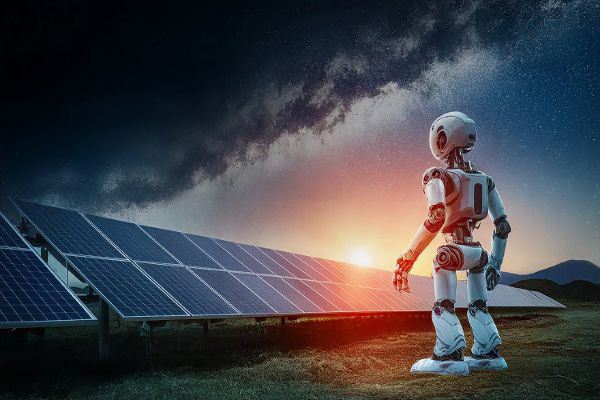
The global energy sector is undergoing a profound transformation. This revolution is fueled by the combination of artificial intelligence (AI) and data mining. As a range of renewable energy resources such as solar and wind power increases, their inherent intermittency creates a need for more precise energy predictions. Rule-based and statistical methods are being supported by AI-based methods that can process large multi-variable datasets in real time. These methods will enable predictions of unparalleled speed and precision.
Artificial intelligence-based energy forecasting uses neural network, machine learning and deep learning techniques. It is employed for the development of energy generation, consumption, and demand pattern forecasting. These models learn from data coming from weather stations, smart meter, satellite data feeds, IoT sensors and historical grid data. These data patterns pave the way for short and long term energy forecasting. The impacts are diverse ranging from lessening of renewable energy curtailment to better grid dispatch and facilitating dynamic pricing and demand response programs.
Technology Behind AI Energy Forecasting
In its fundamental form, AI-based energy forecasting is just a set of good computational approaches. Long Short-Term Memory (LSTM) excels in time-series prediction tasks, making them apt for load and renewable generation forecasting. On the demand side analytics, gradient boosting models and combined learning approaches are found. Interestingly, convolutional neural networks (CNN) apply to spatial data extracted from satellite weather images to improve solar irradiance predictions.
Digital twins, virtual replicas of physical grid assets, are increasingly being paired with AI forecasting engines. It helps simulate grid behavior under varying scenarios. This allows operators to stress-test grid responses before committing to dispatch decisions. Edge AI, where inference is executed locally on IoT devices and smart meters, reduces latency. It also enables near-real-time forecasting at the distribution network level.
Key Applications Across the Energy Value Chain
Renewable Energy Generation Forecasting: One of the most valuable applications of AI deployments in the energy sector, is the generation output forecasting of variable renewable energy generation. Machine learning (ML) models trained on meteorological data, past energy generation trends and equipment dynamic performance indicators are used to generate solar, wind output forecasts hourly or days ahead. This output plays a crucial role in optimizing grid operations for dispatch scheduling, maintenance planning and operational reserve requirements.
AI integration in renewable energy management systems is revolutionizing the industry. It enables more effective and efficient generation of solar and wind based energy systems. By improving weather pattern forecasting, this allows for better anticipating the output generated by solar panels and wind turbines. It results in less wasteful operations and a more reliable and consistent power supply to the grid. AI-powered grid optimization leverages real time energy consumption and production data to deliver power where it is needed most. AI can also facilitate asset management by monitoring equipment performance and identifying the need for preventive maintenance.
Demand Forecasting and Load Management: Accurately forecasting load is a fundamental prerequisite for grid stability and economic efficiency. AI analyzes consumption data from millions of smart meters, in conjunction with consumer behavioral patterns, ambient temperature, industrial activity, and calendar effects, to forecast the electricity required at spatial and temporal scales meaningful to power systems operators. The prediction allows utilities to avoid over-procurement (which is costly) and avoids under-procurement (which would risk blackouts).
AI forecasting becomes particularly relevant as the share of electric vehicle (EV) will increase significantly in the coming decades. Uncontrolled charging of EVs can disrupt local grids. AI-based platforms can predict the load from EV charging and facilitate demand-side management (smart charging) to manage the load predicted by the forecast, thereby reducing the risk of destabilizing the local grid nodes. This is a compelling use case of AI as worldwide vehicle electrification increases.
Energy Storage Optimization: Battery energy storage systems (BESS) are crucial in managing the variability of renewable energy. AI forecasting models identify the best charge and discharge cycles. These models predict future energy prices, grid frequency changes, and demand peaks. This significantly improves round-trip efficiency and prolongs battery lifespan. AI helps predict faults, which reduces unexpected downtime and related costs in grid-scale storage deployments.
Grid Stability and Real-Time Balancing: Power grids are increasingly complex due to the introduction of distributed generation and bidirectional power flows as well as variable renewable energy generation. On top of that, it has become more difficult to operate them reliably and stably. Through AI forecasting tools, grid operators can receive real-time intelligence on frequency regulation, congestion, and voltage stability. By anticipating possible grid imbalances ahead of time, AI systems can aid grid operators in responding more quickly and at lower cost.
Challenges and Barriers to Adoption
Despite the compelling value proposition of AI-based energy forecasting, several barriers impede broader deployment:
Data Quality and Availability: AI forecasting models are as good as the data they consume. Inconsistent metering infrastructure, gaps in weather data coverage, and legacy grid architectures that lack digital sensors create data quality challenges, particularly in emerging markets.
Cybersecurity Risks: The integration of AI and operational technology (OT) systems gives rise to novel cyber attack surfaces that could be detrimental to critical grid infrastructure. AI is increasingly used to manage grid dispatch and balancing operations. The consequences of a successful cyberattack are potentially severe.
Model Interpretability: Regulators and grid operators often require transparent, auditable decision-making. The ‘black box’ nature of deep learning models can create trust and compliance challenges in regulated energy markets.
High Integration Costs: Integrating AI forecasting platforms with legacy grid infrastructure and SCADA systems requires significant capital expenditure and specialist expertise. It poses a barrier for smaller utilities and operators in developing economies.
Skills Gap: Deploying and maintaining AI forecasting systems requires multidisciplinary expertise across data science, power systems engineering, and IT. The shortage of such talent remains a constraint on the pace of adoption globally.
The Road Ahead
The falling cost of AI compute, growth in smart meter coverage, the expanding IoT sensor networks, and regulation-driven decarbonization of the grid all enable the growth of the AI based energy forecasting market. As the global energy mix includes more renewable energy, the economic need for accurate real-time forecasting will intensify in the future.
Emerging innovations include foundation models trained on massive energy datasets, federated learning approaches that enable model training without centralizing sensitive data, and AI integration with digital twin platforms. They are set to advance forecasting accuracy and operational applicability. The convergence of AI with quantum computing, though still nascent, holds the potential to unlock optimization capabilities far beyond what today’s classical systems can achieve.
The growing capabilities of AI forecasting are allowing the creation of new market mechanisms, such as real-time energy trading, peer-to-peer energy markets and AI-run virtual power plants that aggregate distributed resources to deliver grid services at scale. Widespread market momentum in smart grids, AI sustainability platforms and energy management systems illustrates this huge potential.
For energy stakeholders, from utilities and independent power producers to technology vendors and policymakers, understanding and investing in AI-based forecasting capabilities is not merely a competitive advantage. In an era of accelerating energy transition and grid complexity, it is becoming a strategic necessity.