

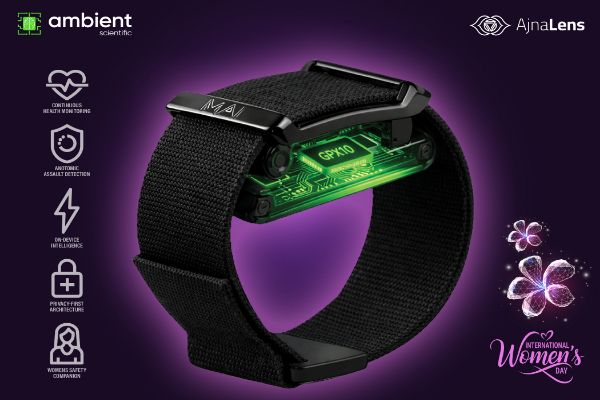
On International Women’s Day, during Embedded World, Ambient Scientific unveiled its collaboration with Dimension NXG to introduce ‘MAI’, a groundbreaking AI-powered wearable designed for women’s health and safety. Equipped with Ambient Scientific’s energy-efficient GPX-10 processor, MAI delivers up to two weeks of battery life.
MAI acts as a women-first health companion with an integrated safety feature. It monitors key daily metrics such as heart rate and SpO₂, and can offer blood pressure insights depending on the sensor setup. By analyzing these signals, MAI transforms raw data into meaningful health insights. Over time, it creates a personalized baseline to detect significant changes early, while providing guidance for everyday wellness through simple lifestyle practices like movement, breathing exercises, sleep optimization, and nutrition.
In critical moments, MAI can act as a safety sentinel, detecting falls, SOS gestures, and opt-in stress cues to trigger rapid alerts. Importantly, MAI is designed with on-device processing so sensitive signals can stay private by default, putting women in control of what gets shared and when. MAI also surfaces early risk insights for conditions like PCOS/PCOD by spotting trends that commonly go unnoticed until clinical intervention is needed, helping women seek guidance sooner and track progress over time.
“With the GPX-10, we have broken traditional power barriers, allowing Dimension NXG to run sophisticated, multimodal AI models locally and continuously. This partnership is a testament to how Ambient Scientific is making sustainable, always-on intelligence a reality for everyone,” said GP Singh, CEO of Ambient Scientific.
A processor that runs AI algorithms continuously at the edge for weeks
To make the Mai wearable viable for its target market, Dimension NXG required a processor capable of running multiple sensor fusion and audio classification models 24/7, without drawing too much power to necessitate daily charging or constant smartphone connectivity.
“MAI is built to be a health companion women can rely on in the real world, not just in ideal network conditions,” said Abhishek Tomar, CTO of Dimension NXG AjnaLens. “Ambient Scientific’s processor gave us the performance headroom to run intelligence locally on the wearable, with low latency and privacy by default, while still achieving up to 14 days of battery life on a 180mAh battery”
Traditional processors move data back and forth between memory and the processor, known as the Von Neumann architecture. The GPX-10’s efficiency stems from its unique DigAn architecture, which uses both digital and analog components. The GPX-10 performs matrix multiplication, the core mathematical operations used in AI algorithms, directly within custom memory arrays. Using a massive parallel multi-core design, the chip can execute 512 billion operations per second (GOPS) while consuming a fraction of the power of its digital-only competitors.
By leveraging Ambient Scientific’s GPX-10, the Mai wearable achieves a breakthrough 10-to-14 day battery while running complex AI algorithms continuously on the device. This extended battery life enables the device to operate in regions of India where consistent access to electricity cannot be guaranteed.
Furthermore, because the GPX-10 handles data processing locally on the device, with only essential data that the user agrees to share being sent to the cloud, the wearable remains secure and fully functional in environments with poor network coverage – ensuring a reliable safety lifeline.
Launch and initial field trials
Following the announcement today on International Women’s Day, the Mai wearable will enter its first major field trial phase on March 19th, 2026. This initial batch will see thousands of devices deployed to pre-order customers and trial participants across India. Dimension NXG then plans to scale to over 10,000 units by the end of the year as the product attains further medical-grade certifications.
Attendees at Embedded World 2026 in Nuremberg can visit Ambient Scientific at Hall 1, Booth 430 to see the technology powering the Mai wearable and learn more about the GPX-10.