
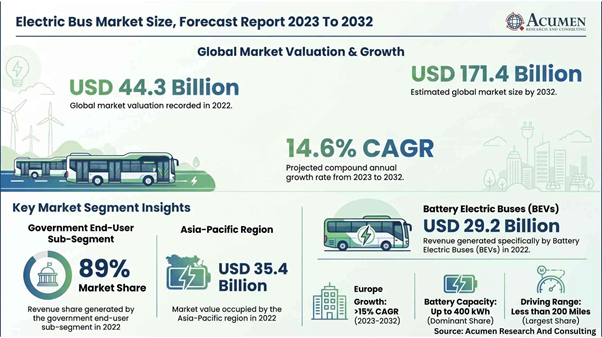
The global Electric Bus Market is experiencing significant expansion as governments, transportation operators, and technology providers accelerate the transition toward cleaner and more sustainable mobility solutions. According to the latest market analysis by Acumen Research and Consulting, the Global Electric Bus Market was valued at USD 44.3 billion in 2022 and is projected to reach USD 171.4 billion by 2032, growing at a CAGR of 14.6% from 2023 to 2032.
The rapid adoption of electric buses is being supported by increasing demand for zero-emission public transportation, advancements in battery technology, government initiatives promoting electric mobility, and growing investments in charging infrastructure. As cities worldwide focus on reducing transportation-related emissions, electric buses are becoming a critical component of sustainable urban mobility strategies.
Electric Bus Market Growth Accelerates with Global Shift Toward Clean Mobility
Electric buses are transforming the public transportation landscape by offering an environmentally friendly alternative to conventional diesel-powered buses. The growing focus on reducing greenhouse gas emissions and improving urban air quality is encouraging transit authorities and fleet operators to adopt battery-powered transportation solutions.
The electric bus industry is gaining momentum as municipalities prioritize sustainable mobility programs. Electric buses provide benefits such as lower operating emissions, reduced dependence on fossil fuels, and improved energy efficiency. These advantages are strengthening their role in modern public transportation networks.
Furthermore, increasing awareness of climate change and the need for cleaner transportation solutions are encouraging governments and private organizations to invest in electric mobility infrastructure.
Key Trends Shaping the Global Electric Bus Industry
Several emerging trends are influencing the growth trajectory of the electric bus market.
Increasing Adoption of Battery Electric Buses
Battery electric buses are becoming one of the most important developments in the transportation sector. Improvements in battery capacity, charging performance, and energy management systems are helping electric buses achieve better operational efficiency.
Modern electric buses are benefiting from advances in lithium-ion battery technology, enabling longer operating ranges and improved reliability. These innovations are helping address previous concerns related to charging time and vehicle performance.
Expansion of Charging Infrastructure
The availability of reliable charging infrastructure is a major factor supporting electric bus deployment. Governments and transportation organizations are investing in charging networks to support growing electric bus fleets.
Fast-charging solutions, depot charging systems, and smart energy management platforms are improving the practicality of electric buses for urban transportation applications.
Growth of Sustainable Public Transportation
Cities across the world are focusing on sustainable transportation solutions to reduce emissions and improve public mobility. Electric buses support these objectives by helping transit operators move toward cleaner fleet operations.
The transition toward electric public transportation is also aligned with broader electric vehicle adoption trends and smart city development initiatives.
Market Drivers Supporting Electric Bus Adoption
Government Support for Electric Mobility
Government policies and environmental regulations are among the key factors driving electric bus adoption. Incentives supporting electric vehicle deployment, investment in charging infrastructure, and emission reduction targets are encouraging transportation operators to transition toward electric fleets.
Public transportation agencies are increasingly exploring electrification strategies as part of long-term sustainability goals.
Rising Demand for Zero-Emission Transportation
The growing need to reduce transportation emissions is creating strong demand for electric buses. Conventional fuel-based buses contribute significantly to urban pollution, while electric buses offer a cleaner alternative.
As cities work toward improving air quality and reducing carbon emissions, electric buses are becoming increasingly important in urban transportation planning.
Technological Advancements in Battery Systems
Battery technology improvements are creating new opportunities for electric bus manufacturers and operators. Enhanced battery efficiency, improved energy storage capabilities, and advanced vehicle management systems are supporting wider electric bus adoption.
Battery innovation remains a critical area of development as manufacturers focus on increasing vehicle range and reducing operational costs.
Electric Bus Market Restraints
Despite strong growth opportunities, several challenges may affect market expansion.
High Initial Investment Costs
The initial purchase cost of electric buses remains higher compared with traditional buses due to expensive battery systems and advanced electric components.
Although electric buses can provide operational savings over time, the upfront investment requirement may create challenges for some transportation operators.
Charging Infrastructure Challenges
The availability of charging infrastructure continues to influence electric bus adoption. Developing adequate charging networks requires significant investment, planning, and coordination between governments, utilities, and transportation providers.
Limited charging availability may slow deployment in regions where infrastructure development is still progressing.
Market Opportunities Emerging Across the Electric Bus Market
Fleet Electrification Programs
Large-scale fleet electrification initiatives represent a major opportunity for the electric bus industry. Transportation operators are increasingly evaluating electric buses as part of their plans to modernize vehicle fleets.
The expansion of electric public transportation networks is expected to create opportunities for manufacturers, battery suppliers, charging solution providers, and technology companies.
Smart Transportation Integration
Integration with smart transportation systems is creating additional growth opportunities. Connected electric buses equipped with intelligent monitoring systems can improve fleet management, energy efficiency, and operational performance.
The combination of electrification and digital technologies is expected to strengthen the future development of sustainable mobility ecosystems.
Electric Bus Market Segmentation Analysis
The electric bus market is segmented based on key industry categories, including:
- Propulsion type
- Battery type
- Vehicle type
- Application
- Region
Each segment contributes to the evolving electric mobility ecosystem as manufacturers develop solutions designed for different transportation requirements.
Battery technology, vehicle configuration, and application needs continue to influence purchasing decisions among transportation operators and fleet managers.
Regional Insights: Global Electric Bus Adoption Patterns
The electric bus market is expanding across multiple regions as governments and transportation authorities increase investments in sustainable mobility.
Asia-Pacific Market Growth
Asia-Pacific represents a significant region for electric bus adoption due to increasing urbanization, growing public transportation demand, and government support for electric mobility initiatives.
Countries across the region are focusing on reducing transportation emissions and improving urban sustainability through electrified transit systems.
North America and Europe Adoption
North America and Europe are also witnessing increased interest in electric buses as cities implement clean transportation strategies.
Environmental regulations, sustainability commitments, and modernization of public transportation infrastructure are supporting regional market development.
Leading Manufacturers and Industry Innovation
The global electric bus market includes several established vehicle manufacturers and technology companies working to advance electric transportation solutions.
Leading companies in the electric bus ecosystem are focusing on:
- Battery performance improvements
- Vehicle efficiency enhancements
- Charging technology development
- Fleet management solutions
- Sustainable transportation platforms
Innovation in electric bus battery technology remains a major competitive factor as manufacturers aim to increase vehicle range, improve charging capabilities, and reduce lifecycle costs.
Electric Bus Technology Trends and Future Outlook
The future of the electric bus market will be shaped by continued improvements in battery technology, charging infrastructure, and intelligent transportation systems.
Electric buses are expected to become increasingly integrated with smart mobility networks as cities seek efficient and sustainable transportation solutions.
The combination of environmental priorities, technological innovation, and government support is expected to create new opportunities throughout the electric bus ecosystem.
According to Acumen Research and Consulting, the global electric bus market is positioned for strong growth, increasing from USD 44.3 billion in 2022 to USD 171.4 billion by 2032, reflecting the accelerating transition toward sustainable transportation.
Frequently Asked Questions (FAQs)
1. What is the current size of the electric bus market?
The global electric bus market was valued at USD 44.3 billion in 2022 and is projected to reach USD 171.4 billion by 2032, growing at a CAGR of 14.6% between 2023 and 2032.
2. What are the current trends shaping the global electric bus industry?
Key trends shaping the electric bus industry include increasing battery electric bus adoption, expansion of charging infrastructure, fleet electrification programs, smart transportation integration, and growing demand for zero-emission public transportation.
3. Who are the leading manufacturers of electric buses globally?
The electric bus industry includes major global manufacturers such as AB Volvo, Ashok Leyland Limited, Daimler Truck AG, Hyundai Motor Company, Man SE, Nissan Motor Corporation, Proterra, TATA Motors Limited, and Zhengzhou Yutong Bus Co., Ltd.
4. Which companies are leading innovation in electric bus battery technology?
Innovation in electric bus battery technology is focused on improving energy density, charging speed, operational range, and lifecycle performance. Battery manufacturers and electric bus producers are investing in advanced lithium-ion battery solutions to support wider adoption.
5. What is the typical range of a modern electric city bus?
The operating range of modern electric city buses depends on battery capacity, vehicle design, operating conditions, and charging technology. The typical range of a modern electric city bus is generally:
- Standard 12-metre electric city bus: 200–350 km per charge
- Long-range models with larger battery packs: 350–500+ km per charge
- Articulated electric buses (18-metre): usually 200–400 km, depending on passenger load and battery size
- Smaller electric minibuses: around 150–300 km
Examples of current-generation buses
- BYD Company city buses commonly operate in the ~250–400 km range depending on configuration.
- Yutong Bus electric buses are offered with ranges often exceeding 300 km in suitable conditions.
- Proterra buses (prior to its restructuring) were designed for several hundred kilometres of urban operation depending on battery configuration.
For Indian city operations (e.g., Pune, Mumbai, Delhi), a practical planning assumption is often 180–300 km per charge per day, considering traffic, AC usage, and route duty cycles.