
India’s push to become a global hub for electronics manufacturing is increasingly taking shape in tangible ways—across production lines, within government policy, and on industry platforms where supply chains are actively evolving.
The 2026 edition of electronica India and productronica India in Greater Noida highlighted this momentum, drawing strong participation from international suppliers, Indian manufacturers, and sourcing leaders. Rather than just an exhibition, the event functioned as a practical marketplace for an industry adapting to geopolitical shifts and rising cost pressures. It saw 20,922 attendees and featured over 1,000 suppliers and distributors from India and around the world.
As the host state, the Government of Uttar Pradesh played a significant role in supporting the event, reflecting its ongoing efforts to strengthen the electronics manufacturing ecosystem through policy backing, infrastructure development, and investment support. The active involvement of senior officials reinforced the state’s ambition to position itself as a preferred destination for electronics manufacturing, while also fostering direct engagement between industry players and policymakers.
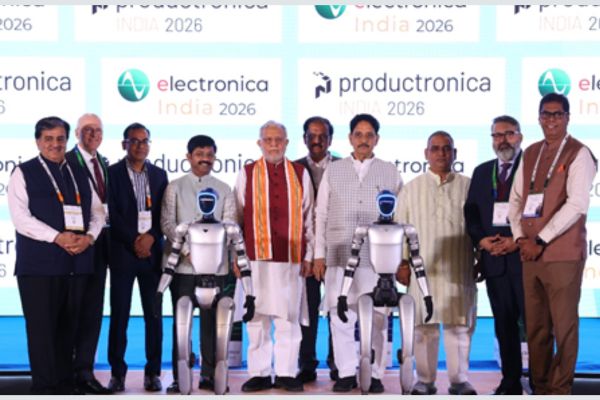
The inauguration brought together key political and industry leaders, including Uttar Pradesh Finance and Parliamentary Affairs Minister Suresh Kumar Khanna and Union Minister of State for Electronics & IT and Commerce & Industry Jitin Prasada, along with other senior ministers and officials from the state.
Scale with direction
Across its dual editions in Greater Noida and Bengaluru, the platform now brings together over 60,000 participants annually, reflecting a 50% expansion in scale and reinforcing its position as a key industry meeting point.
The Greater Noida edition saw significant participation from key manufacturing economies including Germany, China, Japan, Taiwan, and the United States—an indicator of India’s increasing integration into global value chains.
More notably, 1500+ structured and on-ground B2B meetings were conducted during the event, many centred on supplier diversification, localisation strategies, and lead-time optimisation. These are areas that have moved to the top of boardroom agendas as companies reassess dependence on concentrated supply bases.
The current edition reflected a clear emphasis on capability building. Exhibitors pointed to growing interest in component manufacturing, automation, and supply chain resilience. Buyers, particularly from sectors such as automotive and consumer electronics, were seen evaluating domestic suppliers with an eye on long-term partnerships rather than short-term procurement.
Alongside the exhibition, a series of conferences provided a forum for more detailed engagement, aligning with the sector’s current priorities, addressing policy, supply chain resilience, automotive electronics, PCB manufacturing, and advanced production technologies. These themes were explored through platforms such as the UP Electronics Leadership Summit, the ELCINA Supply Chain Summit, the Automotive Display Conference by ICEA, the Bharat PCB Tech Conference, and the SMT Thought Leadership Summit.
The edition also emphasised innovation, featuring a Startup Pavilion supported by the Government of Uttar Pradesh and curated industry podcasts. A notable development was the launch of BPCA, Bharat’s dedicated platform for printed circuits and assemblies, introduced in collaboration with ELCINA and Messe Muenchen India.
Industry bodies such as ELCINA and ICEA were active participants, contributing to both conference discussions and closed-door industry interactions.
Rajoo Goel, Secretary General, ELCINA stated,“The conversations at electronica India and productronica India 2026 reflected a clear shift in industry priorities. Localisation has moved beyond policy intent and is increasingly becoming a business imperative. The platform brought the value chain together in a way that enabled more practical discussions around strengthening component manufacturing capabilities and reducing external dependencies.”
Pankaj Mohindroo, Chairman, ICEA added, “What stood out clearly was the growing maturity of India’s electronics ecosystem. We are now seeing a far stronger convergence between policy direction, industry investments, and supply chain strategies, an alignment that is critical for sustainable scale.
electronica and productronica India 2026 played an important role in advancing this momentum by enabling meaningful, direct engagement between global technology and component suppliers and Indian manufacturers who are expanding with long-term commitment and strategic intent.”
Voices from the floor
Participants indicated that the value of the platform lay in the quality of engagement rather than scale alone.
Tsuyuki Junichi – Division Head – Robotics Support Business Division, Yamaha Motor India Sales (P) Ltd said, “For Yamaha Motor India Sales (P) Ltd., electronica India and productronica India, opened more meaningful conversations with teams that are actively planning their next phase of manufacturing growth.”
Mr. Narendra Savant – VP Operations, Kyoritsu Electric India Pvt Ltd stated, “What stood out for us at electronica India and productronica India 2026 in Greater Noida was the clarity of intent from buyers. They came with defined sourcing requirements, timelines, and technical expectations. We saw strong interest across diverse industrial manufacturers for our Customised Robotic + Automation Integrated solutions and our Made-in India End-of-Line Testers – which aligns with where the Indian electronics manufacturing production needs are heading. For us, the value of this platform lies in the ability to engage with decision-makers who are actively evaluating long-term supply partnerships rather than short-term procurement.”
Raj Kumar Saini – Managing Director, Saini Communications Pvt Ltd, mentioned,“The quality of interaction has definitely gone up. We’re no longer talking about basic automation; most conversations are now around integration, efficiency, and how to scale operations. We’ve had interest coming in from multiple sectors, which is a good sign. You can see that manufacturers are thinking more long-term now, and that changes the kind of discussions you have.”
Visitors highlighted the ability to evaluate global and domestic suppliers within a single platform, enabling faster decision-making.
Robins N T – Head Strategic Sourcing & New Product Development, Simple Energy said, “We are actively looking at diversifying supply chains and increasing localisation, and the interactions here help accelerate that process. The level of preparedness among exhibitors has improved significantly, which makes it easier to move from evaluation to actual business discussions within a short span”.
Srinivasan Sampath – Head NPD Materials at Pricol Limited, said, “What worked well for us at electronica India and productronica India 2026 in Greater Noida was the ability to benchmark multiple suppliers side by side. It helped us compare capabilities, timelines, and approach in a very practical way. In a short span, we were able to narrow down options that would have otherwise taken months to evaluate.”
Anuj Kumar Srivastava – Global Head- Facilities, Secure Meters Ltd. mentioned, “We came in to understand how quickly suppliers in India are adapting to new requirements, especially around quality standards and turnaround times. The interactions here gave us a clearer picture of who is ready to scale and who we can work with as we expand and diversify our operations. Pleased to see focus on Make in India.”
The event also witnessed strategic announcements and MoUs, including expanded collaborations between international PCB and component associations and Indian industry bodies, aimed at strengthening supply chain capabilities and fostering technology exchange.
Dr Reinhard Pfeiffer, CEO, Messe München, said, “What is becoming evident is how quickly India is moving from being part of the conversation about the supply chain to influencing it. Companies no longer assess the country solely based on cost or scale; they are also looking at long-term manufacturing alignment. This shift is reflected in the discussions taking place at electronica India and productronica India 2026 in Greater Noida.”
Bhupinder Singh, President – IMEA, Messe München & CEO, Messe Muenchen India said, “electronica India and productronica India are increasingly reflecting what the industry is dealing with in real time, supply chain adjustments, localisation, and the need for reliable partners. The conversations here are more structured, more practical, and closely linked to actual business decisions, which is where their relevance comes from.”
Looking ahead
The second edition of electronica India and productronica India 2026 is scheduled to be held in Bengaluru from September 16 to 18, 2026, extending the platform’s reach into another major electronics manufacturing hub.
As the industry recalibrates in response to geopolitical and economic shifts, platforms such as these are likely to play a more central role. The question, increasingly, is not whether India will be part of the global electronics supply chain—but how large a role it intends to occupy.