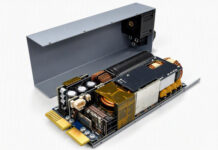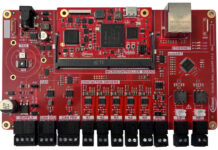

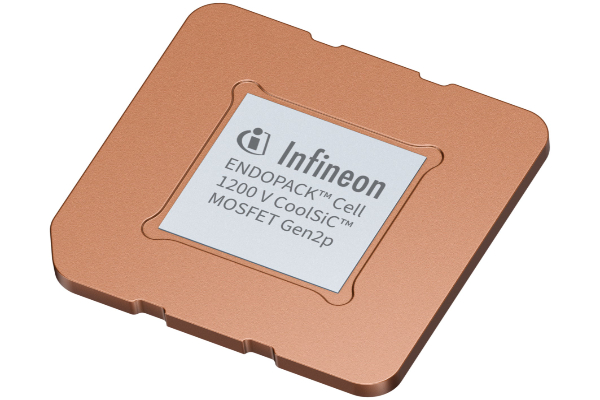
Infineon Technologies AG has introduced ENDOPACK, a new brand for advanced chip-embedding solutions, available across a broad range of voltage classes, form factors, and applications. Building on years of successful low-voltage chip-embedding production, Infineon is now extending the technology to high-voltage power electronics. ENDOPACK Cell is the industry’s first automotive-qualified, high-voltage chip-embedding solution designed for PCB integration. With 1200 V Automotive Gen2p CoolSiC MOSFET technology built directly into the board, it enables automotive manufacturers to develop traction inverters faster and scale them across vehicle platforms through greater design flexibility and reuse, while improving efficiency, power density, and semiconductor utilization.
As vehicle development cycles continue to shorten, automotive manufacturers face sustained cost pressure and the need to meet increasing efficiency and power density requirements while reusing architectures across multiple vehicle programs. Most importantly, they require technologies that enable them to develop and scale traction inverters significantly faster. Traditional architectures often require developing new designs for each application or power class, limiting flexibility and slowing deployment. ENDOPACK Cell addresses these challenges by leveraging standardized PCB design processes and proven manufacturing infrastructure, enabling development cycles up to three times faster than conventional solutions. In addition, it can be seamlessly transferred to a production line that remains entirely design-agnostic, enabling rapid iteration without the need to continuously adapt manufacturing processes.
Instead of placing power semiconductors on top of a substrate, ENDOPACK Cell is embedded directly in the PCB structure, combining advanced semiconductor performance with the flexibility and mature manufacturing ecosystem of PCB technology. The architecture enables a reduced inductance below 2 nH compared to 20 nH, enabling 30 percent lower switching losses and approximately 99.5 percent efficiency under CLTC conditions. Prototype and simulation data indicate up to 200 kW/L peak power density with the potential at vehicle-level to improve the vehicle range by 7 percent.
One of the most important advantages of ENDOPACK Cell is the resulting design freedom. Chip quantity and placement can be adapted to power requirements and installation space, while geometry is no longer largely determined by fixed module housing. Multiple cells can be integrated into a single PCB, allowing the power stage to be configured according to the performance and architecture requirements of specific vehicle platforms. This approach reduces engineering effort and allows a common design to be reused across platform generations.
ENDOPACK represents Infineon’s new category trademark for advanced PCB chip-embedding technologies, providing a scalable foundation that helps automotive manufacturers bring new inverter platforms to market faster while supporting long-term platform scalability, design flexibility, and cost-efficient reuse across vehicle generations.
Availability
ENDOPACK CELL is ready for mass production. Vehicles powered by ENDOPACK Cell are planned to enter mass production in 2027.