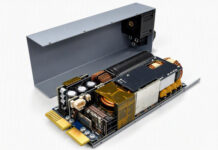

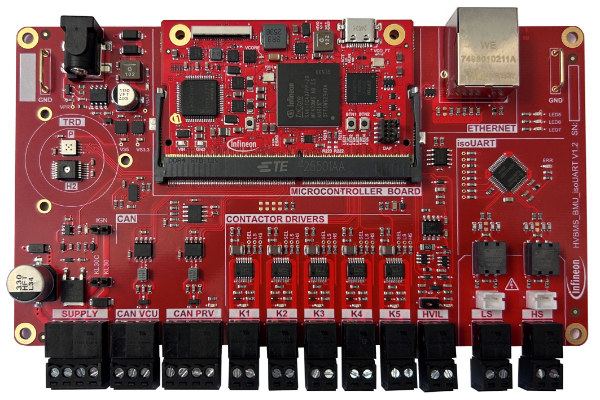
Infineon Technologies AG is introducing a high-voltage BMS reference design that enables computationally intensive battery models to run directly on the Battery Management Unit (BMU). The solution integrates an AURIX TC4x microcontroller with its parallel processing unit (PPU), providing the computing performance required for advanced battery-management functions at the edge. The reference design integrates the BMU with pack monitoring, cell monitoring, and a comprehensive software package, providing a one-stop hardware and software solution for high-voltage BMS development and evaluation.
The PPU of the microcontroller can deliver up to 30 times higher processing performance for workloads than a standard CPU. This additional computing capacity supports advanced modeling approaches, including machine learning, hybrid and electrochemical models, digital twins, and equivalent circuit models. These capabilities can help optimize load profiles, charging strategies, cell utilization, and driving range. In various application scenarios, optimized load profiles will extend battery lifetime by up to 30 percent. The same modeling capabilities allow battery designs with up to 20 percent fewer cells or, alternatively, support longer driving range with an unchanged battery configuration. Additional processing performance may also enable charging times to be reduced by up to 20 percent.
BMU for advanced battery modeling and control
The BMU reference design combines an AURIX TC4x microcontroller-based control board with the interfaces and functions required for high-voltage BMS development. It provides Ethernet, CAN, USB-C, and iso UART connectivity, as well as vehicle and laboratory power-supply inputs, MOTIX contactor drivers, a high-voltage interlock, EEPROM, and XENSIV pressure and gas sensors for thermal-runaway detection. The BMU supports a range of methods for estimating and predicting battery states under different operating conditions, including electrochemical impedance spectroscopy, open-circuit-voltage measurement, coulomb counting, Kalman filtering, equivalent circuit and electrochemical models, digital twins, AI-based models, and other data-driven approaches.
These methods can be used to estimate parameters such as internal cell temperature, state of charge, state of health, state of power, and state of safety, and to identify indicators of lithium platin. The estimates can support battery management during parking, charging, fast charging, driving, and cell balancing. Earlier detection of conditions associated with thermal runaway can provide additional time for a battery-management system to initiate preventive or protective measures.
Running advanced battery models in the vehicle itself lowers the amount of data that needs to be transferred to the cloud for processing. This can reduce cloud-infrastructure requirements and processing latency. Using aligned model architectures across laboratory, cloud, and edge environments can also facilitate model validation, deployment, and software-over-the-air updates.
Integrated monitoring and protection across the battery system
The high-voltage BMS reference design integrates the key functions required across the battery system. In addition to the BMU, the solution includes a Pack Monitoring Unit (PMU), and a Cell Monitoring Unit (CMU). Together with the accompanying software package, these components form a coordinated hardware and software platform for high-voltage BMS development and evaluation.
The PMU is based on the PSOC 4 HVPA SPM 1.0 and provides an ASIL D-compliant solution for key pack-level sensing and protection functions. It supports current sensing, high-voltage monitoring up to 1000 V, isolation-resistance measurement, and coulomb counting. The design also provides iso UART connectivity to TLE9012 and TLE9018 devices, an isolated CAN interface for the host microcontroller, SPI interfaces for pressure sensors, and a pyro-fuse interface.
The CMU integrates the TLE9018DQK, an 18-channel Li-ion battery monitoring and balancing IC that is compliant with ASIL D and ISO 26262. Its ultra-low power consumption allows direct supply from three to 18 cells. Hardware cascading supports up to 62 boards in a daisy chain. The solution also reduces cell-level wiring by using Infineon’s error-compensation concept, which enables a 19-wire AFE connection. It also supports module-to-module current and power matching, including lifetime re-trimming. The TLE9015DQU iso UART transceiver provides the communication interface.