
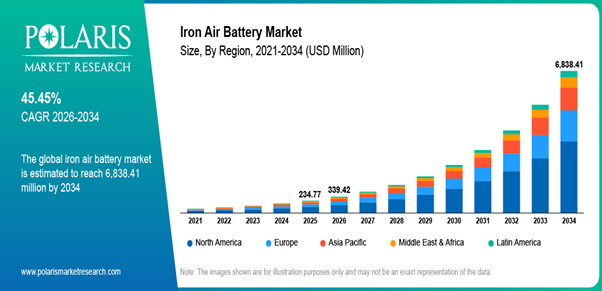
For two decades, the energy storage conversation has been dominated by a single chemistry: lithium-ion. But lithium-ion was built for phones and cars, not for keeping the lights on through a four-day wind lull. As utilities confront the true cost of multi-day renewable backup, a far humbler material is stepping into the spotlight — iron, one of the cheapest and most abundant metals on Earth. The iron air battery market, valued at just USD 234.77 million in 2025, is projected to rocket to USD 6,838.41 million by 2034, a 45.45% compound annual growth rate that ranks among the fastest of any energy storage technology. This isn’t a niche experiment. It’s a structural bet that the next era of grid resilience will be won not by chemistries that are dense, but by ones that are cheap, durable, and endlessly scalable.
Why Iron, and Why Now?
Lithium-ion excels at short bursts of high-density power — exactly what a smartphone or an EV needs. But grid operators face a different problem entirely: how to store renewable electricity for 24, 48, or even 100 hours to smooth out multi-day dips in solar and wind generation. Lithium-ion becomes prohibitively expensive at that duration because you’re essentially buying more and more lithium to store the same kilowatt-hour for longer. Iron air technology sidesteps this economics problem entirely. It works through a simple, reversible “rusting” and “de-rusting” reaction between iron and oxygen — a process that uses one of the most abundant, least geopolitically fraught materials on the planet.
The market’s own numbers tell the story of this shift. Rechargeable iron air batteries already command 48.3% of the type segment, and grid energy storage accounts for 44.7% of total application demand — proof that utilities, not consumers, are the ones placing the biggest bets on this chemistry. Utilities themselves make up the largest end-user category at 46.9% of the market, confirming that this is fundamentally infrastructure investment, not a consumer product story.
The Business Case: Cost Beats Density
The strategic insight utilities and investors need to internalize is this: for storage measured in days rather than hours, cost-per-kilowatt-hour over a 10+ year asset life matters far more than energy density. Iron air cells are estimated at roughly USD 20–80 per kWh, dramatically undercutting comparable lithium-ion storage on a duration-adjusted basis. That economic gap is precisely why five separate market drivers — long-duration storage expansion, government clean-energy support, renewable deployment growth, battery technology advances, and grid modernization spending — are all converging on this one technology simultaneously.
This is also why the fastest-growing sub-segment isn’t the base chemistry but hybrid iron air batteries, engineered to combine iron’s cost advantage with improved charge efficiency. Capital isn’t just flowing toward “cheap batteries” — it’s flowing toward cheap batteries that are getting smarter and faster, closing the last gaps that kept them out of premium grid contracts.
Regional Insights: A Race With Different Motivations
North America leads with 41.6% market share, anchored by projects like Xcel Energy’s 300 MW/30 GWh deployment for a Google data center in Minnesota — a signal that even hyperscale tech buyers now see iron air as bankable infrastructure, not experimental tech. Asia Pacific, however, is the fastest-growing region, driven by China’s manufacturing scale (it produces more than three-quarters of the world’s batteries) and a newly unveiled low-cost all-iron battery aimed squarely at renewable-heavy grids. Europe is leaning on nearly USD 390 billion in 2025 clean-energy investment and sustainability regulation to pull iron air into its energy-security strategy, while the Middle East — anticipating over USD 75 billion in renewable investment by 2030 — and Latin America represent the next wave of adopters as utility-scale storage becomes a baseline requirement rather than an option.
The pattern across every region is consistent: wherever renewable penetration is rising fastest, iron air’s cost logic becomes hardest to ignore.
View More information @ https://www.polarismarketresearch.com/industry-analysis/iron-air-battery-market
Competitive Landscape: Early, Concentrated, and Consolidating Fast
This is still a young, high-conviction field. Form Energy and ESS Tech Inc. lead as pure-play technology developers, while ArcelorMittal brings the raw material supply chain, and utilities like Dominion Energy, Xcel Energy, and Great River Energy are deploying at scale rather than waiting on the sidelines. Barriers to entry remain real — high capital requirements, immature production capacity, and entrenched lithium-ion supply chains — but they’re increasingly being offset by strategic alliances between battery developers, steelmakers, and utilities themselves, a vertical integration pattern rarely seen this early in a battery technology’s commercial life.
Future Outlook: From Pilot to Grid Standard
The trajectory here isn’t speculative — it’s already visible in contracted megawatt deployments, national-level manufacturing initiatives in China, and hyperscale data center commitments. As AI-driven electricity demand collides with intermittent renewable supply, the pressure for cheap, long-duration storage will only intensify. Iron air batteries are positioned to become the default answer for multi-day grid backup precisely because they solve a problem lithium-ion structurally cannot solve at scale: storing enormous amounts of energy, cheaply, for a long time, using a material nobody has to fight a war over.
Conclusion
The iron air battery market’s projected 45% CAGR isn’t hype — it’s a rational response to a cost problem that lithium-ion cannot solve. As utilities, renewable developers, and even tech giants commit real capital to iron-based storage, the message for energy strategists is clear: the next competitive advantage in the power sector won’t come from denser batteries. It will come from cheaper, more abundant ones — and iron is leading that charge.