
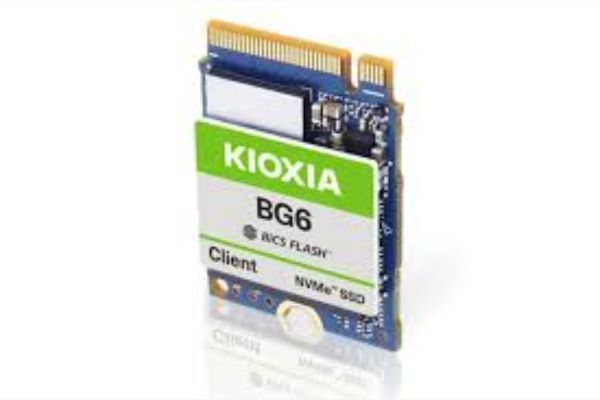
Kioxia Corporation has unveiled the KIOXIA BG8 Series solid state drives (SSDs), the latest addition to its client SSD portfolio aimed at PC OEM customers. Designed to bring PCIe 5.0 performance to the mainstream market, the BG8 Series offers a balance of high speed, energy efficiency, and flexible design options suitable for slim laptops, business notebooks, consumer laptops, and desktop PCs.
The drives use Kioxia’s BiCS FLASH 3D TLC memory (8th generation), delivering improved efficiency and performance over the previous generation. The BG8 Series achieves up to 47% faster sequential read, 67% faster sequential write, 44% higher random read, and 30% higher random write speeds compared to its predecessor.
Performance reaches up to 10,300 MB/s for sequential reads and 10,000 MB/s for sequential writes, while random performance can hit up to 1.4 million IOPS for reads and 1.3 million IOPS for writes, enabling smooth and responsive computing across everyday and demanding workloads.
The DRAM-less design incorporates Host Memory Buffer (HMB) technology, which uses system memory to optimize performance while keeping power consumption and cost in check. The series is offered in M.2 form factors (2230, 2242, and 2280), making it suitable for a wide range of device designs.
Additional features include:
- PCIe 5.0 (Gen5 x4) and NVMe 2.0d compliant
- Self-Encrypting Drive (SED) support based on TCG Opal version 2.02
- Capacities of 512 GB, 1024 GB, and 2048 GB
- Optimized for slim and mainstream client PCs
It also supports PCIe 5.0 (Gen5 x4), NVMe 2.0d, and TCG Opal 2.02 self-encryption features, with capacities ranging from 512 GB to 2 TB. The BG8 Series is currently being sampled to select OEM partners, with commercial PC shipments expected to start in the second quarter of 2026.
Notes:
(1) Compared to KIOXIA BG7 Series SSDs
– Definition of SSD capacity: Kioxia Corporation defines a kilobyte (KB) as 1,000 bytes, a megabyte (MB) as 1,000,000 bytes, a gigabyte (GB) as 1,000,000,000 bytes, a terabyte (TB) as 1,000,000,000,000 bytes, and a kibibyte (KiB) is 1,024 bytes. A computer operating system, however, reports storage capacity using powers of 2 for the definition of 1GB = 2^30 bytes = 1,073,741,824 bytes and 1TB = 2^40 bytes = 1,099,511,627,776 bytes and therefore shows less storage capacity. Available storage capacity (including examples of various media files) will vary based on file size, formatting, settings, software and operating system, and/or pre-installed software applications, or media content. Actual formatted capacity may vary.
– Read and write speed may vary depending on the host device, read and write conditions, and file size.
– IOPS: Input Output Per Second (or the number of I/O operations per second)- Availability of the SED model lineup may vary by region- NVMe is a registered or unregistered mark of NVM Express, Inc. in the United States and other countries.
– PCIe is a registered trademark of PCI-SIG.
– Other company names, product names and service names may be trademarks of third-party companies.