
Military Sensors Cybersecurity Solutions Market Overview
The global Military Sensors Cybersecurity Solutions Market is experiencing sustained growth as defense organizations increasingly depend on connected sensors, digital communications, autonomous platforms, and real-time intelligence systems. Protecting these interconnected technologies against cyber threats has become an important part of military modernization and operational resilience.
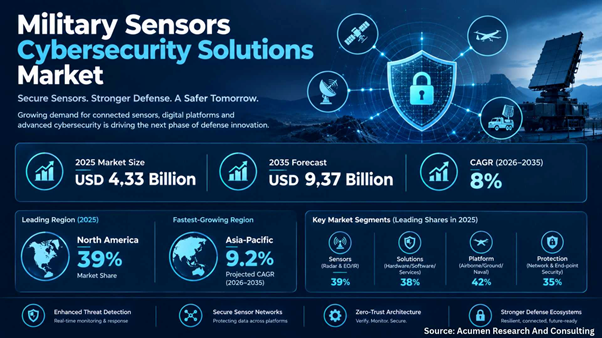
According to Acumen Research And Consulting, the Global Military Sensors Cybersecurity Solutions Market was valued at USD 4,330 million in 2025 and is projected to reach USD 9,373.29 million by 2035, expanding at a CAGR of 8% from 2026 to 2035.
As military platforms become more digitally integrated, cybersecurity requirements extend beyond traditional network protection. Defense organizations increasingly need security measures that protect sensor hardware, embedded software, data transmission, device interfaces, and the systems used to process sensitive information.
These requirements are creating opportunities for cybersecurity software providers, hardware security specialists, defense technology companies, and service providers supporting secure military infrastructure.
Military Sensors Cybersecurity Solutions Market: Key Statistics
- Market size in 2025: USD 4,330 million
- Projected market size by 2035: USD 9,373.29 million
- Forecast CAGR, 2026–2035: 8%
- Leading region in 2025: North America, with 39% market share
- Fastest-growing region: Asia-Pacific, with a projected CAGR of 9.2%
- Asia-Pacific market share in 2025: 27%
Key Factors Driving Market Growth
Increasing Connectivity Across Military Sensor Networks
Modern defense platforms increasingly rely on connected radar, electro-optical, infrared, navigation, surveillance, and communications sensors. These systems generate and transmit sensitive information that supports situational awareness and mission coordination.
Greater connectivity also expands the number of devices, interfaces, and communication pathways that must be secured. Cybersecurity solutions that support device authentication, secure communications, continuous monitoring, and controlled access are therefore becoming increasingly important.
Military Modernization and Digital Transformation
Governments are investing in advanced defense electronics, digital command infrastructure, unmanned platforms, and network-enabled military capabilities. As these investments expand, cybersecurity is becoming a core consideration in the design, deployment, and maintenance of sensor systems.
Defense organizations must consider security throughout the technology lifecycle, including procurement, installation, software updates, maintenance, and eventual replacement.
Growing Adoption of Autonomous and Unmanned Platforms
Unmanned aerial systems, remotely operated platforms, and other autonomous defense technologies depend on sensor data and digital communication links. Their growing use creates additional requirements for securing onboard electronics, communications, navigation information, and supporting software.
This trend is encouraging demand for security approaches that can operate across distributed environments, including systems with limited connectivity and computing resources.
Rising Focus on Zero-Trust Security
Traditional security models often emphasize protecting a network perimeter. However, interconnected defense environments require more comprehensive approaches that continuously verify devices, users, and access requests.
Zero-trust principles, network segmentation, identity-based access controls, and continuous monitoring can help organizations reduce unauthorized access and limit the impact of security incidents. Their adoption is expected to support demand for advanced military cybersecurity capabilities.
Defense Supply-Chain Security Requirements
Military sensor systems can incorporate semiconductors, firmware, software libraries, communication components, and technologies from multiple suppliers. Weaknesses in any part of this supply chain may introduce security risks.
Consequently, defense procurement programs are placing greater emphasis on component traceability, trusted suppliers, secure development practices, and lifecycle risk management. These priorities create opportunities for technologies that improve supply-chain visibility and product integrity.
Military Sensors Cybersecurity Solutions Market Segmentation
The Military Sensors Cybersecurity Solutions Market can be analyzed across solution type, sensor type, platform, and geography.
By Solution Type
- Hardware: Security-focused components and technologies designed to protect sensor electronics and associated computing infrastructure.
- Software: Cybersecurity applications for access management, monitoring, threat detection, data protection, and security management.
- Services: Consulting, integration, assessment, maintenance, and other professional services supporting secure military sensor environments.
Software and hardware solutions can complement one another, while services help defense organizations integrate and maintain security across complex systems.
By Sensor Type
- Radar sensors
- Electro-optical and infrared (EO/IR) sensors
- Electronic warfare and signals intelligence sensors
- Sonar and underwater sensors
- Navigation and positioning sensors
- Acoustic and seismic sensors
- Chemical, biological, radiological, and nuclear (CBRN) sensors
- Other sensor types
The security requirements vary by sensor category. Networked radar and surveillance systems require secure data exchange and system access, while navigation and positioning technologies require measures that help maintain data integrity and reliability. Underwater and acoustic systems may face different communication and deployment constraints.
By Platform
- Airborne platforms
- Naval platforms
- Submarine platforms
- Ground platforms
- Missile and air-defense platforms
- Space platforms
- Other platforms
The platform segment reflects the diversity of environments in which military sensors operate. Airborne and ground systems may require protection across distributed networks, while naval, submarine, and space-based environments present distinct connectivity, maintenance, and lifecycle challenges.
By Region
The Military Sensors Cybersecurity Solutions Market covers North America, Europe, Asia-Pacific, Latin America, and the Middle East & Africa. Regional growth depends on defense modernization programs, cybersecurity priorities, domestic defense technology capabilities, and investment in connected military infrastructure.
Regional Outlook: North America Leads, Asia-Pacific Accelerates
North America
North America accounted for 39% of the global Military Sensors Cybersecurity Solutions Market in 2025, making it the leading regional market. Its position reflects established defense technology capabilities, substantial investment in military modernization, and demand for security across connected defense infrastructure.
The region offers opportunities for suppliers providing embedded security, secure communications, cybersecurity software, systems integration, and defense-focused security services.
Asia-Pacific
Asia-Pacific represented 27% of the Military Sensors Cybersecurity Solutions Market in 2025 and is projected to grow at the fastest regional CAGR of 9.2% between 2026 and 2035.
Defense modernization, expanding domestic technology capabilities, and increasing investment in connected and autonomous systems are contributing to the region’s growth prospects. Countries including India, China, Japan, South Korea, and Australia are important markets to monitor as defense organizations strengthen their digital infrastructure and cybersecurity capabilities.
Europe
European demand is supported by defense technology modernization, cybersecurity requirements, and the need to protect increasingly interconnected military systems. Opportunities include secure sensor integration, software protection, supply-chain assurance, and cybersecurity services.
Latin America and the Middle East & Africa
These regions represent additional opportunities as defense organizations assess the security needs of surveillance infrastructure, communications systems, and modernized military platforms. Growth will depend on procurement priorities, funding, technology access, and the pace of digital transformation.
Emerging Trends Shaping the Military Sensors Cybersecurity Solutions Market
Security Built into Sensor Design
Embedding security into hardware and software during development can help reduce reliance on later-stage fixes. Secure boot, hardware-based trust mechanisms, authentication, and controlled software updates are relevant considerations for manufacturers and defense customers.
Edge Cybersecurity
Military sensors may operate in remote or bandwidth-constrained environments. Security capabilities closer to the source of data can support local monitoring and faster identification of unusual activity without relying entirely on centralized systems.
Artificial Intelligence in Cybersecurity
AI-assisted security tools can help analyze large volumes of system events, identify unusual patterns, and prioritize alerts for human review. Their effectiveness depends on data quality, system validation, and appropriate human oversight.
Firmware and Software Supply-Chain Assurance
As sensor systems depend on complex software and component ecosystems, organizations are paying greater attention to secure development, vulnerability management, component provenance, and software-update integrity.
Protection of Legacy Systems
Many defense organizations operate equipment with long service lives. Integrating modern security capabilities into existing systems can create demand for upgrades, compatibility assessments, and ongoing maintenance without requiring complete platform replacement.
Challenges Facing the Military Sensors Cybersecurity Solutions Market
Despite its growth potential, the Military Sensors Cybersecurity Solutions Market faces several challenges.
- Integration complexity: Cybersecurity measures must work across different sensor types, platforms, communication systems, and legacy technologies.
- High development costs: Specialized hardware, software validation, testing, and certification can require substantial investment.
- Long procurement cycles: Defense purchasing processes may involve extensive technical evaluation, compliance requirements, and approval procedures.
- Supply-chain dependencies: Components and software from multiple suppliers can complicate assurance and lifecycle risk management.
- Specialized workforce requirements: Defense cybersecurity programs require personnel with expertise across embedded systems, networking, software security, and military technology.
- Operational constraints: Security controls must be compatible with reliability, availability, and performance requirements in demanding environments.
Addressing these challenges will require collaboration among defense agencies, sensor manufacturers, cybersecurity vendors, and technology suppliers.
Competitive Landscape and Key Companies
The competitive landscape includes established defense contractors, cybersecurity specialists, electronics manufacturers, and suppliers of embedded computing and secure communications technologies.
Companies that may be relevant to the broader defense electronics and cybersecurity ecosystem include:
- Lockheed Martin Corporation
- BAE Systems plc
- RTX Corporation
- Thales Group
- Honeywell International Inc.
- Curtiss-Wright Corporation
- TE Connectivity Ltd.
- Kongsberg Gruppen ASA
These companies operate across different areas of defense technology and electronics; their inclusion does not imply that each has the same level of direct exposure to every segment of this market. Competitive positioning depends on product portfolios, contract wins, technology partnerships, certification requirements, and the ability to meet defense customers’ security and reliability standards.
Future Outlook: Cybersecurity Becomes Integral to Military Sensor Modernization
The military sensors cybersecurity solutions market is expected to benefit from the continued digitization of defense systems and the increasing importance of protecting connected sensor infrastructure. As military platforms integrate more advanced electronics, autonomous capabilities, and data-driven systems, cybersecurity will remain an important consideration throughout the technology lifecycle.
The Military Sensors Cybersecurity Solutions Market’s projected expansion from USD 4.33 billion in 2025 to USD 9.37 billion by 2035 highlights the growing importance of this field. Vendors offering interoperable, reliable, and lifecycle-oriented security capabilities may be well positioned to address evolving defense requirements.
For market participants, strategic priorities include secure-by-design development, supply-chain assurance, compatibility with existing infrastructure, and collaboration with defense customers. These factors will influence the market’s evolution over the coming decade.
Frequently Asked Questions (FAQs)
What is the size of the military sensors cybersecurity solutions market?
The global military sensors cybersecurity solutions market was valued at USD 4,330 million in 2025, according to Acumen Research & Consulting.
What will the military sensors cybersecurity solutions market be worth by 2035?
The Military Sensors Cybersecurity Solutions Market is projected to reach USD 9,373.29 million by 2035.
What is the projected CAGR of the Military Sensors Cybersecurity Solutions Market?
The Military Sensors Cybersecurity Solutions Market is expected to grow at a CAGR of 8% from 2026 to 2035.
Which region leads the market?
North America led the Military Sensors Cybersecurity Solutions Market in 2025, accounting for 39% of global revenue.
Which region is expected to grow fastest?
Asia-Pacific is projected to be the fastest-growing region, with a CAGR of 9.2% from 2026 to 2035.
What are the major market segments?
The market is segmented by solution type, sensor type, platform, and region. Solution types include hardware, software, and services.
What are the major factors driving growth?
Key drivers include military modernization, greater connectivity among sensor systems, autonomous platform adoption, zero-trust security initiatives, and growing emphasis on defense supply-chain assurance.
About Acumen Research And Consulting
Acumen Research And Consulting is a market research and business consulting firm providing industry analysis, market intelligence, and forecast reports across a range of sectors. Its research supports organizations seeking to understand market trends, growth opportunities, competitive dynamics, and strategic developments.
Explore the report: https://www.acumenresearchandconsulting.com/military-sensors-cybersecurity-solutions-market