

Overview
Modern medical devices are becoming better at sensing, processing, and interpreting complex biological signals. But traditional processors still rely on conventional computing architectures that can require significant power when handling continuous streams of health data.
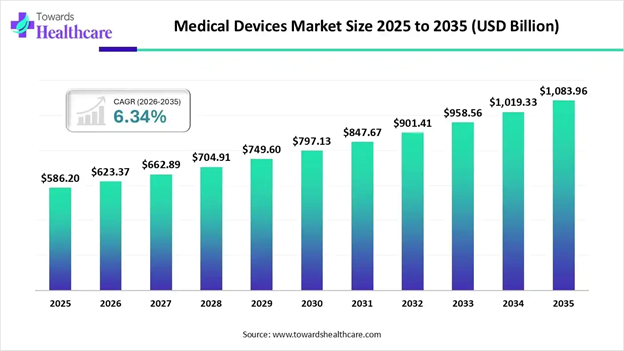
According to Towards Healthcare, the global medical devices market size is calculated at USD 586.20 billion in 2025, grew to USD 623.37 billion in 2026, and is projected to reach around USD 1083.96 billion by 2035. The market is expanding at a CAGR of 6.34% between 2026 and 2035.
Neuromorphic chips take a different approach. Inspired by the way neurons and synapses process information, these chips use specialized hardware to handle data through neural-inspired circuits. In healthcare, this could enable medical devices to process biological signals faster while using less power.
What Are Neuromorphic Chips?
Neuromorphic chips are specialized processors designed to imitate certain principles of biological neural systems.
Instead of processing information only through conventional sequential computing, neuromorphic hardware can use networks of artificial neurons and synapses that respond to changes in incoming signals.
A simplified architecture can be viewed as:
Sensors → Signal Conditioning → Neuromorphic Processor → Local Decision → Medical System
This approach is particularly interesting for healthcare because many biological signals are continuous, time-dependent, and event-driven.
How Does Neuromorphic Computing Work?
Traditional processors typically perform calculations using a clock-driven architecture. Neuromorphic systems can use spiking neural networks (SNNs), where information is represented through electrical pulses known as spikes.
A neuron-like circuit can remain inactive until an input reaches a specific threshold. It then generates an output spike and passes information to other processing elements.
This event-driven approach means the chip does not necessarily need to process every data point continuously. It can focus computational resources on meaningful changes in the signal.
Technologies Used
Neuromorphic healthcare systems can combine several electronic technologies:
- Spiking Neural Networks (SNNs): Represent information through discrete neural spikes.
- Artificial Neurons: Electronic circuits that replicate selected behaviors of biological neurons.
- Artificial Synapses: Hardware elements that represent connections between neurons.
- Memristors: Non-volatile devices that can be used to model synaptic behavior and perform computation near or within memory.
- Event-Based Sensors: Sensors designed to respond primarily to changes rather than continuously producing conventional data streams.
- Analog and Mixed-Signal Circuits: Help neuromorphic hardware process biological signals efficiently.
- Edge AI Processors: Allow data to be analyzed locally instead of sending every signal to a remote cloud system.
- Low-Power Semiconductor Architectures: Reduce energy consumption during continuous signal processing.
Where Could Neuromorphic Chips Be Used?
One potential application is wearable health monitoring.
A wearable device could continuously observe signals such as movement, heart activity, or other physiological patterns. Instead of transmitting all raw sensor data to another processor, a neuromorphic chip could identify important changes locally.
Neuromorphic systems could also have applications in neuroprosthetics and brain-computer interfaces. Neural signals are naturally time-dependent and can contain complex patterns, making them a potential match for event-driven processing.
Another area is medical imaging and diagnostics, where specialized processors could assist with pattern recognition and signal interpretation. However, the exact benefits depend heavily on the algorithm, hardware architecture, and clinical application.
Why Is This Important for Medical Electronics?
Healthcare devices often need to process data continuously while operating within strict power and size constraints.
A wearable or implantable device cannot simply use a large, power-hungry computing system. It needs efficient electronics that can perform useful computation close to the sensor.
Neuromorphic hardware offers one possible route toward this goal by combining sensing, computation, and AI-oriented processing in a more energy-efficient architecture.
Advantages
- Low-power processing: Event-driven architectures can avoid unnecessary computation.
- Real-time response: Signals can be processed locally as events occur.
- Edge intelligence: Data can be analyzed closer to the patient.
- Reduced data transmission: Devices may transmit selected events instead of continuous raw data.
- Potential for miniaturization: Specialized chips can support compact medical electronics.
- Suitable for temporal signals: Spiking architectures can naturally represent time-dependent information.
Limitations
- Complex hardware design: Neuromorphic systems require specialized architectures.
- Limited standardization: The technology is still developing compared with conventional processors.
- Algorithm conversion: Existing AI models may need modification for neuromorphic hardware.
- Programming challenges: Developing and optimizing spiking neural networks can require specialized expertise.
- Clinical validation: Medical applications require extensive testing before deployment.
- Hardware variability: Emerging devices such as memristors can introduce manufacturing and reliability challenges.
Challenges and Opportunities
Challenges
- Developing reliable neuromorphic semiconductor architectures
- Integrating sensors and processors into compact medical devices
- Ensuring predictable performance across different hardware conditions
- Establishing healthcare-specific standards and validation methods
- Protecting sensitive patient data processed at the edge
- Translating laboratory demonstrations into clinically validated products
Opportunities
- Ultra-low-power wearable health monitoring
- Intelligent medical patches and biosensors
- Real-time neurological signal processing
- Brain-computer interfaces and neuroprosthetics
- Edge AI for continuous patient monitoring
- Faster local analysis of physiological signals
- More autonomous medical electronics
What Could Come Next?
The future of neuromorphic healthcare electronics may not involve replacing conventional CPUs and GPUs entirely. Instead, neuromorphic processors could work alongside traditional computing systems.
A medical device could use conventional electronics for general processing while a neuromorphic chip handles specific event-driven tasks such as biosignal analysis or pattern recognition.
As semiconductor technology, memristive devices, event-based sensors, and spiking neural networks continue to develop, neuromorphic computing could become another important layer in medical electronics.
Source: https://www.towardshealthcare.com/insights/medical-devices-market-sizing
About Author
Payal Rabde is a Healthcare Market Research Analyst at Towards Healthcare Research & Consulting with over 4+ years of experience in pharmaceutical, biotechnology, medical device, and healthcare market research. She holds an MBA in Pharmaceutical-Biotechnology Management and a B.Pharm, specializing in market analysis, forecasting, competitive intelligence, and strategic healthcare insights.
About Towards Healthcare Research and Consulting
Towards Healthcare Research & Consulting is a global strategy consulting firm with a presence in both Canada and India. We provide innovative solutions customized to the healthcare sector, helping business leaders overcome challenges and accelerate growth. We specialize in delivering advanced technological solutions, clinical research services, and powerful data analytics. Our focus is on building meaningful partnerships that foster innovation and deliver actionable insights to drive success in healthcare.