
From aerial systems to underwater vehicles, the next generation of autonomous platforms relies on advanced power solutions to meet demanding operational requirements, says Christian Jonglas, Technical Support Manager at GAIA Converter.
Autonomous and remotely piloted vehicles are transforming the nature of military engagements worldwide. From the smallest Remotely Piloted Aircraft System (RPAS) designed for surveillance through to large underwater vehicles piloted and powered with the help of cable connections, designers are exploring the limits of what sophisticated electronics and computer software can enable.
Powering Diverse Defence Platforms
Systems range from drones piloted by remote control using fibre-optic cable or RF transmissions to fully autonomous vehicles that can identify and pursue targets using a combination of sensor modalities. With tasks that include reconnaissance, logistics, combat support, as well as offensive capabilities, each design will need to support a specific set of actuators to provide motive power and perform its core tasks.
Each use case has implications for the subsystems that provide power to the various motors and electronic controls inside the drone. A smaller RPAS is likely to use a lithium-ion battery for all of its power requirements. To achieve high energy densities, larger vehicles will utilise an internal combustion engine that powers an electrical generator. A larger UUV may receive power through a cable from a host ship or shore-based system, with the option of using an onboard battery if the external power is interrupted. To minimise electrical losses in the cable, the power will usually be supplied at high voltage.
Overcoming Power Challenges in Harsh Environments
A common factor in these designs is the need for power that is stable, reliable, and clean, delivered by circuitry that not only minimises size and weight but which is adapted to the target environment. For example, the cables used to deliver electrical power to UUVs often introduce high levels of inductance and source impedance, which can lead to oscillations in voltage. This can be corrected with power-converter circuitry that matches the impedance. But this is often not found in mass-market converters, as most applications have lower impedance levels.
Another issue that needs to be addressed is dealing with electrical power from the thermal sources used in larger RPAS and land vehicles. The power supplied is often noisy and subject to short interruptions. A converter that provides power to delicate sensors and other electronic controls must filter out noise, sags, and spikes. It may also need to switch from the thermal source to a backup battery in the event of a fuel interruption. Similarly, the power converters in tethered UUVs may need the ability to switch between external and internal power sources.
Even where the vehicle relies on a single battery pack, a power converter needs to handle a wide range of input voltages. As the capabilities of drones increase, designers are moving from packs with comparatively few cells in series, with correspondingly low voltage outputs, to where they are using ten or more cells in series to exploit the higher efficiencies of an increased supply voltage. A multi-cell architecture for an RPAS or UUV may deliver 44V at peak. As its stored energy depletes, the voltage delivered will drop to almost half the maximum. A power converter that can exploit that full range will maximise the useful operating range and life of the drone.
In addition to these requirements, the power converters will need to be both light and compact, which implies the use of high levels of integration and efficient circuit architectures. Underwater operation brings further considerations. Although they will usually be deployed in sealed containers, the modules must be able to withstand high pressures. Designers need to take care to avoid using certain types of components that are unsuitable. Aluminium capacitors present reliability challenges at high pressure levels. Air voids inside the casing can collapse, leading to component failure. Replacement with ceramic or another technology removes this risk.
The compact nature of many uncrewed vehicles can present thermal challenges, with limited opportunities for transferring heat away from the power systems that might need to be placed deep inside the chassis of a vehicle that will experience high levels of fluid or air flow outside. Vibration from propellers and motors can reduce reliability. The use of potting, a technique that GAIA employs extensively, in combination with baseplates of high thermal conductivity, helps address these environmental issues.
There are other effects that are more challenging for the designer to anticipate, but which suppliers, such as GAIA, have considered in their circuit design. For example, common component choices can adversely affect the long-term reliability required for defence applications. Many switched-mode power converters use optocouplers to convey information about changes in output voltage to the pulsewidth-modulation controller, while preserving isolation between electrical domains. The attraction of the optocoupler lies in its relatively low cost and ability to transmit a signal with good linearity. But the optocoupler’s transfer functions drift. The cause is a gradual degradation in the efficiency of the light-emitting diode (LED) that transmits voltage information across the isolation barrier. This drift will ultimately lead to the power converter failing.
Replacing the optocoupler with a magnetic coupler overcomes this reliability problem. In GAIA’s converters, reliability can exceed one million hours, far higher than the several hundred hours of many designs that continue to use optocouplers.
With such a wide range of operating requirements, no single power-converter design can satisfy all of them. There are some commonalities, such as the need for a wide input voltage range, even for systems fed by a single power source. However, some projects will require front-end spike and surge filters, along with hold-up circuitry, to accommodate the characteristics of generators powered by thermal engines, as well as situations where the drone needs to switch between the primary power source and a battery backup. Others may require multiple independent output voltage rails or specific forms of EMI filtering.
Modular Solutions for Defence-Grade Power Systems
Traditionally, designers would be forced to consider using a custom-designed solution to tune the power converter to the precise needs of the application, thereby guaranteeing low overall weight. Thanks to advances in circuit design and architectural improvements, a modular approach provides the means for optimising space, weight, and power (SWaP) for each use case.
A modular architecture provides the developer with the ability to add functions where needed and to comply with key military standards. MIL-Std-1275, for example, requires filtering to protect against voltage transients and EMI. MIL-Std-704 or DO-160 have power hold-up requirements that may demand additional support. To minimise weight and volume but still deliver a high level of hold-up capability, GAIA has used high-voltage internal design in its front-end modules. This allows for a reduction in the size of the tank capacitor that is used as the energy reservoir to compensate for temporary power interruptions.
Similarly, clean power to the rails used by sensor-array circuitry is a crucial consideration in these systems, as it prevents them from being thrown off target by electrical interference. Specifying power converters that can comply with the stringent requirements of MIL-Std-461 will often be a vital aspect of the design process.
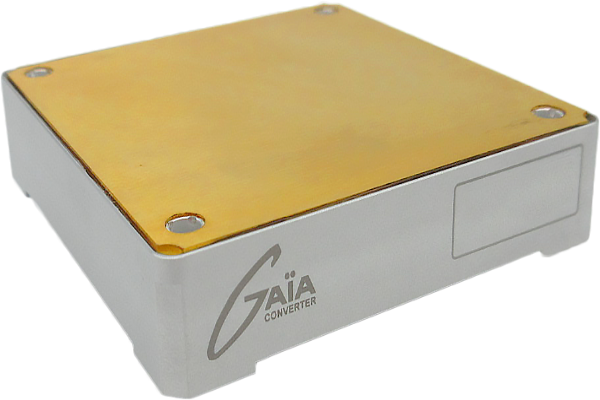
Although they provide flexibility, not all modular solutions offer the characteristics required by defence-grade drones. Many are designed for industrial settings where the input voltage is predictable, though they may function with higher or lower voltage levels. This allows for shortcuts in the design where the highest efficiency is focused on a narrow voltage range. In such designs, efficiency degrades rapidly outside this window. Used in a drone, which can severely limit effective range and operating time. Modules such as those in GAIA’s MGDD series deliver a consistent level of efficiency from 12V to more than 100V. The modules can tolerate surges that may be 50V larger without the use of an external filter, which may limit the need for an external filter in a space-constrained system.
Another feature that helps align with the needs of defence is the ability to alter the core switching frequency of the converter to avoid interference with highly sensitive receivers, such as those needed for radar. Where modules are used in parallel, they can be synchronised to the same frequency to reduce the overall effects of switching noise.
Future developments will enable more compact and capable unmanned vehicles that demand higher density from power converters. GAIA is exploring the use of GaN and SiC in its power converters because of the ability of these materials to support higher switching frequencies and for their improved thermal performance. That, alongside further innovation in circuit design informed by the demands of the defence sector, will help future power converters push the boundaries of what is possible in a domain led by SWaP considerations.