
Overview: A New Investment Priority for Hospitals
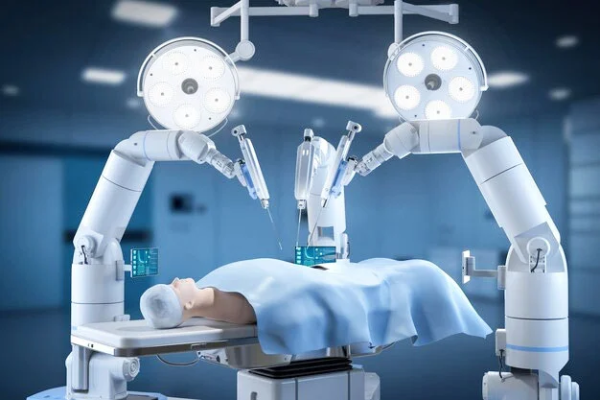
The robotic surgery market is entering a more competitive phase. Hospitals are looking beyond conventional minimally invasive surgery and evaluating robotic systems for complex procedures, improved visualisation, instrument control and operating-room efficiency.
In 2027, opportunities are expected to come from next-generation surgical platforms, AI-assisted procedures, affordable robotic systems and wider adoption across urology, gynaecology, orthopaedics, oncology and general surgery.
The business opportunity extends beyond robot manufacturers. Imaging companies, sensor suppliers, semiconductor manufacturers, software developers and hospital infrastructure providers are also part of this expanding ecosystem.
History of Robotics in Surgery
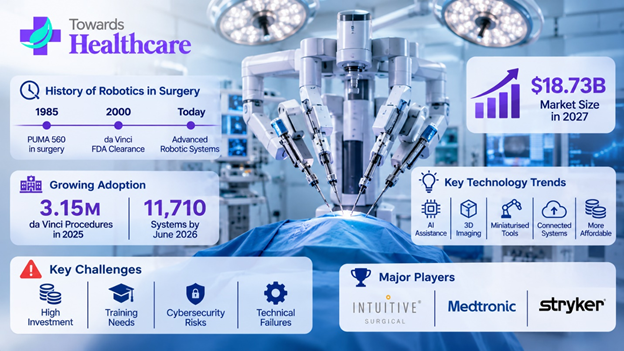
The development of surgical robotics began with computer-assisted systems designed to improve surgical precision. In 1985, the PUMA 560 robotic arm was used in a brain biopsy procedure, demonstrating the potential of robotic assistance in surgery.
The field advanced with systems such as AESOP and ZEUS. In 2000, the FDA cleared Intuitive Surgical’s da Vinci system for general laparoscopic procedures, marking an important milestone in commercial robotic surgery.
Since then, platforms have evolved from basic robotic assistance to sophisticated systems featuring 3D visualisation, wristed instruments, motion scaling and advanced control technologies.
Market Performance and Hospital Adoption
Robotic surgery market will grow USD 18.73 billion in 2027, according to Towards Healthcare.
The growth is visible in real-world procedure volumes. Intuitive Surgical reported approximately 3.15 million da Vinci procedures in 2025, an 18% increase from 2024. Its global da Vinci installed base reached approximately 11,106 systems by December 2025.
By June 2026, the installed base had increased further to 11,710 systems, demonstrating continued hospital demand for robotic-assisted procedures.
India is also becoming an important growth market. Robotic-assisted surgical procedures increased from 8,912 in 2021 to 44,857 in 2025, according to figures reported at the Society of Robotic Surgery India 2026 conference.
These figures indicate growing adoption, but procedure growth does not automatically mean every hospital can afford or effectively utilise a robotic system.
Key Technology Trends Shaping 2027
1. AI-assisted surgical systems: Computer vision can help identify anatomical structures, track instruments and support surgical guidance. AI-based feedback and performance assessment are also attracting research interest.
2. Advanced 3D imaging: High-definition cameras, stereoscopic vision and image-processing processors help surgeons view the surgical field with greater depth perception.
3. Miniaturised robotic instruments: Compact actuators, precision motors and flexible instruments support the development of smaller and more specialised surgical platforms.
4. Connected surgical systems: Device telemetry, cloud-based analytics and digital dashboards can help hospitals monitor equipment utilisation, maintenance requirements and procedure records.
5. More affordable platforms: Competition from emerging manufacturers could create additional purchasing options for hospitals that cannot justify the cost of established systems.
Materials and Technologies Behind Surgical Robots
A surgical robot is a combination of mechanical engineering, electronics, software and medical-grade materials.
- Materials: Stainless steel, titanium alloys and medical-grade polymers are used in structural components, instrument shafts, housings and reusable or disposable accessories. Material selection depends on strength, biocompatibility, sterilisation compatibility and durability.
- Motion systems: Servo motors, actuators, gears and rotary encoders coordinate precise instrument movements.
- Sensors: Force, torque and position sensors provide feedback about instrument movement and mechanical performance.
- Imaging: CMOS image sensors, endoscopic cameras, optical components and image processors support surgical visualisation.
- Computing: Embedded processors, real-time controllers and software coordinate commands, monitor system status and manage safety functions.
The combination of these technologies allows surgeons to control robotic instruments through a console while the system translates their movements into instrument actions.
Challenges and Risks in 2027
High capital investment: Purchasing, installing and maintaining surgical robots requires substantial hospital investment. Smaller hospitals may struggle to achieve enough procedure volume to justify the expense.
Training requirements: Surgeons and operating-room teams need specialised training. A robotic platform cannot deliver consistent results without skilled operators and established clinical workflows.
Cybersecurity and connectivity: Connected systems create risks involving unauthorised access, software vulnerabilities and sensitive surgical data. Hospitals need strict network controls, secure updates and access monitoring.
Technical failures: Sensor errors, software faults, instrument malfunctions and power interruptions can disrupt procedures. Hospitals must maintain validated backup procedures and emergency conversion protocols.
Uneven clinical benefits: Better visualisation and instrument control do not guarantee improved outcomes in every procedure. Hospitals must evaluate clinical evidence rather than relying only on manufacturers’ claims.
Will Robots Replace Surgeons?
Not in the foreseeable future. Today’s mainstream robotic-assisted surgical systems are controlled directly by trained surgeons. They translate the surgeon’s hand movements into instrument movements rather than independently deciding how to perform an operation.
The FDA explicitly states that these systems cannot perform surgery without direct human control.
AI may increasingly assist with image recognition, surgical planning, instrument tracking and selected repetitive tasks. However, clinical judgement, unexpected complications and responsibility for patient care still require human expertise.
Research into autonomous surgery is progressing, but complex soft-tissue procedures remain a significant technical and clinical challenge.
Opportunities and Risk Management for 2027
For hospitals, the opportunity lies in selecting systems that match their surgical specialities, procedure volumes, budgets and infrastructure. Utilisation tracking, surgeon training and lifecycle-cost analysis can help protect investment.
For manufacturers, developing modular platforms, reliable instruments, better imaging and affordable systems could open opportunities in emerging healthcare markets.
For technology companies, there is room in AI software, surgical data analytics, cybersecurity, sensor technology and predictive maintenance. These suppliers can participate in the robotic surgery ecosystem without manufacturing an entire surgical robot.
The biggest risks can be addressed through clinical validation, regulatory compliance, cybersecurity testing, preventive maintenance, staff training and clear emergency protocols.
By 2027, the robotic surgery market will be shaped not only by the number of robots sold, but also by how effectively hospitals integrate them into clinical practice. Affordability, surgeon expertise, system reliability and measurable patient outcomes will influence long-term adoption.
The next competitive advantage will belong to companies that combine reliable surgical hardware, intelligent software and practical hospital integration.
Source: https://www.towardshealthcare.com/insights/robotic-surgery-market-sizing
About Author
Payal Rabde is a Healthcare Market Research Analyst at Towards Healthcare Research & Consulting with over 4+ years of experience in pharmaceutical, biotechnology, medical device, and healthcare market research. She holds an MBA in Pharmaceutical-Biotechnology Management and a B.Pharm, specializing in market analysis, forecasting, competitive intelligence, and strategic healthcare insights.
About Towards Healthcare Research and Consulting
Towards Healthcare Research & Consulting is a global strategy consulting firm with a presence in both Canada and India. We provide innovative solutions customized to the healthcare sector, helping business leaders overcome challenges and accelerate growth. We specialize in delivering advanced technological solutions, clinical research services, and powerful data analytics. Our focus is on building meaningful partnerships that foster innovation and deliver actionable insights to drive success in healthcare.