
The automotive industry is currently undergoing a significant transformation, shifting from internal combustion engine vehicles toward electrification, connectivity, and enhanced intelligence. This transition is driving the development of next-generation vehicle designs, including software-defined vehicles, and reshaping existing electrical/electronic (E/E) systems and power architectures.
This article provides an overview of the evolution and comparison of 12V, 24V, and 48V automotive electrical systems. It examines the progression from early 6V batteries to advanced 48V systems featured in mild hybrids and electric vehicles. The discussion highlights key advantages of 48V systems, including reduced wiring weight and improved efficiency, while also addressing technical challenges related to electromagnetic compatibility, arcing prevention, and standards for transient surge protection.
Introduction
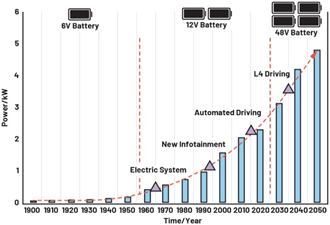
Early vehicles relied on a magneto for engine ignition and gas-powered headlights rather than a dedicated battery-based electrical system. The 6V batteries were adopted in the electrical system of vehicles from the 1920s to the 1950s.1 Since more vehicles were equipped with higher horsepower and compression ratio engines, the 6V batteries cannot provide enough cranking power and meet the growing power demands of the electrical/electronic (E/E) system. Since the 1950s, the 12V system has been the standard in the automotive industry.2 In the 2010s, the 48V mild-hybrid systems were used in hybrid powertrains for the improvement of performance and efficiency, which can achieve regenerative braking.3 Following the industry transition toward higher-voltage architectures, a fully integrated 48V electrical system was introduced in 2023.4
12V, 24V, and 48V Batteries in Vehicles
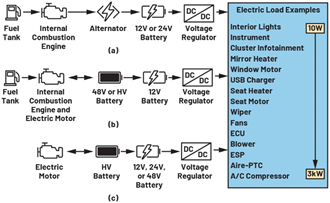
Automotive electrical systems commonly utilize 12V, 24V, and 48V batteries. The 12V battery is predominantly found in passenger vehicles, while 24V batteries are typically employed in heavy-duty trucks and commercial vehicles. In contrast, 48V batteries are used in mild-hybrid vehicles and for powering small electric motors. Currently, 48V batteries also serve as auxiliary power sources in electric vehicles.
Figure 1 illustrates a simplified electric powertrain architecture. Conventional vehicles, also referred to as internal combustion engine vehicles, utilize an alternator to recharge the auxiliary battery. In contrast, hybrid vehicles supply charge to the auxiliary battery through either a 48V or high-voltage (HV, defined as ≥200V) battery. Hybrid models equipped with 48V primary batteries are commonly designated as mild hybrids. Plug-in hybrid vehicles incorporate an HV battery and feature on-board charging capabilities. Vehicles powered exclusively by HV batteries are classified as battery electric vehicles (BEVs).
Advancements and Challenges in Automotive Electrical Systems
Innovations within the automotive industry have played a pivotal role in driving vehicle performance forward, elevating in-cabin comfort, and establishing higher safety standards. One prominent development has been the introduction of hybrid vehicles, which are designed to lower fuel consumption and boost overall efficiency. The integration of high-resolution displays with advanced cockpit platforms has significantly improved user interfaces, offering drivers and passengers a richer and more intuitive in-cabin experience.
Furthermore, advancements in autonomous driving, including the integration of radar and camera systems, have enhanced both safety and the overall driving experience. The ongoing addition of sensors, high-performance system-on-chip (SoC) platforms, computing units, and various electronic modules continues to refine driving dynamics and safety features. However, these technological enhancements also bring about new challenges for automotive power systems, as they increase the demands placed on electrical infrastructure.
Limitations of the Conventional 12V System
Historically, rising electrical demands drove the transition from 6V to 12V systems; today, similar trends are again pushing the limits of 12V architectures. This is largely attributed to the rapid expansion of autonomous driving technologies and the growing emphasis on vehicle connectivity. The rise in the number of electronic control units (ECUs), sensors, infotainment modules, and safety systems has resulted in a substantial increase in overall power demand. Consequently, the automotive engineering landscape faces a range of new challenges, while also presenting opportunities for further innovation.
Due to these technological advancements and the proliferation of power-hungry components, the low-voltage power requirements in modern vehicles now span a range from 1.2kW to 4kW.5 This progression is depicted in Figure 2, which illustrates the evolution of low-voltage power demands in automotive applications.
48V System Benefits
The 48V system is particularly well-suited for modern electrical architecture that addresses increasing power demands by replacing traditional mechanical and hydraulic systems, such as steer-by-wire (2kW) and brake-by-wire (2kW) technologies. Compared to conventional steering and braking mechanisms, steer-by-wire and brake-by-wire systems offer enhanced comfort, safety, and agility. Additionally, these advanced electrical systems reduce both cabin space requirements and vehicle weight, enabling greater flexibility in interior design and contributing to improved fuel efficiency. Furthermore, the new electrical systems can respond rapidly and accurately to driver control inputs.
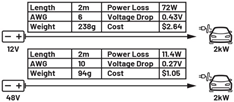
As the demand for electrical power continues to increase, adopting a 48V E/E system presents notable benefits. One of the primary advantages of the 48V E/E system is its ability to significantly reduce current compared to a traditional 12V system. With the current reduced to one-fourth, both the weight of the wiring harness and the dimensions of the printed circuit board (PCB) are minimized. Additionally, power loss across the wire harness is decreased, as thinner wires with lower resistance and reduced current flow result in improved efficiency.
According to specifications outlined by the American Wire Gauge (AWG) system,5–6 Figure 3 provides a general comparison between 12V and 48V wire harnesses. In addition to considering maximum power transmission, it is important that the voltage drop due to wire resistance remains below 3%. This means wire resistance is more critical for 12V systems than for 48V systems. Using copper’s density (8.96g/cm³) and cost ($11.11/kg), the weight and price of the wires can be readily calculated.
48V System Challenges
The design challenges of 48V systems at the power management IC level include electromagnetic compatibility (EMC), arcing prevention, and voltage surges.
Electromagnetic Compatibility
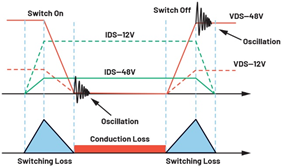
The transient voltage (dv/dt) and current (di/dt) produced during hard switching negatively impact the EMC of switching regulators. Electromagnetic interference (EMI) can be divided into differential-mode and common-mode noise: the former is primarily due to parasitic inductance and transient currents, while the latter stems mainly from parasitic capacitance and transient voltages. As illustrated in Figure 4, the process of turning semiconductor devices on and off creates both transient voltages and currents, as well as power dissipation. When comparing 12V and 48V systems, the 48V system exhibits a higher dv/dt, whereas the 12V system displays a higher di/dt. Although conduction losses are greater in the 12V system, the 48V system experiences significantly higher switching losses, resulting in increased parasitic energy during switching. This can cause oscillations with greater amplitude at the switching node, thereby impacting EMI.
Clearance and Creepage
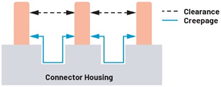
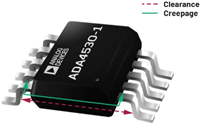
Mitigating arcing phenomena in 48V automotive electrical architectures necessitates strict adherence to advanced insulation, mechanical, and environmental design standards that surpass those applied to traditional 12V systems. The increased voltage elevates the risk of sustained electrical arcing due to higher electric field intensity, with arc temperatures potentially reaching several thousand degrees Celsius, which can accelerate the degradation of terminals, plating layers, and connector housings. To preserve system reliability, connector solutions must be designed with precisely defined creepage and clearance distances, as specified by IEC 60664-1 and related low-voltage transportation standards, to prevent discharge across insulating surfaces or through air under both standard and contaminated conditions. Furthermore, adopting 48V systems in automotive applications also heightens creepage and clearance requirements for ICs, PCBs, and other components, which prevents unintended current flow between conductors. Figure 5 illustrates the creepage and clearance paths within the connector. Figure 6 shows the creepage and clearance paths within the IC.
Transient Surges
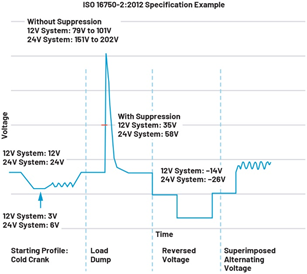
In automotive systems, addressing transient surges is crucial to safeguard sensitive semiconductor components. Two key standards for 12V and 24V systems—ISO 7637-2 and ISO 16750-2—define protection requirements against such surges.11 Figure 7 illustrates the waveform of test pulses applied to the 12V and 24V power rails under ISO 16750-2 specifications. Typically, transient voltage suppressors (TVS) are employed to limit the 12V power rail to 35V and the 24V power rail to 58V.
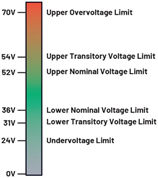
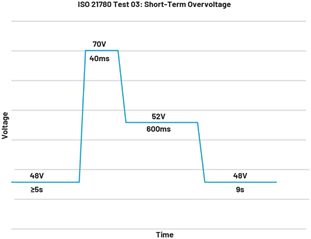
ISO 21780 defines the 48V power rail voltage range, requiring overvoltage tolerance up to 70V, though switching transients can exceed this level. Figure 8 illustrates the voltage range, while Figure 9 shows the short-term overvoltage profile.
Conclusion
The implementation of 48V systems offers several benefits, including reduced cost and weight of wire harnesses as well as enhanced high-power capability. Nevertheless, challenges related to EMC, arcing prevention, and voltage surges remain areas of concern. With the introduction of advanced features in software-defined vehicles, OEMs must strategically determine their approach for transitioning to 48V architectures.
References
1“From Horsepower to Battery Power: The Journey of the Car Battery.” GTK Marine Power.
2“The Evolution of the Automotive Battery.” Clore Automotive.
3Nick Goodnight, “The Evolution of the Automotive Battery.” Clore Automotive.” CDX Learning Systems, April 2023.
4Mark Kane. “Great for the Industry’: Ford, Others Get Tesla Cybertruck 48V System Specs.” Motorsport Network, December 2023.
5Chinmaya Joshi. “Shrink the 12V Battery By Half and Maintain Cold Crank?” Vicor, 2022.
6K. Seifert. “How to Make the Leap to 48V Electrical Architectures.” Aptiv, 2023.
7Noa Margolin. “BEVs Have a Weight Problem That Can’t Be Solved with Traditional Approaches.” Vicor Corporation, November 2023.
8Dr. Thorsten Huck, Dr. Andreas Achtzehn, Dr. Felix Hoos, Alexander Fuchs, Jonas Stüble, Dr. Tobias T. Traub, Vasileios Kourtidis, Manuel Eder, and Dr. Karsten Wehefritz. “Gear Up Vehicle Powernets for Future Mobility.” Robert Bosch GmbH.
9“How to Select the Right Wire for Automotive Applications.” OGA, May 2022.
10“Wire Gauge and Current Limits Including Skin Depth and Tensile Strength.” PowerStream Technology, April 2023.
11Dan Eddleman. “LTspice: Models of ISO 7637-2 & ISO 16750-2 Transients.” Analog Devices, Inc., April 2017.
About the Author
Yujie Bai is a staff applications engineer at Analog Devices and is responsible for support and application of automotive power products. Yujie joined Maxim Integrated (now part of Analog Devices) in 2020 and holds a master’s degree in electrical engineering from Miami University (Ohio).