
Abstract
Advances in patient safety and surgical outcomes have evolved surgical tools from basic implements to intelligent devices that assist surgeons. Integrating sensors, actuators, or noise-free power into next-generation tools is challenging, especially in constrained spaces while ensuring safety and authenticity. Analog Devices is constantly investigating and developing technology that pushes the boundaries of physics to enable customers to tackle these hard problems. This article discusses some of these technologies and how to design the next best surgical tool.
Introduction
Today, there is a better understanding of medicine and access to sophisticated tools to treat diseases with more success than ever. Surgical interventions save countless lives each year, and smart surgical tools enable doctors to successfully perform these surgeries.
In modern medicine, surgery is often necessary to remove, repair, and reconstruct tissue to cure diseases. Multi-disciplinary research and technology have brought about sophisticated surgical tools to perform these functions, often specific to surgery and indication. This article discusses some of the latest advancements in semiconductor technology that enable safer, smarter, and smaller surgical tools.
Leverage Sensors in Surgery
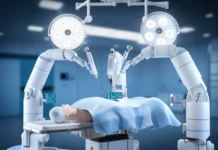
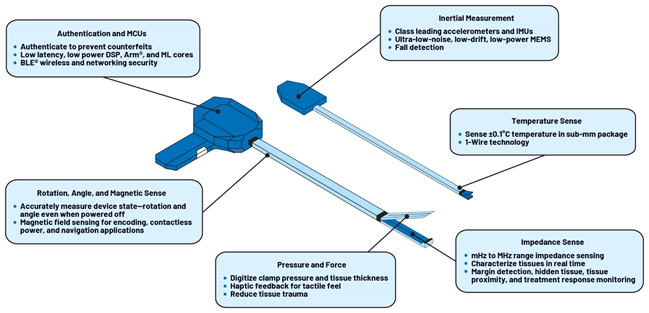
Analog Devices manufactures several sensors and sensor front ends to solve application needs (see Figure 1). Within the context of an operating room (OR), a sensor can be used for different purposes, such as lighting control or surgical tool location. Surgical tools use sensors to enable, monitor, and/or verify treatment. Sensors can also be used in surgical robots or telemanipulators to fine-tune movements and implement safety protocols. Additionally, sensors can be used to provide real-time feedback and enhance the senses of the surgeon/machine, such as providing insight into the state of tissue health.
Sensors for Surgical Tooling
An accurate temperature sensor can be vital in a surgical tool in many situations. In tools that deliver therapeutic heating or cooling, a temperature sensor can be utilized to verify that treatment was successful. In other cases, it can be used as a watchdog to monitor equipment malfunctions. In either of these situations, having high accuracy impacts patient safety. ADI temperature sensors and temperature analog front ends (AFEs) enable accurate, precise measurements for better patient outcomes.
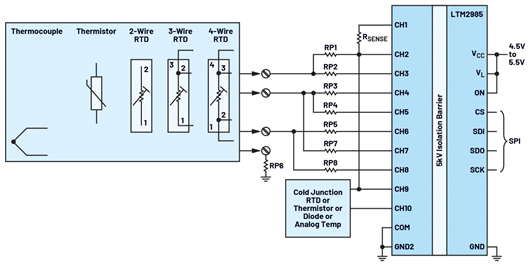
Integrated sensors such as the MAX30210, or its 1-Wire cousin, the MAX30207, allow direct temperature digitization at ±0.1°C accuracy. The LTM2985 allows a designer to connect virtually any standard (Type B, E, J, K, N, S, R, T) or custom thermocouple and achieve ±0.1°C accuracy with ±0.001°C resolution (Figure 2). In addition, it has 5000V rms isolated power, an SPI interface with 50Hz/60Hz rejection, and on-chip EEPROM for configuration and coefficients. No matter what temperature or resolution your application requires, ADI has you covered.
Accelerometers and gyroscopes are relatively easy devices to integrate into a surgical tool and can be used in a variety of ways. They can be used for sterile user inputs such as taps/double taps, detecting damage during shipping to prevent damaged equipment use, to trace liability in malfunction situations, for gesture recognition, for power savings, and more.
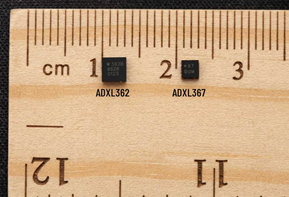
With innovations in MEMS technology, ADI offers accelerometers such as the ADXL362 or the even smaller ADXL367 (see Figure 3). The ADXL367 has high-resolution 0.25mg/LSB, low-noise 170μg/√ Hz, and can be operated with just 0.89μA. The standby mode and motion-activated mode power consumption are even lower at just 40nA and 180nA, respectively. The diminutive 2.2mm × 2.3mm package enables mounting in the most space-constrained designs.
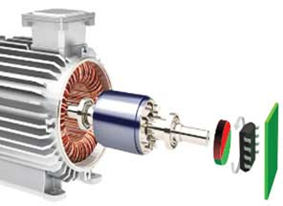
In mechanical devices like surgical staplers that require absolute angular or rotary feedback, magnetoresistive sensors are a great fit. The ADA4571 or ADA4571-2 offer ±0.1° angular accuracy, which can be incorporated into a system that allows for extremely accurate rotary encoding. Their operating principles allow them to be independent of physical placement (the air gap), hence allowing for a higher degree of design flexibility (see Figure 4).
Sensors for Robots and for OR Automation
“What if we had the power to be powerless?” is the question our engineers asked when building the ADI MagIC™ breakthrough multiturn sensing technology.1 With three sensor elements using both giant magnetoresistive (GMR) and anisotropic magnetoresistive (AMR) technologies, the ADMT4000 is the first product of its kind to achieve ±0.25° accuracy with up to 46 turns.
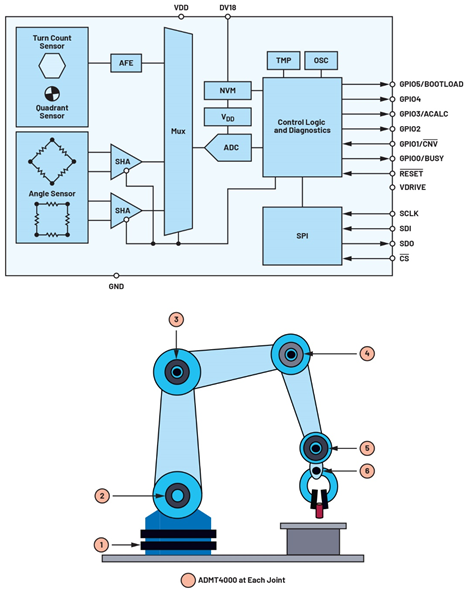
In surgical robots and other OR automation technologies, absolute encoding is a vital necessity for accurate motion control. The ADMT4000 keeps count of the turns and angles even without power (see Figure 5). This allows tracking rotary joints without power in situations like transport from one OR to another, storage and boot-up, or even in unexpected power outage situations.
Inertial measurement units (IMUs) offer great advantages in designing robotic kinematics systems, allowing verification and redundancy to rotary joint encoding. With industry-leading iMEMS processes, ADI offers IMUs that reliably sense and process multiple degrees of freedom that include full factory calibration, embedded compensation, and sensor processing. IMUs range from the miniature ADIS16470 44-ball, 11mm × 15mm × 11mm BGA module that allows for simple assembly, to the autonomous grade ADIS16550 with 1°/hr in-run bias stability that allows for extreme drift resistance.
In telesurgery systems where the surgeon at the console is separate from the patient cart, the surgeon typically doesn’t receive feedback on the amount of force they are applying to tis-sue. Force, pressure, and torque measurements can be used to fill this haptic gap by providing force feedback to the surgeon’s controls. In applications like surgical stapling, force can act as useful feedback in selecting stapling parameters.
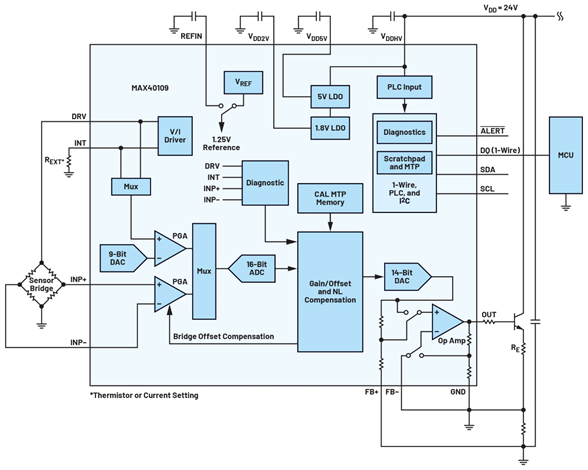
The MAX40109 is a highly integrated force/pressure sensor AFE that can connect to a variety of common load sensor types, offering a choice of analog or digital output (Figure 6). It incorporates 1-Wire and power line communication (PLC) interfaces and built-in zero-pressure offset compensation to skip laser trimming of resistors during calibration in the manufacturing process. It includes built-in calibration memory with third-order polynomial for temperature compensation, which it can optionally measure directly from the resistive bridge. It is a versatile IC offered in an optional wafer-level package that measures 1.988mm × 1.988mm.
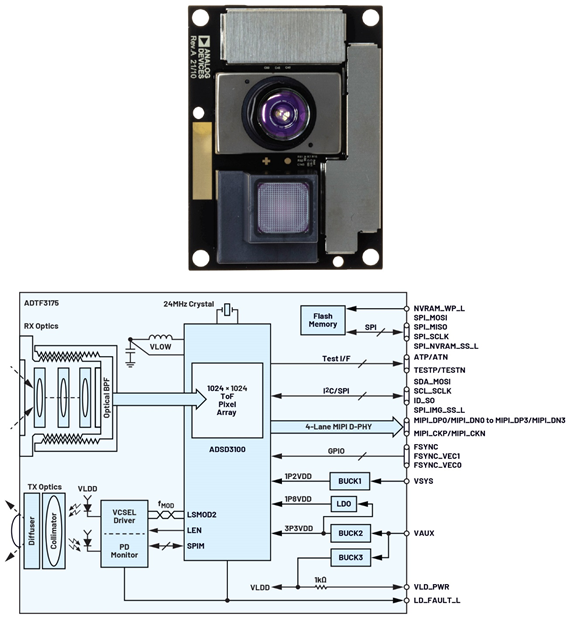
A robotic system with perception of the world around is more flexible and safer than a system without awareness of its surroundings. The ADTF3175 is a time-of-flight (TOF) module that provides 3D perception with ±5mm depth accuracy across a full range of 0.4m to 4m: an excellent fit for OR applications (see Figure 7).
Sensors for the Surgeon
The passive electrical properties of tissues that change with frequency can be investigated with an impedance analyzer or an inductor-capacitor-resistor (LCR) meter. Impedance analyzers are typically LCR meters capable of measuring a wide range of frequencies. ADI makes impedance analyzers at an IC scale as well as a module scale. The IC scale impedance analyzers such as the AD5940 or the MAX300xx family are compact in size, enabling them to be placed closer to the measurement site, avoiding parasitics that a long cable connection is prone to. The module scale impedance analyzers like the AD-IMP2501-SL or the ADMX2001 are larger replacements with rich features and the ability to measure higher frequencies, up to 1.5MHz and 10MHz, respectively. These compact modules can be used for initial experimental feedback, as reference designs, or, in some cases, integrated directly into equipment for faster prototyping.
Impedance sensing requires a wet or dry electrical contact to the tissue of interest, allowing one to easily integrate with existing surgical tools without a specialized transducer. Electrical impedance spectroscopy (EIS) provides intraoperative feedback to the surgeon during an operation on the tissue the surgical tool is touching. Such feedback can be in the form of tissue identification, disease identification, lesion margin sensing, orientation of surgical tool, or performing tissue proximity sensing.
Impedance is just an example modality. Other modalities such as temperature, tissue deformation, or intra-operative imaging all offer useful insight into tissue for the surgeons.
Safely Measure Accurate Data
More sensors mean more data to be measured, translated, processed, and protected. ADI provides the technology required for full signal chain integration.
Digitize High-Resolution Data Faster
Today’s surgical systems rely on accurate sensor measurements to close control loops and provide real-time feedback to surgeons. The AD7771 8-channel, 24-bit ADC offers simultaneous sampling for multiple sensor inputs. With 24-bit resolution and low-noise performance, it can detect the smallest changes in sensor readings that may be critical in surgical procedures.
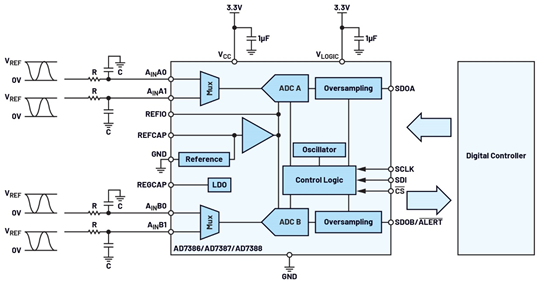
For signal chains requiring faster sampling rates, the AD7386 4-channel, 4MSPS ADC provides the speed necessary for real-time control loops such as high-frequency impedance measurements or motion control position feedback (see Figure 8). Its simultaneous sampling architecture ensures that multiple sensor or positional inputs are synchronized, allowing for accurate spatial data during tool or tissue manipulation.
Isolated Converters for Patient Safety
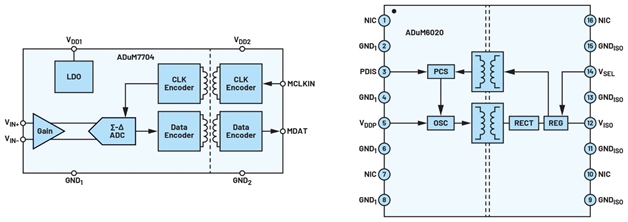
Almost all surgical applications require isolation to protect the patient and the system’s integrated sensors. The ADuM7704 isolated ADC (see Figure 9) provides 16-bit resolution, data rates up to 21MHz, and operates from 4.5V to 20V. This allows designers to place ADCs close to sensors where signal integrity is highest, while safely sending digital data back to the controller. The 5kV rms isolation rating can help eliminate costly or bulky isolation components in certain application spaces.
The ADuM6020 isolated DC-to-DC converter and data isolator integrates power and signal isolation in a single package (see Figure 9). By providing both isolated power (up to 0.5W) and isolated digital communication channels, it enables isolation without the complexity of traditional isolation transformers and optocouplers. This can be valuable in handheld surgical instruments or other systems where size and weight are a concern.
Simply Move with Precision
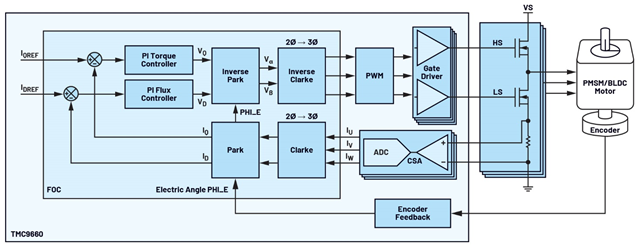
Surgical robots require precise, repeatable motion across multiple axes to safely manipulate instruments within and around the human body. The TMC9660 70V gate driver, with field-oriented control (FOC), enables motor control algorithms that deliver accurate movements for difficult surgical procedures (Figure 10). Its high voltage capability allows it to drive most motors required by surgical instruments, while FOC algorithms provide torque control during sensitive movements.
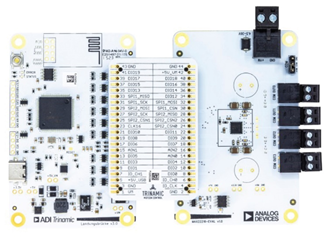
For valve control, actuated tool functions, or emergency relays, the MAX22216 and MAX222xx family of solenoid drivers offer integrated current control and diagnostics. These drivers enable designers to build smarter surgical instruments that can detect mechanical failures, verify successful actuation, and provide feedback to the control system. The integrated package and safety components provide more advanced features in less space than most traditional discrete implementations. The MAX22216EVKIT allows customers to start development with little to no design time and provides them the flexibility to evaluate all the MAX22216 has to offer (Figure 11).
In minimally invasive surgical robots where space is becoming more of a premium, the LT8418 half-bridge gallium nitride (GaN) driver allows for smaller and more efficient designs. GaN devices switch faster with greater efficiency than traditional MOSFETs, allowing for reduced magnetic components and heat sinks. This translates directly to smaller, lighter surgical instruments that can access more confined surgical locations, while maintaining the power needed for surgical robotic motion control.
Implement Efficient Power Compactly
As surgical devices become more complex, integrating more sensors into smaller systems, delivering efficient power in a minimal space becomes a priority.
The LTM4644 μModule regulator transforms power supply design for surgical devices by integrating the switching controller, FETs, inductor, and passives into a single package. This 4-output, low-voltage regulator can deliver multiple supply rails from 5.5V down to 0.6V for all sensor and processing needs, measuring just 9mm × 15mm × 5mm (see Figure 12).
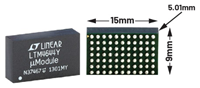
The space savings enable designers to reduce board area and include more features. Its integrated design eliminates many common electromagnetic interference (EMI) issues that affect traditional switching regulators, reducing the risk of noise and interference on sensitive analog signals. The module’s thermal design efficiently dissipates heat, allowing up to 5.5W dissipation with no heat sink. The compact, integrated nature of μModule regulators from ADI enables entirely new form factors for surgical devices.
Protect Patients, Protect Business
Protecting companies and customers from counterfeit devices and device maltreatment has also become a major concern.
Counterfeit medical devices pose risks to patient safety and hospital operations. Counterfeit or refurbished surgical tools may fail unexpectedly during procedures or may not meet performance specifications.
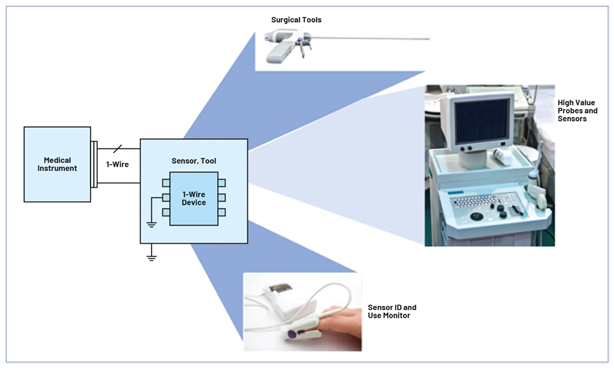
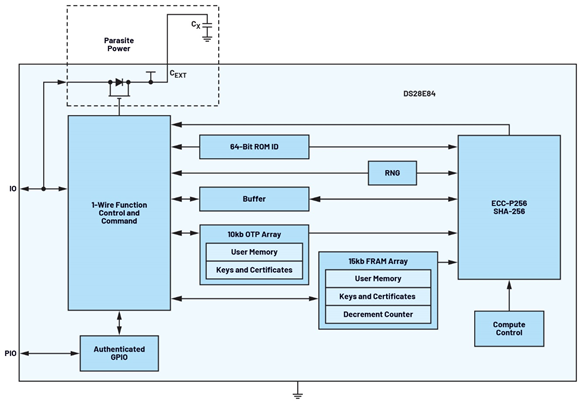
The DS28E family of secure authenticators provides hardware-based authentication that enables medical device manufacturers to protect their products, their brand, and their patients (Figure 13). These devices use cryptographic algorithms and secure key storage to create protected digital signatures that verify the authenticity of surgical instruments, disposable components, and consumables. DS28E parts simplify implementation through the 1-Wire interface, which enables communication over long cables or through mechanical connectors. These secure parts can be used to track usage cycles for surgical instruments that may require calibration or replacement after a specific number of procedures. Secure memory storage devices like the DS28E36 or DS28E84 with radiation tolerance can hold calibration data, manufacturing information, or device-specific parameters that enable specific surgical tool behavior (Figure 14). From consumables to battery packs to the tools themselves that integrate into the capital equipment, the DS28E family of authenticators can help protect precision surgical equipment.
Conclusion
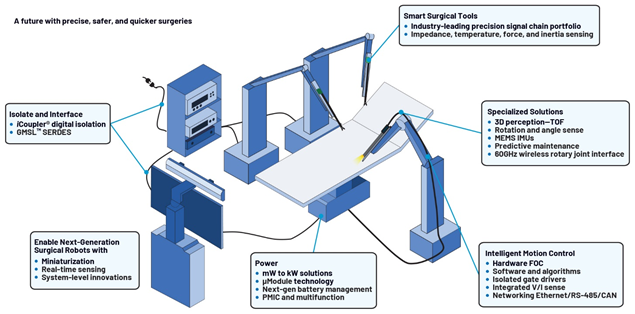
Integrating motion control, isolation, compact power solutions, and hardware security with an increased number of sensors can help designers create products that are not only smarter, smaller, and more efficient, but also protected. These advanced technologies from ADI help customers design surgical devices that improve patient outcomes. The technologies presented in this article highlight some of the best recommendations in ADI’s portfolio, but there is even more ADI can offer in the surgical application space (see Figure 15). Explore our website or reach out to your local expert to see how ADI can assist with your next great challenge.
Reference
1ADI MagIC+. Analog Devices, June 2022.
About the Authors
Ben Ferrara is part of Analog Devices’ Healthcare Business Unit and works on applying semiconductor technologies to surgical devices. Ben has a bachelor’s degree from Northeastern University in electrical engineering and has 15 years of experience in designing electronic systems.
Harsha Devaraj is part of Analog Devices’ Healthcare Business Unit and works on applying semiconductor technologies to surgical devices. Harsha has a doctoral degree from Dartmouth College in engineering sciences and has 5+ years of experience working on intra-operative surgical sensing. He is passionate about translational clinical research toward improving patient outcomes.