
A few years ago, manufacturing discussions were largely centred on output metrics—How many pieces per hour can we produce? How many additional lines can we install? Scale was often viewed through the narrow lens of capacity expansion and volume growth.
Today, that perspective has evolved significantly. As manufacturing becomes more complex and globally integrated, business leaders are asking deeper, more strategic questions: How do we ensure consistent quality across shifts, sites, and skill levels? How do we reduce changeover time while managing increasing product customization and shorter life cycles? How do we meet stringent global requirements for traceability, compliance, and reliability? How do we optimise energy consumption and control costs in an environment of rising volatility?
Underlying all of these questions is a defining leadership challenge for modern manufacturing: How do we scale operations in a way that is sustainable—protecting performance, safeguarding quality, and most importantly, enabling the people who make manufacturing possible?
This shift in thinking is precisely why Industry 5.0 is gaining relevance—and why human–robot collaboration is emerging as a decisive advantage for Indian manufacturing as we move toward 2026.
Industry 5.0: From Automation to Architecture
Industry 5.0 is often described as the successor to Industry 4.0, but in reality, it represents a deeper recalibration. Industry 4.0 helped us connect machines, digitise processes, and use data to drive efficiency. It brought intelligence and visibility to the shop floor.
Industry 5.0 builds on that foundation, but it moves beyond component-level automation. It represents a shift from isolated automation blocks to well-designed system architecture, where machines, software, energy systems, and people operate as one cohesive ecosystem.
This approach is guided by three principles that are becoming non-negotiable for modern manufacturing: human-centricity, resilience, and sustainability.
Globally, this transition is already underway. In 2024 alone, more than 540,000 industrial robots were installed worldwide, taking the global installed base beyond 4.6 million units. What is notable is not just the scale, but the intent—manufacturers are increasingly automating to improve consistency, safety, and resilience, not merely output.
The factories that will succeed in the next phase will not be those with the highest number of robots, but those that architect automation systems that complement human skill and judgement.
Why Human–Robot Collaboration Matters for India
India’s manufacturing ecosystem is fundamentally different from many developed markets. We operate at massive scale, but with extraordinary diversity—large export-oriented plants, fast-growing mid-sized manufacturers, and MSMEs that must remain agile under tight constraints.
This is precisely why human–robot collaboration resonates so strongly in the Indian context.
India today ranks among the top six countries globally in annual industrial robot installations, with over 9,000 robots deployed in factories in the last reported year. At the same time, robot density in India remains significantly lower than in advanced manufacturing economies.
This gap is not a weakness—it is an opportunity. It signals that India’s automation journey is still in its expansion phase, where flexible, collaborative, and scalable automation models are far better suited than rigid, capital-intensive approaches.
2026: Growth Is Assured. Consistency Is the Real Test.
There is no shortage of optimism around India’s manufacturing growth. Electronics, electrical equipment, automotive, machine tools, and emerging sectors such as semiconductors are all witnessing strong investment momentum.
India’s industrial automation market is expected to grow at around 14% CAGR, nearly doubling in value over the next five years as manufacturers invest in digitisation, efficiency, and global competitiveness.
However, growth alone will not define success in 2026.
The real test will be repeatable performance—the ability to deliver consistent quality, uptime, traceability, and compliance at scale. Global customers are no longer evaluating suppliers only on cost or capacity; they are evaluating reliability and resilience across entire production systems.
Human–robot collaboration directly supports this requirement by combining machine precision with human adaptability, while integrated automation platforms ensure that performance is sustained across the full production lifecycle.
What Collaboration Looks Like on the Shop Floor
In practical terms, collaboration begins with identifying tasks that are repetitive, fatigue-prone, or highly sensitive to variation—areas where quality losses and rework typically originate.
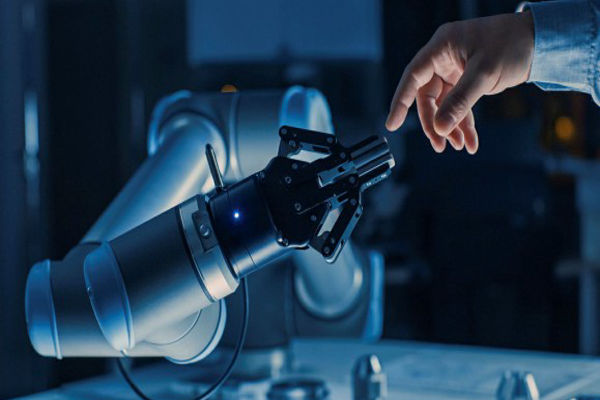
Collaborative robots are increasingly used for pick-and-place operations, precision dispensing, and repetitive assembly, while operators focus on inspection, adjustment, and exception handling. This enables faster adoption without major disruption to existing workflows.
More importantly, true collaboration does not stop at robotics. It extends across the automation stack—PLCs, motion control, energy-efficient drives, servo systems, robotics, SCADA/MES platforms, and IIoT systems—working together as an integrated architecture rather than siloed solutions.
This end-to-end integration delivers stability, real-time visibility, and actionable insights, allowing manufacturers to manage complexity without increasing operational risk.
Workforce Enablement: The Cornerstone of Industry 5.0
One of the most critical—and often underestimated—dimensions of Industry 5.0 is workforce enablement.
India’s electronics manufacturing sector alone employs over 2.5 million people, underscoring the scale of human capital involved in this transformation. Automation in this context is not about replacement; it is about capability building.
Training and upskilling—across customers, system integrators, and channel partners—are essential to ensuring that advanced automation systems are adopted, operated, and sustained effectively. As systems become more integrated, the skills required also evolve—from machine operation to system understanding and process optimization.
The operator of 2026 is no longer a machine handler, but a process owner—supported by intuitive systems, guided by data, and empowered to make informed decisions.
A Practical Blueprint for Manufacturers
Based on what I see consistently delivering results across factories, four principles stand out:
- Automate bottlenecks, not entire factories
- Build visibility before sophistication
- Design for safe, intuitive human–machine collaboration
- Treat energy as a core production variable, not an overhead
Together, these principles help manufacturers transition from fragmented automation to resilient, scalable system architectures.
The Way Forward
India’s manufacturing future will not be defined by automation alone. It will be defined by how intelligently technology is integrated with human capability.
Industry 5.0 is not about creating darker factories. It is about creating smarter ones—factories where machines deliver consistency, systems provide intelligence, energy is optimised by design, and people drive progress.
That is the blueprint that will power India’s manufacturing boom in 2026 and beyond.