The Intelligence Revolution on the Edge of Connectivity
Imagine yourself navigating through a city where the traffic lights adapt themselves on the go, mitigating any form of congestion that arises. Here, self-driving buses continuously talk to the road network, whereas smart buildings regulate their energy consumption according to the weather forecasts and occupancy. At a hospital located elsewhere, the patients’ vital signs are monitored using wearable technology that alerts the physicians of any anomaly. Also, the equipment in a factory is being predicted of possible failures several days in advance to avoid disruption.
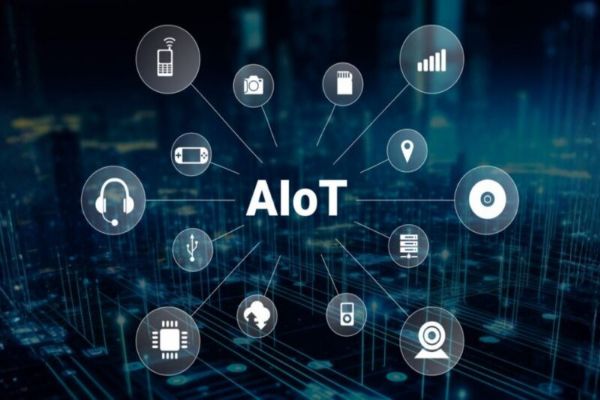
These aren’t scenes of a distant future. These are cases of the technological convergence that is taking place at an unprecedented scale around the world—the convergence of Artificial Intelligence (AI) and the Internet of Things (IoT) into one term called AIoT.
As corporations become more efficient through automation and innovation, AIoT is increasingly proving to be one of the most important technological revolutions in the twenty-first century. It is transforming the way businesses, cities, and people function.
AIoT Understanding
It is important to have a clear understanding of the two main technologies that AIoT combines in order to understand the importance of AIoT.
The Internet of Things is a technology which involves a network of devices equipped with sensors, software, and communications features that gather and share information via the internet and other networks. Smart thermostats, industrial sensors, health wearables, smart cars, and environmental monitoring systems are some examples.
Artificial Intelligence, on the other hand, allows machines to imitate human cognitive functions such as learning, reasoning, identifying patterns, and making decisions.
The convergence of these technologies creates AIoT
In classic IoT systems, machines mostly gather and deliver data. Humans or pre-programmed software then use their judgement to interpret the data. The advantage of AIoT is the introduction of intelligence in the system. It not only gathers data but also interprets the situation, predicts the future occurrences, and takes action.
For instance, while an IoT sensor detects the increase in the temperature of machines in industries, an AIoT system is able to determine whether the increased temperature poses a threat of machine failure in the near future and also schedule maintenance for the machine before the occurrence of any malfunction.
Key Components of AIoT Ecosystem
The efficiency of AIoT lies in the complex ecosystem of connected technologies.
- Sensors and smart devices constitute the basis of this system and can be described as the eyes and ears of AIoT that monitor physical environments, machinery, people, and infrastructure.
- This data is then transmitted via connectivity solutions such as Wi-Fi, Bluetooth, 5G, LPWAN, and satellite communications.
- A crucial technology is edge computing, meaning that data processing is conducted at the edge of networks rather than at distant cloud servers. It helps reduce latency, improves security, and allows for real-time decision making.
- To complement edge computing, cloud computing solutions are used for storing data, conducting analytics, and providing additional computing power.
- Machine learning models are a key part of the AIoT as they are responsible for pattern recognition, anomaly detection, predictive analytics, and optimization.These machine learning models are supported by data analytics platforms.
- Digital twins are another example of an emerging element in which a physical item or process is replicated digitally. Digital twins provide a means for companies to test and analyze situations and performances without interfering with their actual operations.
- Autonomous decision-making systems allow AIoT solutions to act on their own decisions without requiring any human interference.
How AIoT Works: A Sequence of Steps
AIoT’s capacity becomes clear upon reviewing its operational process flow.
- First, data collection takes place as sensors in devices collect relevant information on temperature, pressure, location, movements, energy consumption, or health status.
- Then follows the step of data transmission as information goes through the network to edge devices or cloud systems.
- Data processing happens next, as superfluous or duplicated information is sorted out, cleaned up and structured for further analysis.
- The information processed becomes analyzed by using AI technologies finding patterns, comparing historical data and identifying trends or anomalies.
- The results help make decisions about what needs to be done in a particular situation.
- The decision leads to an automated reaction to the situation, whether it involves changing machine parameters, redirecting traffic, triggering safety procedures, or informing people.
- The last step is learning as new data allows improving accuracy and making better decisions in the future.
Real-World Uses of AIoT
The effects of AIoT are already apparent in many different industries.
- Smart Cities:
Urban areas are employing AIoT in various ways including improving traffic management, enhancing safety, optimizing waste removal, and saving energy. Intelligent traffic systems evaluate traffic conditions and control traffic lights accordingly to minimize congestion.
- Smart Healthcare:
Healthcare facilities deploy wearables, medical equipment, and AI in order to achieve better results for their patients. Health issues can be detected early due to constant monitoring.
- Industrial Automation:
Companies use AIoT systems to keep an eye on their machines, optimize their manufacturing lines, and forecast maintenance needs. Just predictive maintenance can save companies millions of dollars due to prevention of unplanned breakdowns of machines.
- Smart Manufacturing:
Companies implement connected sensors and AI-powered analysis to enhance quality control and efficiency.
- Agriculture & Precision Farming:
Increasingly, agricultural practices depend on AIoT in monitoring crops, irrigation management, pest detection, and yield predictions. Decisions made are backed by data and aim at achieving efficiency while preserving the resources.
- Transport and Autonomous Vehicles:
Connected cars collect data using cameras, radar technology, and roads themselves. Artificial intelligence uses this data to increase navigation efficiency, safety, and autonomy.
- Energy:
Utilities benefit from using AIoT technologies when optimizing energy distribution, predicting energy needs, and incorporating renewable energy into their system. Smart grids help maintain equilibrium between supply and demand without waste.
- Retailing and Customer Experience:
Retailers use AIoT to track stock levels, study customers’ actions and preferences, and create customized customer experience.
- Smart Home:
AIoT smart homes can control temperature, lighting, security, and appliance usage based on preferences and habits.
- Environmental Monitoring:
Governments and other organizations make use of AIoT technologies for monitoring air quality, water supply, climate, and natural disasters.
Advantages of AIoT
There are several factors behind the increasing adoption of AIoT , the greatest one is the numerous advantages of it.
- Among the first is real-time intelligence that provides visibility into what is happening in an organization at any moment thus allowing quick response to any changes.
- Predictive maintenance allows preventing any downtimes by discovering equipment problems in advance. This function is very important for airlines, manufacturing companies and energy companies.
- AIoT is increasing efficiency thanks to process optimization, waste reduction and resources maximization.
- Automation allows conducting some processes without human participation thus giving employees a possibility to perform other work.
- Analytics help to make correct decisions based on real data rather than assumptions.
- Cost savings remain the key factor behind the use of AIoT thanks to its cost-saving capabilities.
- AIoT is the ability to optimize energy consumption especially of buildings, industrial facilities and utility grids.
Challenges and Threats
Even though AIoT possesses an enormous potential, it entails many challenges.
- The threat posed by cybersecurity is one of the major risks for this technology. As billions of devices become connected to each other, the amount of attacks’ surface increases drastically.
- Data security is also crucial because businesses have to collect, store and use data responsibly.Ethical risks occur when the decisions made by the AI systems affect people or particular groups.
- A great amount of infrastructure costs can prevent companies from implementing this technology.
- Integration issues become an obstacle for implementation because businesses may find it difficult to integrate their legacy systems with the modern AIoT solutions.
Transformative Technologies Impacting AIoT
The development of the AIoT in the coming years will be spurred by many transformative technologies.
- Generative AI, AIoT becomes capable of generating content, engaging in human-like communication, and offering decision support.
- Edge AI takes machine learning to the edge devices for better performance and enhanced privacy.
- TinyML makes it possible to deploy powerful AI models on power-saving sensors and microcontrollers.
- Digital twins grow in popularity due to the need to simulate and optimize processes in real time.
- The emergence of 5G and further 6G connectivity will greatly increase speed and reliability of networks.
- Advancements in autonomous systems are leading to self-managing infrastructure, vehicles, and production processes.
- Although at its infancy, quantum computing could eventually change the landscape of model training and optimization.
Outlook for the Future: The Decade of AIoT Ahead
In the next decade, AIoT is likely to emerge as a core layer of the world’s digital economy.
Organizations will move from reactive approaches to proactive and autonomous systems. Factories will transform themselves into self-organizing plants. Cities will become responsive to their citizens’ demands. Healthcare will be based on continuous monitoring and prevention.
Collaboration between humans and machines will deepen as AI will facilitate decisions while not automating them. People will work side by side with intelligent digital assistants able to analyze complex data.
Conclusion
The combination of Artificial Intelligence and the Internet of Things is not simply an evolution of technology. This phenomenon means a change in the way machines see and perceive the surrounding reality.
By turning interconnected devices into intelligent machines, AIoT is changing industries, increasing efficiency, ensuring safety and allowing for completely new solutions. From smart cities and autonomous production facilities to healthcare and sustainable construction, its impact is already changing the modern world.