
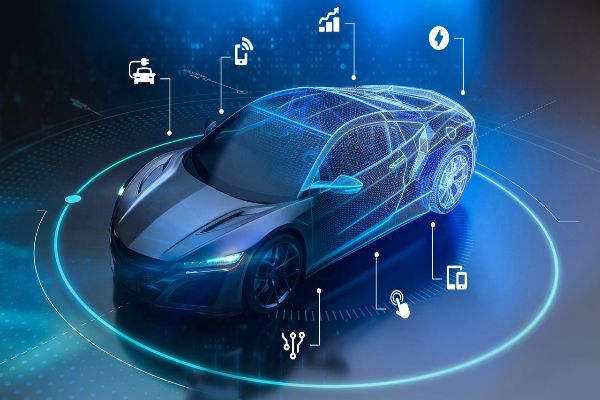
The automotive industry is undergoing one of its most transformative shifts since the invention of the internal combustion engine. At the heart of this revolution is the Software-Defined Vehicle (SDV). In these vehicles, software determines the vehicle’s features, performance, and user experience. Smartphones replaced feature phones by enabling continuous upgrades through operating systems and apps. Similarly, SDVs are poised to replace traditional, hardware-locked vehicles with agile, upgradeable, and intelligent platforms.
In a software-defined vehicle, most of functions, from powertrain control and safety systems to infotainment and autonomous driving, are controlled, enhanced, and updated through software layers. These layers are built upon centralized computing architectures. This paradigm shift enables automakers to deliver new features remotely, reduce time-to-market, and generate recurring revenue streams through post-sale digital services, putting vehicles closer in nature to connected platforms than to conventional mechanical products.
A Market Poised for Explosive Growth
According to Polaris Market Research, the global software-defined vehicle market was valued at USD 266.47billion in 2025. The market is projected to grow to USD 3,027.50 billion by 2034, at a CAGR of 31.0% during 2025–2034. Increasing adoption of electric vehicles (EVs), the maturation of over-the-air (OTA) update technology boost the market growth. Also, rising consumer demand for connected experiences and the rapid advancement of autonomous driving systems fuel the growth. This growth doesn’t exist in isolation. The SDV ecosystem is underpinned by a constellation of adjacent markets that form the digital backbone of tomorrow’s mobility. The connected car market forms a foundational layer of the SDV stack.
From ECUs to Centralized Compute: The Architecture Revolution
Traditional vehicles use many discrete Electronic Control Units (ECUs). Each ECU performs a specific function, for example, controlling a window motor, engine timing, or operating HVAC controls. This arrangement has become increasingly difficult to maintain as new vehicles contain thousands of software components spread among more than 150 ECUs, resulting in complex wiring, high costs and other integration challenges.
SDVs fundamentally restructure this paradigm. The vehicles consolidate functions into a handful of high-performance domain controllers or zonal compute platforms. The automotive ECU market is evolving rapidly. The growth is driven by the shift toward fewer but more powerful compute nodes. Domain-centralized architecture currently dominates the SDV landscape. It allows high-performance domain controllers to consolidate control of ADAS, infotainment, and powertrain management. This reduces ECU count and wiring complexity while lowering manufacturing and maintenance costs.
The architecture evolves it to a new software stack that abstracts hardware from application logic. That’s what operating systems did for personal computers. By removing software layer from underlying hardware, automakers will be able to launch new features that can also be updated remotely, eliminating the use of recalls or visits to dealers.
OTA Updates: The Engine of Continuous Innovation
One of the defining capabilities of SDVs is over-the-air (OTA) software updates. It can deliver software improvements, bug fixes, feature unlocks, and security patches directly to vehicles via wireless connectivity. This mirrors how mobile operating systems function, but with far greater stakes given vehicle safety implications.
OTA technology is a critical competitive differentiator. For instance, in May 2025, General Motors announced it is developing a next-generation vehicle software platform. The company stated that it aims to enhance functionality and reduce costs. It will also create new revenue streams through faster, cloud-based OTA updates like smartphone systems. Tesla pioneered this approach. It has since become a standard expectation among consumers of premium and mid-range vehicles alike.
Beyond convenience, OTA is transforming the automotive business model. Instead of revenue being locked into the point of sale, SDVs enable manufacturers to monetize the vehicle throughout its lifecycle via subscription features, on-demand capability unlocks, and evolving digital services. This service-driven model would become a significant revenue generator for OEMs globally.
ADAS and Autonomous Driving: The Software-Safety Link
Perhaps no technology is more central to the SDV value proposition than Advanced Driver Assistance Systems (ADAS). These intelligent systems encompass adaptive cruise control, lane-keeping assist, automatic emergency braking, and blind-spot detection. The systems are the most visible embodiments of software-defined functionality for consumers.
The global ADAS market is expected to witness growth due to rising government mandates for intelligent connected vehicles. Also, increasing 5G-V2X infrastructure deployment fuels the market growth. The ADAS sensor ecosystem comprises LiDAR, radar, cameras, and ultrasonic sensors. It provides the perceptual foundation upon which SDV intelligence is built. As vehicle autonomy levels increase, the demand for richer, higher-resolution sensing is expected to intensify.
Cybersecurity Imperative
Greater software sophistication comes with a corresponding expansion of the attack surface. As vehicles become more connected and software-dependent, they become potential targets for cyberattacks. Regulatory frameworks have responded accordingly. The United Nations Economic Commission for Europe (UNECE) adopted UN R155. UN R155 regulation mandates the implementation of cybersecurity management systems for all new vehicle types from production in signing states, throughout the entire vehicle life cycle.
The V2X cybersecurity market is emerging as a critical investment zone. AI and machine learning (ML) algorithms can analyze vast amounts of vehicle data in real time. They are used to identify patterns indicative of security breaches. The technologies are becoming standard components of SDV security architectures. Additionally, the expansion of 5G technology is enabling faster, more reliable V2X communication while simultaneously raising the bar for security protocol sophistication.
What Lies Ahead: Vehicles as Living Platforms
The long-term trajectory of the SDV market points toward a future where vehicles function as living platforms. The vehicles are continuously improving, deeply personalized, and interwoven with broader digital ecosystems. Automakers are pivoting their business models from one-time hardware sales to ongoing service relationships, where the vehicle itself is merely the starting point.
Emerging trends include the rise of subscription-based feature unlocks, such as enabling heated seats or enhanced range via software. Also, another trend is AI-driven predictive maintenance that alerts drivers before failures occur. In addition, adoption of vehicle-as-a-service (VaaS) models is rising, where software orchestrates entire mobility fleets with minimal human oversight.
As SDV capabilities mature, driven by advances in AI, 5G connectivity, edge computing, and sensor fusion, the line between a car and a connected computing platform will blur entirely. The vehicles of the next decade will not simply be modes of transportation; they will be intelligent, always-updated companions that learn, adapt, and improve over their entire operational life.
Conclusion
Software-defined vehicles represent one of the most consequential technological transitions in the history of mobility. The global SDV market is expected to grow rapidly in the coming years. Thus, those who invest early in software talent, centralized compute architecture, OTA infrastructure, and robust cybersecurity frameworks will be best positioned to lead the next era of automotive innovation. The road ahead is not just electric, it is fundamentally software-defined.