
Infusion pumps are essential medical devices that deliver fluids such as medications, nutrients, and other therapies into a patient’s body in precisely controlled amounts. They play a critical role in modern healthcare across hospitals, nursing homes, outpatient clinics, and increasingly home-care settings. In hospital environments alone, these pumps are used at the bedside of nearly 90% of patients, highlighting their importance in daily clinical care.1,2 Infusion pumps are also being adopted in increasingly diverse environments (often with minimal clinician supervision) as the prevalence of chronic diseases rises, the population ages, and more therapies shift toward ambulatory and home-based settings. This shift underscores the need for manufacturers to prioritize safety, reliability, and user-friendly design to ensure robust safety features and effective error prevention during extended periods of unattended operation.
Modern infusion and syringe pumps therefore demand ultra-precise, low-noise, and highly reliable motion control. These requirements extend beyond user experience: they directly impact patient safety, drug efficacy, and regulatory compliance. At low-flow rates and long duty cycles, even small mechanical disturbances, excess heat, or acoustic artifacts can lead to dosing inaccuracies, degradation of heat sensitive drugs, or patient discomfort.
Infusion pumps employ a variety of pumping mechanisms including syringe, linear peristaltic, and diaphragm-based designs. Each has distinct requirements for accuracy, force control, and long-term reliability. Syringe pumps rely on precise, low-speed linear motion to deliver exact volumes, peristaltic pumps continuously compress and release flexible tubing to enable continuous or high-volume delivery, and diaphragm pumps use controlled pressure differentials for specialized infusion scenarios. Despite these mechanical differences, all pump types share common demands for smooth motion, quiet operation, reliable occlusion detection, and energy efficiency.
Analog Devices addresses these demands through its ADI Trinamic motor and motion-control solutions that combine advanced drive technology and integrated diagnostics. Features such as silent voltage mode chopping, sensor-free load detection, and adaptive current control allow designers to reduce system complexity while improving performance, safety, and battery life across various pump architectures.
Within this portfolio, ADI’s TMC5262 stepper motor controller and driver represents the latest generation of ADI Trinamic motion-control technology. This article describes how the StealthChop+ technology family (Figure 1) including StealthChop+, StallGuard+, CoolStep+, and complementary features such as µDcStep and TriCoder, work together to enable safer, quieter, and more energy-efficient infusion pump designs.
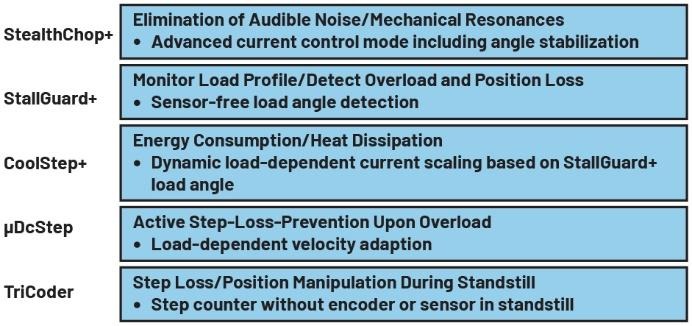
Figure 1. Overview of the StealthChop+ family of features.
The StealthChop+ Technology Family
StealthChop+: Silent, Resonance Damped Motion
StealthChop+ is an advanced ADI Trinamic voltage mode pulse-width modulation (PWM) chopper designed for ultra-quiet, low-vibration stepper motor operation. Unlike conventional current-mode choppers (which inherently introduce current ripple, audible noise, and torque variation), StealthChop+ regulates motor voltage using a feed forward approach while maintaining precise electrical angle alignment. The result is near silent motion, high microstepping linearity, and active suppression of mid-range mechanical resonances.
In infusion pump applications, these characteristics translate directly into smoother plunger motion, reduced flow pulsation, and significantly quieter operation—key contributors to dosing accuracy and patient comfort. StealthChop+ also reduces switching losses, improving overall efficiency, and supports flexible deceleration behavior that helps designers safely manage regenerated energy and simplify overvoltage protection during rapid stops. By integrating sensorless load measurement and resonance damping, StealthChop+ delivers premium motion quality with no audible standby noise, even during long dwell periods common in low-flow infusion profiles.
Figure 2 illustrates the resonance behavior inherent to stepper motors and the benefits of advanced ADI Trinamic motion control. Due to their high pole-pair count, stepper motors exhibit pronounced low-frequency mechanical resonances that are easily excited in low- and mid-speed regions. When driven with conventional current control, these resonances manifest as torque ripple, audible noise, and localized torque drop, reducing usable torque and motion stability. In contrast, StealthChop+ operation with the TMC5262 significantly suppresses resonance excitation by minimizing current ripple and actively damping mechanical oscillations. As shown in the torque-vs.-speed comparison, higher torque is maintained through the resonance region while acoustic emissions are reduced. This enables smoother, quieter motion and more stable flow delivery in precision medical pump systems.
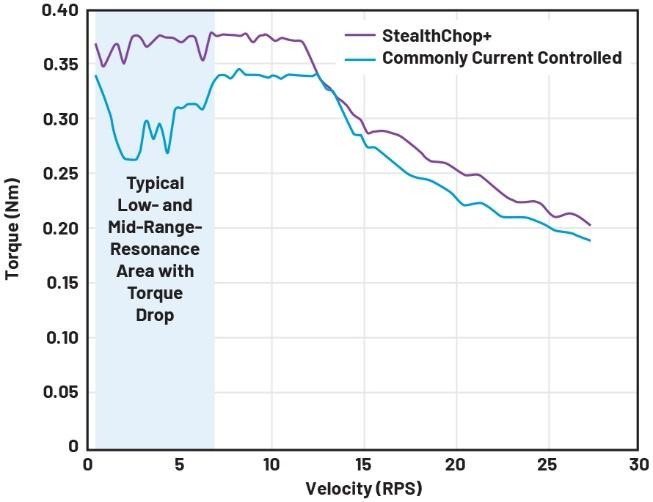
Figure 2. Torque benefits from StealthChop+.
StallGuard+: Sensorless Load and Stall Detection
StallGuard+ is an advanced sensorless load detection technology that measures mechanical load directly from the motor’s electrical behavior without external force sensors, encoders, or switches. The StallGuard+ algorithm monitors the motor’s real-time electrical operating point and calculates SGP_RESULT, a dimensionless load indicator.
This value reflects the motor’s electrical load angle and therefore its available torque reserve, providing a direct, real-time measure of how close the motor is operating to its stability limit. As mechanical load increases, the StallGuard+ value decreases proportionally, indicating a growing load angle and a corresponding reduction in usable torque margin. High SGP_RESULT values reflect ample torque reserve, while values near zero signal the motor is approaching its torque limit and step loss is likely.
While StallGuard+ is more effective at the low speeds typical of medical pumps than traditional back-electromotive force (EMF)-based methods, it provides a consistent indication of motor load over a broad speed range until high back-EMF or field-weakening effects dominate. At very low speeds, slope-based detection enables reliable end-stop sensing without mechanical switches. To implement StallGuard+ as a protection mechanism, the controller includes a built-in, programmable load threshold representing the minimum allowable torque reserve. As mechanical resistance increases, SGP_RESULT decreases, and when it drops below SGP_THRS, the device automatically intervenes to protect motion integrity—preventing step loss and flagging an overload condition for higher-level system handling. In addition to this automated protection, the SGP_RESULT value can be read directly by firmware, allowing designers to implement custom detection, logging, or application-specific control strategies if desired.
Sensorless Load Monitoring for Occlusion Detection
In infusion pumps, occlusion detection is traditionally based on pressure sensing load cells or strain gauges pressed against compliant tubing. When flow is obstructed, pressure inside the tubing gradually builds, causing the tubing to expand and apply force to the sensor. The pump monitors this pressure increase over time and triggers an alarm once a threshold or rate of rise condition is met. While effective, this approach can be very slow at low-flow rates, where pressure accumulates gradually.
When an occlusion such as a kinked line, clamped tube, or downstream blockage occurs, the resistance to fluid flow increases immediately. This increased resistance manifests as higher mechanical load on the motor, which, in turn, alters the motor’s current draw and electrical operating point. StallGuard+ detects this change directly, enabling the system to recognize abnormal load conditions.
To illustrate sensor-free occlusion detection, a syringe pump demonstrator was assembled (Figure 3) to monitor motor load indicators alongside line pressure.
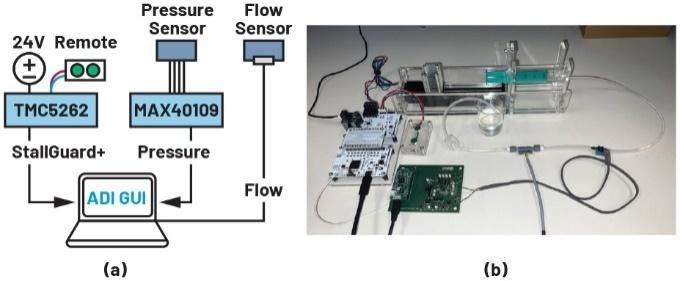
Figure 3. A syringe pump (a) system-level block diagram and (b) demonstrator setup.
Figure 3a presents a simplified system-level block diagram of the syringe pump demonstrator used to evaluate sensor-free occlusion detection. A TMC5262-EVKIT drives the syringe pump mechanism from a 24V supply, while simultaneously reporting motor load information via StallGuard+. A MAX40109EVSYS precision signal conditioning analog front end interfaces to an in-line pressure sensor, providing a direct measurement of in-line pressure for comparison against motor-based diagnostics. All subsystems are connected to a host PC over USB, which logs motor parameters, pressure, and flow data in real time. This architecture allows direct correlation between pressure-based occlusion detection and StallGuard+-based motor load sensing under identical operating conditions.
Figure 3b shows the physical syringe pump demonstrator used in the experiment. The setup consists of a linear syringe pump assembly driving a fluid filled syringe connected to compliant tubing. The tubing routes through a pressure sensor and flow sensor before terminating in a collection vessel. During testing, occlusions are introduced by clamping the tubing downstream of the syringe, allowing controlled observation of how pressure and motor load evolve over time.
Figure 4 shows the results of the measurements. First, the tubing was clamped to create an occlusion downstream of the pumping mechanism. Pressure increased gradually over time, while the StallGuard+ indicator dropped over time, showing a clear inverse correlation. In this setup, StallGuard+ eventually reached its minimum value of zero, at which point software used the stall indication to stop the motor and trigger an alarm. As previously mentioned, this threshold can be controlled in soft-ware to determine sensitivity of occlusion detection. The result demonstrates that motor-based diagnostics can provide a fast, sensor-free estimate of system load.
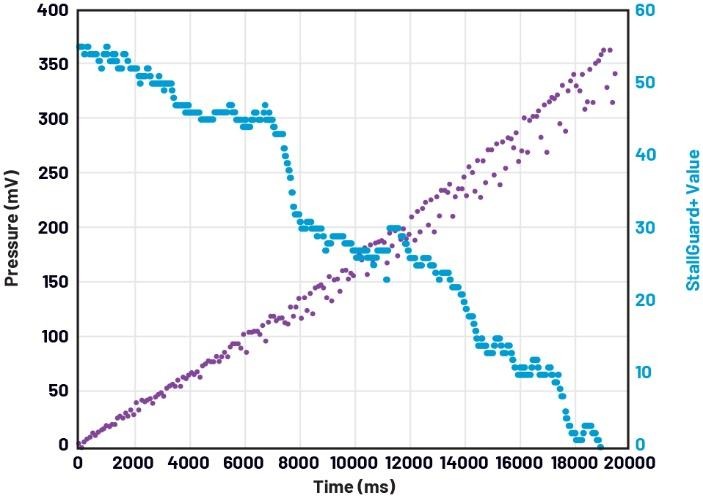
Figure 4. StallGuard+ vs. pressure buildup in response to an occlusion.
This strong correlation validates StallGuard+ as a reliable, sensor-free indicator for occlusion detection, especially in lower flow regimes where pressure-based alarms can be inherently delayed. However, StallGuard+ is best viewed as a complementary signal rather than an outright replacement for pressure sensors. It can help provide faster initial detection, redundancy for safety monitoring, or diagnostic insight in designs where pressure sensors are constrained by size, cost, or mechanical placement.
CoolStep+: Load Adaptive Current Control
CoolStep+ builds on StallGuard+ by closing the loop between real-time load feedback and motor current regulation. Instead of driving the motor with a fixed worst-case current, CoolStep+ continuously adjusts phase current so the motor operates with only the torque required for the instantaneous load condition.
At the system level, CoolStep+ monitors the StallGuard+ load indicator (SG_RESULT) and dynamically scales motor current. Current is automatically reduced under light load while increasing resistance, such as during plunger acceleration or the onset of an occlusion, prompts a controlled current increase to preserve torque margin. This closed-loop behavior allows the motor to traverse load transients smoothly without excess energy dissipation or loss of positional integrity.
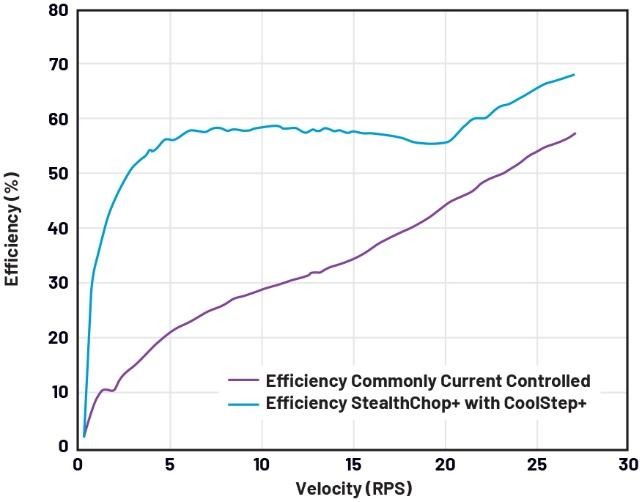
Figure 5. Increased energy efficiency with CoolStep+.
Figure 5 highlights the resulting efficiency gains. The plot compares motor efficiency vs. speed at a constant low torque (0.1 N×m) for a conventional fixed-current drive and for a drive operating with StealthChop+ and CoolStep+ enabled. With fixed current control, efficiency improves only gradually with speed. In contrast, CoolStep+ aggressively reduces current under light load, delivering substantially higher efficiency across the entire operating range and particularly at the low speeds typical of infusion pump operation. In this regime, CoolStep+ maintains efficiencies above ~50%, directly reducing power dissipation and motor heating. Because motor heating scales strongly with coil current, even moderate current reduction yields a disproportionately large reduction in electrical losses, helping prevent temperature-dependent coil resistance increases that would otherwise degrade efficiency and torque margin over time.
For medical pumps, reduced heat is more than an efficiency benefit: it directly supports drug integrity, patient safety, and long-term reliability. By minimizing motor self-heating, CoolStep+ helps protect heat-sensitive therapeutics while reducing the need for bulky thermal mitigation. Lower average motor current also reduces acoustic excitation, complementing StealthChop+ to maintain quiet operation throughout long infusion cycles. Together, StealthChop+ and CoolStep+ enable infusion pumps to operate quietly while minimizing heat generation near sensitive drugs, lowering enclosure temperature, and supporting smaller form factors with fewer thermal design constraints. In battery-powered pumps, improved efficiency enables longer run time or smaller batteries, delivering clear benefits for portable medical devices.
µDcStep and TriCoder: Maintaining Accuracy Under Disturbance
µDcStep is designed to preserve motion accuracy when the system is subjected to transient overloads or unexpected disturbances. In infusion pumps, these events can occur during syringe loading, startup, rapid flow changes, or when mechanical resistance increases abruptly due to downstream occlusions or friction changes. Under such conditions, a stepper motor driven at a fixed velocity may exceed its available torque margin, leading to step loss and dosing inaccuracies.
µDcStep continuously monitors motor load and velocity using internal diagnostics and adaptively modifies the motion profile when torque limits are approached. Rather than allowing the motor to lose steps, µDcStep automatically reduces speed just enough to remain within the motor’s achievable torque envelope. This closed-loop, encoder-free behavior allows the pump to maintain position accuracy and volumetric delivery without adding mechanical complexity or external sensing hardware. Once the transient condition passes, normal motion resumes seamlessly, preserving both accuracy and throughput.
The TriCoder feature further enhances system robustness by providing sensorless standstill step-loss detection with full-step position feedback. This capability is particularly valuable in infusion pump use cases that require deterministic position knowledge without encoders, such as syringe insertion and removal or homing sequences. By detecting when the motor is moved manually, TriCoder enables reliable re-establishment of absolute position reference when motion resumes.
Beyond real-time protection, the combination of µDcStep, StallGuard+, CoolStep+, and the supporting evaluation hardware and software toolchain enables deep system-level analysis during development. Continuous access to load indicators such as SGP_RESULT allows designers to quantify load reserve at critical operating points and to better understand true safety margins under real operating conditions. This insight supports more informed motor and mechanical sizing decisions. In many cases, it enables the use of smaller, more cost-efficient motors, as conservative over-dimensioning can be reduced when active thermal management, short-term boost current capability, and protective mechanisms like StallGuard+ and µDcStep help safeguard position integrity and reliable motor operation.
Together, µDcStep and TriCoder complement StallGuard+ and CoolStep+ by extending intelligence beyond efficiency and load monitoring into motion integrity, fault resilience, and system optimization. The result is a stepper motor control system that not only operates quietly and efficiently, but also maintains accurate, repeatable dosing under real-world mechanical disturbances while enabling more compact and cost-effective pump designs.
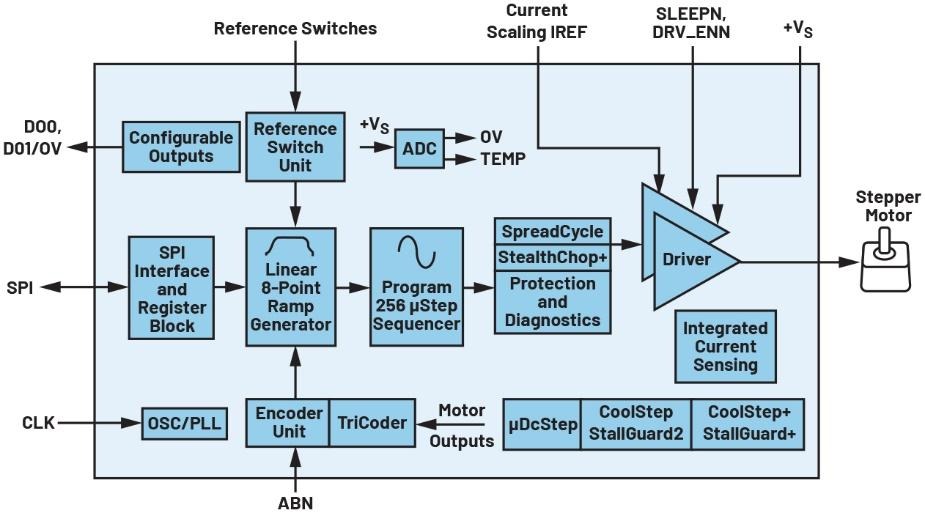
Figure 6. The TMC5262 block diagram.
TMC5262 Overview
The TMC5262 is a compact, high-power, single axis stepper motor controller and driver designed for highly integrated, energy efficient motion systems (Figure 6). It supports a wide 4.5V to 65V supply range and integrates low-impedance power MOSFETs to enable high efficiency and low heat generation. Each H-bridge delivers up to 4.25A rms (6A sine peak, 9A peak), providing ample torque margin for a wide range of syringe and peristaltic pump architectures.
Beyond the advanced on-chip diagnostics described above, additional capabilities include motor coil resistance measurement, passive braking and freewheeling modes, on-chip temperature and supply monitoring, comprehensive fault protection, and a real-time on chip scope interface (RT OCSI) for in system tuning and validation. All functionality is packaged in a compact, thermally optimized 30-lead, 6mm × 6mm FCQFN, making the IC well suited for space constrained medical pump designs. Together, these features allow motors to operate at extremely low current when unloaded while dynamically supplying torque only when needed, minimizing heat and maximizing efficiency.
Conclusion
The TMC5262 demonstrates how intelligent, sensorless motion control can elevate stepper-based infusion pump design beyond basic actuation into a platform for safety, efficiency, and differentiation. By tightly integrating StealthChop+ silent motion, StallGuard+ real-time load monitoring, CoolStep+ adaptive current control, and complementary features such as µDcStep and TriCoder, the TMC5262 enables infusion pumps that are quieter, cooler, and more responsive to real-world operating conditions. For pump manufacturers, these capabilities translate directly into simpler system architectures, improved patient comfort, extended battery life, and greater design flexibility—supporting the development of next-generation infusion platforms that meet increasingly stringent clinical, regulatory, and user expectations.