Remote healthcare depends on more than sensors that can measure temperature, blood pressure, glucose, heart rate, or other physiological parameters. Those measurements also need to travel from the patient to a gateway, monitoring platform, or healthcare provider. This is where wireless connectivity becomes an important part of medical electronics.
LoRaWAN, or Long Range Wide Area Network, is one technology designed for this type of communication. It enables low-power devices to transmit small amounts of data over long distances, making it useful for remote monitoring, connected healthcare facilities, medical equipment tracking, and other applications where conventional short-range wireless technologies may not be practical.
Unlike Wi-Fi or Bluetooth, LoRaWAN is designed around long-range, low-power communication. This combination makes it particularly interesting for Digital Health Monitoring Devices that need to operate for long periods without frequent battery replacement.
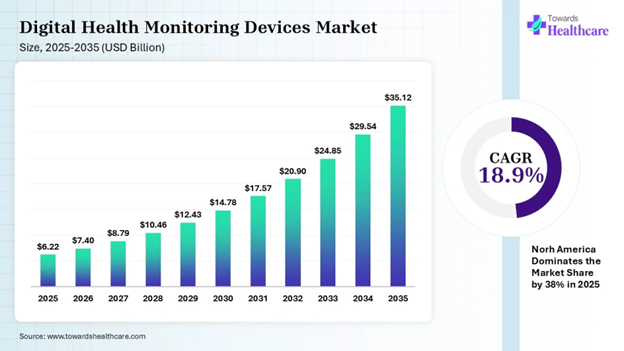
According to Towards Healthcare Research and Consulting, the global digital health monitoring devices market size reached US$ 6.22 billion in 2025 and is anticipate to increase to US$ 7.40 billion in 2026. By 2035, the market is forecasted to achieve a value of around US$ 35.12 billion, growing at a CAGR of 18.9%.
How LoRaWAN Connects a Medical Sensor
A typical LoRaWAN healthcare system can be understood as a simple electronics chain:
Medical Sensor → Signal Conditioning → Microcontroller → LoRa Transceiver → Gateway → Network Server → Healthcare Platform
The sensor first captures a physiological or environmental parameter. An analog front end may amplify or condition the signal before an analog-to-digital converter converts it into digital data.
A microcontroller then processes the measurement and prepares a small data packet. The LoRa transceiver modulates this information onto a radio-frequency signal and transmits it to a nearby LoRaWAN gateway.
The gateway acts as a bridge between the local sensor network and the wider internet. From there, the information can move to a cloud platform, hospital system, dashboard, or remote monitoring application.
This architecture can support Digital Health Monitoring Devices that need to collect measurements continuously or at scheduled intervals while keeping their communication electronics energy efficient.
Why LoRaWAN Is Different
The key advantage of LoRaWAN is its combination of long communication range and low power consumption.
LoRa uses a spread-spectrum radio modulation technique that can maintain communication over relatively long distances while transmitting small data packets. LoRaWAN then provides the network protocol and architecture needed to manage these devices.
For medical sensors, this matters because many devices do not need to continuously transmit large files. A temperature sensor, for example, may only need to send a measurement periodically. The same applies to many environmental and physiological monitoring applications.
This allows the electronics to spend most of their time in a low-power state and activate the radio only when data needs to be transmitted.
Technologies Used
- LoRa Radio: Provides long-range wireless communication using low-power RF electronics.
- LoRaWAN Protocol: Manages communication between end devices, gateways, and network servers.
- Microcontrollers: Process sensor readings and control when the device wakes, measures, and transmits.
- MEMS Sensors: Can measure parameters such as motion, pressure, acceleration, and other physical variables.
- Analog Front Ends: Amplify and condition weak sensor signals before digitization.
- Power Management ICs: Regulate and distribute power to sensors, processors, and RF components.
- RF Transceivers: Convert digital information into radio signals and receive incoming wireless data.
- Gateways: Collect transmissions from multiple devices and forward them to internet-connected systems.
Where Can LoRaWAN Be Used in Healthcare?
LoRaWAN can be useful when healthcare devices need long-range communication but do not require high-bandwidth data transmission.
In remote patient monitoring, sensors can periodically transmit measurements from homes or rural locations to a centralized platform. Healthcare teams can then review incoming information without requiring a continuous wired connection.
This can complement Digital Health Monitoring Devices used for tracking physiological parameters outside conventional healthcare facilities.
Hospitals and healthcare facilities can also use long-range wireless sensors for monitoring equipment, room conditions, temperature-sensitive storage areas, and other assets.
Another potential application is connected medical infrastructure. Sensors distributed across a large facility or healthcare campus can communicate with gateways without requiring every device to have a direct Wi-Fi connection.
The Electronics Challenge
LoRaWAN is not intended to replace every wireless technology used in healthcare.
Its strength is transmitting small amounts of data efficiently over long distances. It is therefore less suitable for applications requiring high data rates, such as continuous medical imaging, video, or large diagnostic files.
Medical-device designers also need to consider RF interference, antenna design, battery capacity, network coverage, data security, and regulatory requirements.
For physiological measurements, accuracy remains equally important. A reliable wireless connection cannot compensate for a poorly designed sensor or noisy analog front end.
Challenges and Opportunities
Challenges
- Limited data throughput compared with Wi-Fi and cellular networks
- Dependence on suitable gateway coverage
- RF interference and antenna constraints
- Battery limitations in remote sensors
- Data security and device authentication
- Integration with existing healthcare systems
- Medical-device reliability and regulatory requirements
Opportunities
- Long-term remote patient monitoring
- Connected healthcare facilities
- Rural and decentralized healthcare
- Medical equipment and asset tracking
- Temperature monitoring for medicines and biological materials
- Low-power wearable and environmental sensors
- Large-scale healthcare sensor networks
What Comes Next?
The future of LoRaWAN-based healthcare will depend on how effectively low-power electronics, sensors, gateways, and healthcare software work together.
More efficient microcontrollers, improved RF transceivers, smaller antennas, better power-management circuits, and smarter edge processing can make connected medical sensors more compact and energy efficient.
As Digital Health Monitoring Devices become more connected, different wireless technologies can serve different parts of the healthcare ecosystem. A medical device could use short-range communication for local interaction while long-range networks such as LoRaWAN provide connectivity to remote monitoring infrastructure.
Rather than replacing Bluetooth, Wi-Fi, or cellular connectivity, LoRaWAN is likely to remain another layer in the healthcare connectivity ecosystem.
Conclusion
LoRaWAN demonstrates how wireless technology can extend healthcare beyond the hospital. By combining long-range RF communication with low-power electronics, it provides a practical connectivity option for medical sensors that need to send small amounts of information over extended periods.
The real value is not simply the radio connection. It is the complete electronics chain, from sensor and signal conditioning to microcontroller, RF transceiver, gateway, and healthcare platform. Together, these technologies can turn isolated medical sensors into connected systems capable of supporting remote and distributed healthcare.
Source: https://www.towardshealthcare.com/insights/digital-health-monitoring-devices-market-sizing
About Author
Payal Rabde is a Healthcare Market Research Analyst at Towards Healthcare Research & Consulting with over 4+ years of experience in pharmaceutical, biotechnology, medical device, and healthcare market research. She holds an MBA in Pharmaceutical-Biotechnology Management and a B.Pharm, specializing in market analysis, forecasting, competitive intelligence, and strategic healthcare insights.
About Towards Healthcare Research and Consulting
Towards Healthcare Research & Consulting is a global strategy consulting firm with a presence in both Canada and India. We provide innovative solutions customized to the healthcare sector, helping business leaders overcome challenges and accelerate growth. We specialize in delivering advanced technological solutions, clinical research services, and powerful data analytics. Our focus is on building meaningful partnerships that foster innovation and deliver actionable insights to drive success in healthcare.