
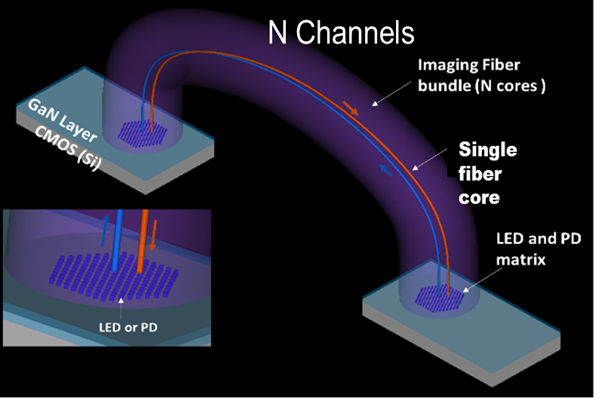
CEA-Leti is launching a collaborative, multi-partner program aimed at advancing microLED technology for extremely high-speed data transmission, with the goal of boosting the development of artificial intelligence. The lab-to-fab effort builds on the institute’s long-standing strengths in microLED processing.
Announced at SEMICON Europa in Munich, the three-year program will start in January 2026. It will bring together companies involved in microLED manufacturing, optical fibers, photodiodes, interconnect technologies, along with chip producers, system integrators, and major cloud-scale players.
“Over the past decade, the computing power required to train leading-edge AI models has exploded by factors of millions, doubling roughly every three to four months as systems become more complex and data-hungry,” said CEA-Leti CEO Sébastien Dauvé. “Supercomputers demand ever-faster communication links with very high energy efficiency and ultra-low latency—but interconnect performance is lagging behind compute power. That gap calls for a paradigm shift capable of boosting high-performance computing speed by orders of magnitude.”
Currently the tech industry is using slower copper-based data systems and costly laser-based solutions. MicroLEDs, supported by a mature technology base, offer a compelling alternative—consuming less energy than either copper- or laser-based systems.
In a recent report on MOSAIC, Microsoft’s novel optical-link technology, a Microsoft team noted that “microLEDs are significantly smaller than traditional LEDs (and) can be modulated at several Gbps using a simple ON‑OFF scheme.” The report, “MOSAIC: Breaking the Optics versus Copper Trade-off with a Wide-and-Slow Architecture and MicroLEDs”, also noted that the technology “achieves 10× the reach of copper, reduces power consumption by up to 68%, and offers 100× higher reliability than today’s optical links”.
“MicroLED represents a true paradigm shift for short-range optical, point-to-point data interconnects,” Dauvé added. “It delivers extremely high data-density transfer rates with far better energy efficiency than current technologies. Unlike silicon photonics or VCSEL, microLED is scalable for massive parallel communication. By combining the complementary expertise of our program members, we aim to break through the interconnect power and density bottlenecks that limit next-generation computing.”
CEA-Leti, a global leader in microLED R&D for lighting, display and data communications, has been developing the technology for more than 15 years. The institute holds roughly 100 patents. Its use of silicon wafers and standard processes to produce microLEDs both scales and transfers easily to standard microelectronics foundries.
The institute will lead the Multilateral MicroLED Data Link Program with financial backing from its industrial partners. Together, members will map out a technical roadmap that sets clear objectives, milestones, and deliverables, and will track progress closely—adjusting course as needed to keep the collaboration on pace and on target.