


Overview
Healthcare cloud computing has become the digital backbone of modern healthcare. Hospitals, diagnostic laboratories, insurance providers, and telehealth platforms are increasingly moving their data, software, and applications to secure cloud environments to improve patient care and operational efficiency.
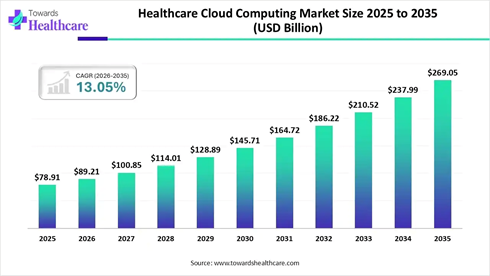
In 2026, the global healthcare cloud computing industry is valued at USD 89.21 billion and is expected to reach USD 269.05 billion by 2035, growing at a 13.05% CAGR. The rapid adoption of electronic health records (EHRs), AI-powered healthcare applications, telemedicine, and digital hospitals continue to accelerate cloud investments worldwide.
What is Healthcare Cloud Computing?
Healthcare cloud computing refers to delivering computing services, including storage, software, databases, networking, analytics, and infrastructure, over the internet for healthcare organizations.
Instead of storing patient records on local servers, hospitals can securely access information from anywhere, improving collaboration between physicians, laboratories, pharmacies, insurers, and patients while reducing infrastructure costs.
How AI is Transforming Healthcare Cloud Computing
AI in healthcare has become one of the biggest drivers of cloud adoption. Modern cloud platforms process massive healthcare datasets within seconds, helping hospitals identify disease patterns, predict patient risks, and automate repetitive administrative work.
Generative AI is also improving medical documentation, radiology workflows, clinical decision support, patient communication, and hospital operations. Companies including Bayer, Cognizant, Google Cloud, GE HealthCare, and Philips continue expanding AI-powered cloud healthcare solutions across global healthcare systems.
Major Healthcare Cloud Computing Trends in 2026
Telemedicine Expansion
Virtual healthcare has become a standard part of patient care. Cloud infrastructure enables secure video consultations, remote patient monitoring, digital prescriptions, and faster communication between patients and physicians.
Growing Healthcare Data
Healthcare organizations generate enormous amounts of patient information every day. Cloud platforms simplify secure storage, backup, sharing, and analytics while improving collaboration across healthcare teams.
AI-Powered Hospitals
Hospitals are increasingly integrating AI with cloud infrastructure to automate scheduling, medical documentation, imaging analysis, predictive analytics, and workflow optimization.
Cloud-Based Medical Imaging
Medical imaging is rapidly moving to cloud platforms, allowing radiologists to access CT, MRI, and X-ray images from different locations while supporting collaborative diagnosis and faster reporting.
Hybrid Cloud Adoption
Many healthcare organizations now combine private and public cloud infrastructure to balance scalability, operational flexibility, and regulatory compliance.
Pros of Healthcare Cloud Computing
- Faster access to patient records
- Lower infrastructure and maintenance costs
- Better collaboration among healthcare teams
- Supports telemedicine and remote care
- Scalable storage for growing healthcare data
- Improved disaster recovery and data backup
- Faster deployment of healthcare applications
- Easier integration with AI and analytics
- Better operational efficiency
- Supports digital transformation initiatives
Cons of Healthcare Cloud Computing
- Cybersecurity and ransomware risks
- Strict regulatory compliance requirements
- Internet dependency for continuous access
- Potential service downtime
- Complex migration from legacy systems
- High initial implementation planning
- Vendor lock-in concerns
- Data privacy challenges
- Staff training requirements
- Ongoing cloud subscription costs
Regional Highlights
North America – The Digital Healthcare Leader (46% Market Share)
North America accounted for nearly 46% of the global market in 2025, supported by advanced healthcare infrastructure, strong cloud adoption, and mature IT ecosystems.
The United States continues to lead because of widespread EHR implementation, growing AI adoption, HIPAA-compliant cloud platforms, and investments from companies such as Microsoft, Oracle, IBM, Amazon Web Services, and Google Cloud.
Asia Pacific – The Fastest Growing Region
Asia Pacific is expected to witness the highest growth throughout the forecast period as governments continue investing in digital healthcare infrastructure.
Countries including China, India, Japan, and South Korea are rapidly expanding telemedicine services, smart hospitals, cloud-enabled diagnostics, and digital health platforms to support their growing populations.
Europe – Building Secure Healthcare Clouds
European healthcare providers are investing heavily in secure cloud environments that comply with strict patient privacy regulations.
Germany’s healthcare cloud regulations and the UK’s NHS Cloud Strategy are encouraging hospitals to modernize healthcare infrastructure while ensuring stronger cybersecurity and standardized patient data management.
Source: https://www.towardshealthcare.com/insights/healthcare-cloud-computing-market-sizing
About Author
Payal Rabde is a Healthcare Market Research Analyst at Towards Healthcare Research & Consulting with over 4+ years of experience in pharmaceutical, biotechnology, medical device, and healthcare market research. She holds an MBA in Pharmaceutical-Biotechnology Management and a B.Pharm, specializing in market analysis, forecasting, competitive intelligence, and strategic healthcare insights.
About Us
Towards Healthcare Research & Consulting is a global strategy consulting firm with a presence in both Canada and India. We provide innovative solutions tailored to the healthcare sector, helping business leaders overcome challenges and accelerate growth. We specialize in delivering advanced technological solutions, clinical research services, and powerful data analytics. Our focus is on building meaningful partnerships that foster innovation and deliver actionable insights to drive success in healthcare.