


Healthcare IoT Security Overview
Healthcare IoT security includes the technologies, policies, and processes used to protect connected medical devices and the data they collect and exchange. These systems can include patient monitors, infusion pumps, smart beds, wearable devices, connected imaging systems, and remote monitoring platforms.
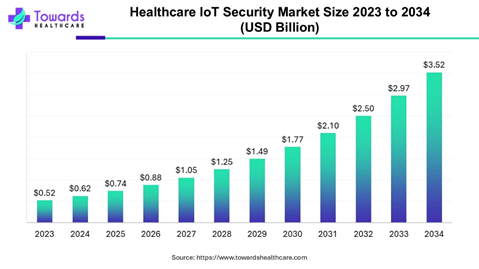
global healthcare IoT security market size is calculated at US$ 0.74 in 2025, grew to US$ 0.88 billion in 2026, and is projected to reach around US$ 4.15 billion by 2035. The market is expanding at a CAGR of 18.83% between 2026 and 2035.
The challenge is growing as healthcare organizations add more connected devices. A large hospital can operate thousands of devices across different departments, manufacturers, networks, and software environments, making it difficult to monitor and secure every connection.
IoMT security is also different from traditional IT security because a compromised device can potentially affect real-world patient care. An attack on a medical device could interfere with monitoring, treatment delivery, or clinical decision-making.
According to Towards Healthcare Research and Consulting, the global healthcare IoT security market size is calculated at US$ 0.74 in 2025, grew to US$ 0.88 billion in 2026, and is projected to reach around US$ 4.15 billion by 2035. The market is expanding at a CAGR of 18.83% between 2026 and 2035.
Major Cybersecurity Threats
Healthcare organizations are attractive targets because they manage valuable personal, financial, and clinical information. Cybercriminals can exploit vulnerable IoMT devices to gain access to larger hospital networks or disrupt healthcare services.
The major threats include:
- Ransomware: Attackers can lock systems or data and demand payment.
- Data breaches: Patient records and confidential healthcare information can be stolen.
- Unauthorized access: Weak credentials or poor authentication can allow attackers to control devices.
- Malware and phishing: Employees can unknowingly provide attackers with access to healthcare systems.
- DDoS attacks: Large volumes of malicious traffic can make connected services unavailable.
- Supply-chain attacks: Vulnerabilities in third-party software or technology providers can enter healthcare environments.
The consequences can go beyond financial losses. A cyberattack can cause system downtime, delay treatments, interrupt hospital operations, and create risks for patient safety.
Key Vulnerabilities in IoMT Devices
Many IoMT security weaknesses come from the devices themselves. Medical devices often have long operating lifecycles, and some may continue using older software or operating systems that were not designed to handle today’s cybersecurity threats.
Common vulnerabilities include weak passwords, outdated software, unpatched security flaws, inadequate encryption, insecure communication protocols, and limited authentication controls.
Another major issue is device interoperability. Connected medical devices often need to communicate with electronic health records, hospital networks, cloud platforms, and other systems. Each additional connection can create another potential security exposure.
Manufacturers also face a difficult balance between security and clinical functionality. Applying a software update to a medical device may require testing and regulatory approval, making security patching more complicated than it is for ordinary IT equipment.
Data Privacy and Regulatory Compliance
Healthcare IoT devices generate and transmit large amounts of sensitive information, including patient identities, medical histories, diagnostic information, biometric data, and real-time health measurements.
Protecting this information is not only a cybersecurity requirement but also a data privacy and compliance responsibility. In the U.S., healthcare organizations must consider requirements such as HIPAA, while organizations handling European patient data may need to comply with GDPR.
Healthcare providers and device manufacturers are increasingly focusing on encryption, strong authentication, access controls, network segmentation, vulnerability management, and continuous monitoring to reduce security risks.
Regulatory expectations around medical device cybersecurity are also becoming stronger, encouraging manufacturers to consider security throughout the entire device lifecycle, rather than treating it as an issue after a product reaches the market.
Role of AI and Machine Learning
AI and machine learning can play an important role in protecting increasingly complex IoMT environments. Traditional security tools may find it difficult to monitor thousands of connected devices and identify every unusual activity pattern.
AI-based systems can analyze network traffic and device behavior to identify anomalies. For example, if a medical device suddenly communicates with an unfamiliar server or behaves differently from its normal pattern, an AI system can flag the activity for further investigation.
AI can support real-time monitoring, anomaly detection, predictive threat identification, and automated incident response. However, AI is not a complete solution. Organizations must also secure the AI systems themselves and ensure that the data used to train and operate them is reliable.
Challenges in Healthcare IoT Security
Building a secure IoMT environment remains difficult because healthcare organizations must protect connected devices without interrupting critical medical services.
Key challenges include:
- Legacy devices with limited security capabilities
- High costs of replacing or upgrading infrastructure
- Shortage of skilled healthcare cybersecurity professionals
- Difficulty applying security patches to clinical devices
- Complex and highly connected hospital networks
- Third-party and supply-chain security risks
- Lack of consistent security standards across device manufacturers
As healthcare becomes increasingly digital and connected, IoMT security will become a core part of healthcare infrastructure. Hospitals and manufacturers will need to move toward security-by-design, stronger authentication, continuous monitoring, zero-trust approaches, and better coordination across the healthcare technology ecosystem.
Ultimately, healthcare IoT security is not simply about protecting computers or data. It is about protecting patient privacy, medical devices, clinical operations, and patient safety. As the number of connected healthcare devices continues to grow, organizations that build security into every stage of the IoMT lifecycle will be better positioned to adopt new technologies while managing cyber risks.
Source: https://www.towardshealthcare.com/insights/healthcare-iot-security-market-sizing
About Author
Payal Rabde is a Healthcare Market Research Analyst at Towards Healthcare Research & Consulting with over 4+ years of experience in pharmaceutical, biotechnology, medical device, and healthcare market research. She holds an MBA in Pharmaceutical-Biotechnology Management and a B.Pharm, specializing in market analysis, forecasting, competitive intelligence, and strategic healthcare insights.
About Us
Towards Healthcare Research & Consulting is a global strategy consulting firm with a presence in both Canada and India. We provide innovative solutions tailored to the healthcare sector, helping business leaders overcome challenges and accelerate growth. We specialize in delivering advanced technological solutions, clinical research services, and powerful data analytics. Our focus is on building meaningful partnerships that foster innovation and deliver actionable insights to drive success in healthcare.