

Healthcare is no longer limited to hospitals, clinics, or scheduled doctor visits. Today, medical care can continue while a patient is at home, walking in a park, sleeping, or even traveling. The reason behind this shift is the IoT.
Instead of waiting for patients to report symptoms, connected medical devices continuously collect health information and share it with healthcare providers. This allows doctors to understand a patient’s condition in real time and respond much faster when something changes.
Understanding IoT in Healthcare
IoT, or the Internet of Things, is simply a network of connected medical devices that communicate through the internet. These devices collect health data, send it securely to healthcare systems, and help doctors monitor patients without requiring them to be physically present.
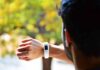
Examples include smartwatches that measure heart rate, continuous glucose monitors for diabetes, connected inhalers for asthma patients, wearable ECG patches, smart hospital beds, and even medication dispensers that remind patients to take their medicines on time.
The real value of IoT isn’t the device itself, it’s the continuous flow of accurate health information that helps healthcare professionals make quicker and better decisions.
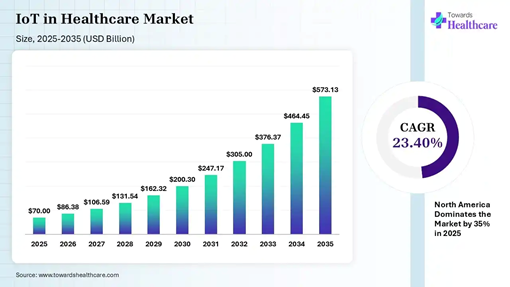
According to Towards Healthcare Research and Consulting, the IoT in healthcare market is forecast to grow at a CAGR of 23.4%, from USD 86.38 billion in 2026 to USD 573.13 billion by 2035, over the forecast period from 2026 to 2035.
Why IoT Is Becoming So Important
Modern healthcare is facing increasing pressure from rising chronic diseases, aging populations, and growing patient numbers.
According to the World Health Organization, chronic diseases account for nearly 74% of deaths worldwide, while millions of people require long-term monitoring rather than emergency treatment. IoT helps fill this gap by allowing doctors to monitor patients remotely and detect warning signs much earlier.
Hospitals also use IoT to manage medical equipment, monitor medicine storage conditions, track expensive assets, and improve overall patient safety.
Before AI vs. After AI: A Huge Leap Forward
When IoT first entered healthcare, connected devices mainly collected data.
Doctors received reports showing blood pressure, oxygen levels, heart rate, or glucose readings. While useful, healthcare professionals still had to manually review the information, compare previous records, and determine whether immediate action was necessary.
Artificial intelligence has completely changed this process.
Today, AI-powered IoT systems don’t just collect information, they understand it. They recognize patterns, predict potential complications, prioritize high-risk patients, and provide clinical recommendations based on large volumes of historical medical data.
Instead of reacting after a patient’s condition worsens, healthcare teams can often intervene before serious complications develop.
The Biggest IoT Trends in 2026
Healthcare IoT continues to evolve rapidly in 2026.
Remote Patient Monitoring (RPM) is becoming one of the fastest-growing applications as hospitals increasingly care for patients outside traditional clinical settings. Connected wearables are now monitoring heart rhythm, oxygen saturation, sleep quality, blood glucose, and physical activity throughout the day.
Smart hospitals are also becoming more common. Connected infusion pumps, RFID-enabled equipment tracking, automated temperature monitoring for vaccines, and digital patient rooms are helping hospitals improve operational efficiency while reducing human error.
Another major trend is the combination of IoT, cloud computing, and AI, allowing healthcare providers to access patient information instantly from virtually any location.
The Benefits That Make IoT Worth the Investment
One of the greatest advantages of IoT is continuous patient monitoring. Instead of relying on occasional hospital visits, doctors receive regular health updates that support earlier diagnosis and faster treatment.
IoT also improves patient convenience by reducing unnecessary hospital visits, supports better chronic disease management, lowers operational costs, minimizes equipment downtime, and enables more personalized healthcare.
For hospitals, connected systems improve workflow efficiency, optimize resource utilization, and reduce delays caused by missing equipment or incomplete patient information.
Pros and Cons of IoT in Healthcare
Pros
- Continuous patient monitoring enables doctors to track health conditions in real time, leading to earlier diagnosis and faster medical intervention.
- Better chronic disease management helps patients with diabetes, heart disease, asthma, and hypertension receive ongoing care without frequent hospital visits.
- Improved operational efficiency allows hospitals to track equipment, automate workflows, and reduce administrative workload.
- Personalized treatment becomes possible as healthcare providers can make decisions based on real-time patient data instead of occasional checkups.
- Lower healthcare costs can be achieved by reducing emergency admissions, preventing complications, and supporting remote care.
Cons
- Cybersecurity risks remain a major concern because connected medical devices can become targets for cyberattacks if not properly protected.
- High implementation costs make adoption challenging for smaller hospitals that need to invest in devices, software, and IT infrastructure.
- Integration issues occur when devices from different manufacturers cannot communicate smoothly with existing hospital systems.
- Dependence on internet connectivity means device performance may be affected in areas with poor network coverage.
- Privacy concerns continue to grow as large volumes of sensitive patient information are collected, stored, and shared digitally.
About Author
Payal Rabde is a Healthcare Market Research Analyst at Towards Healthcare Research & Consulting with over 4+ years of experience in pharmaceutical, biotechnology, medical device, and healthcare market research. She holds an MBA in Pharmaceutical-Biotechnology Management and a B.Pharm, specializing in market analysis, forecasting, competitive intelligence, and strategic healthcare insights.
About Towards Healthcare Research and Consulting
Towards Healthcare Research & Consulting is a global strategy consulting firm with a presence in both Canada and India. We provide innovative solutions customized to the healthcare sector, helping business leaders overcome challenges and accelerate growth. We specialize in delivering advanced technological solutions, clinical research services, and powerful data analytics. Our focus is on building meaningful partnerships that foster innovation and deliver actionable insights to drive success in healthcare.