

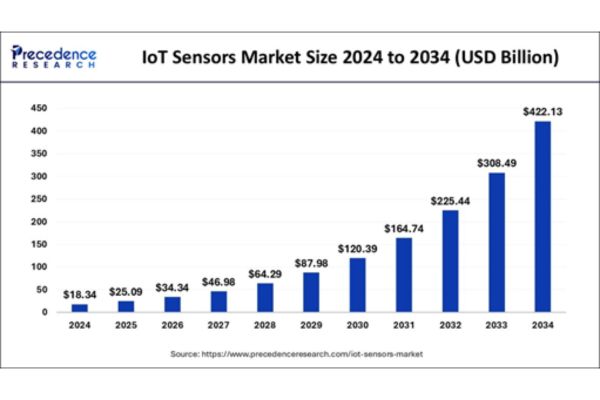
The global IoT sensors market size reached USD 18.34 billion in 2024 and is projected to be worth around USD 422.13 billion by 2034, expanding at a CAGR of 36.84% from 2025 to 2034. This surge is propelled by key market drivers such as steeply declining device costs, the explosion of new IoT applications, and the rapid embrace of smart manufacturing and connected devices across diverse industries.
Quick Insights
- 2024 Global Market Size: USD 18.34 billion
- 2034 Forecast: USD 422.13 billion
- CAGR (2025–2034): 36.84%
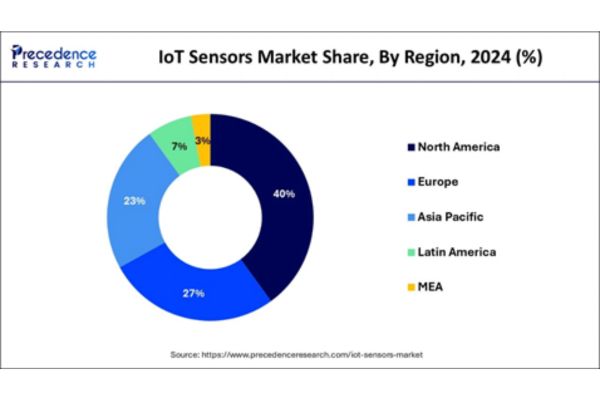
- Top Region in 2024: North America (~40 % revenue share)
- Fastest Growing Region: Asia‑Pacific
- Leading Sensor Type (2024): Pressure sensors
- Network Leadership (2024): Wired technologies; however, wireless is on track to outpace in forecast period
- Key End‑Use Sectors: Automotive, industrial, consumer electronics, and smart infrastructure
What Opportunities and Trends Are Fueling Next-Wave IoT Growth?
The Race to Smarter Factories and Industrial IoT
Smart factories powered by the Industrial Internet of Things (IIoT) are reshaping the manufacturing sector globally. By integrating sensors across robots, smart machines, and warehouse floors, manufacturers achieve new heights in real-time data collection, predictive maintenance, and operational safety. Leaders like China and Germany showcase early adoption, unlocking new business models and KPIs.
Real-Time Monitoring: Predictive Analytics Meets Value Creation
Big data and IoT-connected devices remove the guesswork from maintenance and process optimization. Factories now pinpoint potential failures before they happen, leveraging real-time sensor data to maximize productivity and minimize costly downtime.
Miniaturization & MEMS Technology: Sensors Get Smaller and Smarter
Breakthroughs in microelectromechanical systems (MEMS) technology have unleashed a wave of miniaturized sensors, fueling the wearable, drone, and robotics market booms of the last five years.
Expert Quote
“The era of connected intelligence is here. With exponential growth in IoT sensors, industries can transform routine operations into predictive, autonomous processes—making environments safer, smarter, and immeasurably more efficient. As key applications expand across factory floors, cars, and healthcare settings, value creation through data will be the market’s defining hallmark over the next decade.”
— Maya Kapoor, Principal Consultant, Precedence Research
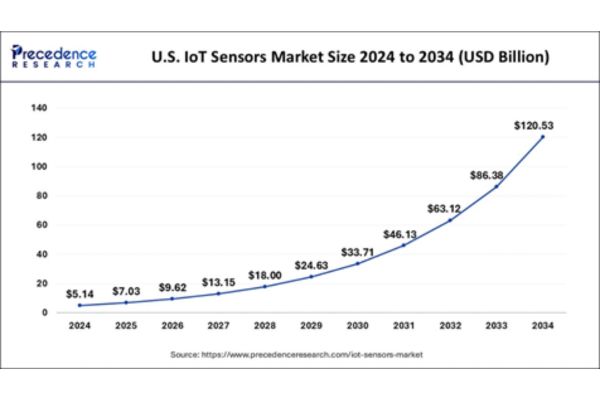
U.S. IoT Sensors Market Size Growth (2025 to 2034)
The U.S IoT sensors market size was USD 5.14 billion in 2024 and is expected to reach around USD 120.53 billion by 2034, at a CAGR of 37.09% from 2025 to 2034.
North America: Early Adoption and Market Leadership
North America reigns supreme, holding 40% of global revenue in 2024. The region’s established vendor base and rapid consumer adoption, with two-thirds of homes containing at least one IoT device, underscore its leadership position. Market penetration is supported by robust consumer demand and corporate investments in monitoring solutions.
Asia Pacific: Fastest Growing Hub
Asia Pacific witnesses a surge, driven by technology champions in India, China, Japan, South Korea, and Australia. These markets not only empower consumer electronics but also spearhead industrial deployments under Industry 4.0 transformations.
India: Poised for a sensor surge via Industry 4.0 initiatives and smart city programs—complemented by growing local IoT manufacturing capabilities and pilot deployments in urban infrastructure
Launched multiple cellular IoT modules, including LTE Cat 4, 5G RedCap, and ultra‑low‑cost Cat 1.bis, ailored for smart meters, telematics, and industrial telemetry
China & South Korea: Tech titans like STMicroelectronics and Murata are scaling operations and forging partnerships to meet surging demand for consumer and industrial sensors
By Sensor Type:
The IoT sensors market encompasses magnetometers, gyroscopes, inertial sensors, image sensors, touch sensors, temperature and humidity sensors, pressure and flow sensors, accelerometers, and an emerging “others” category. These sensors are crucial for applications ranging from navigation and autonomous vehicles to consumer electronics, smart homes, healthcare, industrial monitoring, automotive safety, and smart manufacturing, collectively underpinning IoT ecosystems.
By Network Technology:
Network technologies, both wired and wireless, are essential for IoT sensor integration. Wired protocols such as Ethernet, MODBUS, LonWorks, DALI, and KNX are utilized in industrial automation and building management for their reliability and low latency. Wireless technologies like Zigbee, Z-Wave, Wi-Fi, and Bluetooth (including Bluetooth 5 and ANT+) are prevalent in consumer and commercial IoT. NFC and RFID are key for contactless payments, smart cards, and asset tracking. Emerging low-power wireless protocols are also extending IoT applications into wearables, smart cities, and healthcare by reducing costs and increasing device lifecycles, enabling flexible sensor deployment across diverse environments.
By Vertical:
The IoT sensors market is segmented by vertical into industrial, consumer, commercial, and others. The industrial sector is the leading adopter, driven by Industry 4.0, predictive maintenance, and robotics. The consumer sector shows rapid growth due to wearables, smartphones, and home automation. The commercial sector focuses on smart buildings, retail analytics, and facility management for energy efficiency and improved customer experiences. The “others” category, including healthcare, agriculture, and defense, is a growing frontier with applications like remote patient monitoring and precision farming.
IoT Sensors Market Top Companies
- AMS OSRAM AG
- Analog Devices Inc.
- Broadcom Inc.
- Emerson Electric Co.
- Honeywell International Inc.
- Infineon Technologies AG
- Innovative Sensor Technology IST AG
- International Business Machines Corp.
- Knowles Corp.
- Libelium Comunicaciones Distribuidas SL
- Monnit Corp.
- NXP Semiconductors NV
- OMRON Corp.
- SENSATA TECHNOLOGIES HOLDING PLC
- Siemens AG