

Medical robots are no longer limited to futuristic hospitals or complex surgical procedures. They are gradually becoming part of everyday healthcare, helping hospitals manage routine work, assist patients, and improve operational efficiency.
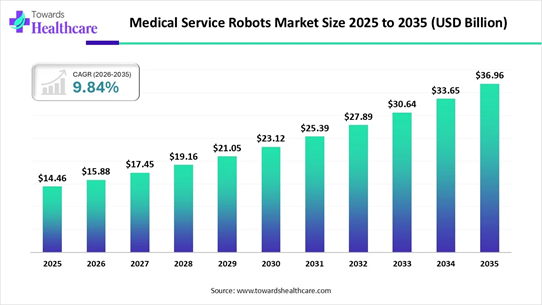
According to Towards Healthcare Research and Consulting, the global medical service robots market was valued at USD 14.46 billion in 2025, reached USD 15.88 billion in 2026, and is projected to reach around USD 36.96 billion by 2035. The market is expected to expand at a 9.84% CAGR from 2026 to 2035.
Let’s Understand Robotics in Medical Services
When people hear the word medical robotics, they often think about robotic surgery. However, medical service robotics covers a much wider range of applications.
These robots can transport medicines and samples, disinfect hospital rooms, assist patients, support rehabilitation, and help healthcare staff with repetitive tasks. Simply put, robots are increasingly being used as support systems rather than replacements for healthcare professionals.
The idea is not to make healthcare completely automated. Instead, robotics can take care of repetitive and time-consuming activities while doctors, nurses, and technicians focus more on patients and clinical responsibilities.
Where Are Medical Service Robots Being Used?
One of the most practical uses of robots is hospital logistics. Robots can transport medicines, medical supplies, meals, and laboratory samples between departments, reducing the time staff spend moving materials around the hospital.
Disinfection robots are another growing application. These systems can move through designated areas and use technologies such as UV light to support hospital cleaning and infection-control processes.
Robots are also finding their place in patient assistance and rehabilitation. They can support physical therapy, mobility exercises, and certain rehabilitation activities, especially when patients need repeated assistance.
In pharmacies and laboratories, robots can also support medicine handling, sample movement, and other repetitive workflows. Surgical robots represent another important part of medical robotics, providing surgeons with greater control and precision during selected procedures.
Medical Robots: Before vs. After
Before robots became part of healthcare workflows, many routine activities depended completely on hospital staff. Carrying supplies, transporting samples, delivering medicines, and repeatedly moving between departments could consume a considerable amount of staff time.
That time matters because healthcare professionals already have demanding workloads. Spending less time on routine transportation can give them more time for patients and higher-value clinical activities.
With robots, some of these repetitive processes can be automated. A robot can follow a programmed route, transport materials, and return for another task without requiring a staff member to perform every movement.
However, this does not mean robots replace healthcare workers. Human judgment, empathy, communication, and clinical decision-making remain essential. Robots mainly take over tasks where automation can provide practical benefits.
Key Trends Shaping the Market in 2026
Artificial intelligence is becoming an important part of medical robotics. AI-enabled systems can help robots understand their surroundings, navigate complex environments, identify objects, and respond to predefined situations.
Automation is also moving beyond large hospitals. Rehabilitation centers, laboratories, pharmacies, and specialized healthcare facilities are exploring robotics for specific operational needs.
Another important trend is the connection between robots and hospital digital infrastructure. Connected robotic systems can potentially work with inventory management, laboratory workflows, hospital information systems, and other digital platforms.
There is also growing interest in autonomous mobile robots, particularly for internal transportation. Instead of simply performing one fixed task, these systems can navigate changing hospital environments and handle multiple types of routine deliveries.
The Challenges Healthcare Faces with Robots
Medical robotics has strong potential, but adoption comes with practical challenges. High upfront investment is one of the biggest barriers, especially for smaller hospitals with limited technology budgets.
Hospitals also need trained employees who can operate, monitor, troubleshoot, and maintain robotic systems. A robot may reduce manual work, but it still requires technical support and regular maintenance.
There are also concerns related to cybersecurity, patient safety, data protection, system failures, and interoperability. If robots are connected to hospital networks, organizations need to make sure those systems are properly protected.
Most importantly, hospitals need to identify the right tasks for automation. Installing a robot simply because the technology is available does not guarantee better healthcare outcomes.
Pros and Cons of Medical Service Robots
Pros
- Reduces repetitive workload: Robots can handle routine transportation, delivery, and other repetitive activities.
- Saves staff time: Healthcare workers can spend more time on patients and important clinical responsibilities.
- Improves operational efficiency: Automated workflows can help hospitals manage routine processes more consistently.
- Supports infection control: Specialized robots can assist with disinfection and reduce human exposure to certain environments.
- Works continuously: Robots can perform designated tasks for extended periods without fatigue.
- Supports rehabilitation: Robotic systems can provide consistent assistance during selected rehabilitation activities.
- Improves precision in selected applications: Certain robotic systems can provide controlled and highly precise movements.
Cons
- High initial investment: Purchasing and installing advanced robotic systems can be expensive.
- Maintenance costs: Robots require regular servicing, software updates, and technical support.
- Training requirements: Staff need appropriate training to operate and manage robotic systems.
- Technical failures: A malfunction can interrupt workflows and may require human intervention.
- Cybersecurity concerns: Connected robots can introduce additional cybersecurity risks.
- Limited human interaction: Robots cannot replace the empathy, communication, and judgment provided by healthcare professionals.
- Integration challenges: Connecting robots with existing hospital systems can be complicated.
What Comes Next?
The future of medical service robotics is unlikely to be about creating hospitals where robots replace people. Instead, it will be about creating smarter healthcare environments where humans and robots work together.
As technology becomes more capable, hospitals will increasingly look at robotics from a practical perspective: Which tasks take too much staff time? Which processes can be made safer? And where can automation genuinely improve patient care?
That shift; from simply adopting robotics to using it where it creates real healthcare value; is likely to define the next stage of the medical service robots market.
About Author
Payal Rabde is a Healthcare Market Research Analyst at Towards Healthcare Research & Consulting with over 4+ years of experience in pharmaceutical, biotechnology, medical device, and healthcare market research. She holds an MBA in Pharmaceutical-Biotechnology Management and a B.Pharm, specializing in market analysis, forecasting, competitive intelligence, and strategic healthcare insights.
About Towards Healthcare Research and Consulting
Towards Healthcare Research & Consulting is a global strategy consulting firm with a presence in both Canada and India. We provide innovative solutions customized to the healthcare sector, helping business leaders overcome challenges and accelerate growth. We specialize in delivering advanced technological solutions, clinical research services, and powerful data analytics. Our focus is on building meaningful partnerships that foster innovation and deliver actionable insights to drive success in healthcare.