
We are living in the era of digital and technological transformations and amidst all this buzz is another noise creating ripples across the Indian subcontinent: “Make in India’. Yes, it is a slogan echoing in all directions across the country. Be it automotive, energy, pharmaceuticals or the semiconductor industry, every Indian sector is already embraced digitalization and automation to augment quality and productivity. And all this happening keeping another important factor in mind: to reduce waste. Smart instrumentation is the true enabler in all regards.
From Conventional Gauges to Intelligent Systems
Earlier and until recently, measuring temperature, pressure, flow, and level were executed using analog instruments. Though the reliability quotient of these devices were good, these needed manual inspection and intervention. Any deviation or drift in measurement could result in process inefficiencies, product inconsistencies, or even safety hazards.
The new generation of smart instruments has added a fresh dimension to the earlier story. These devices have advanced sensors, follow digital communication protocols, and have self-diagnostic capabilities. Alongside measurement, these instruments analyze, communicate, and optimize. By continuously collecting high-resolution data and transmitting it in real time to centralized control systems, they provide actionable insights that enable predictive maintenance, energy optimization, and quality control.
In reality, smart instrumentation has developed a connected process, where every valve, transmitter, and sensor becomes a node in the larger Industrial Internet of Things (IIoT).
The Backbone of Industry 4.0
The shift toward Industry 4.0 is driven by the convergence of cyber-physical systems, cloud computing, and data analytics. Smart instruments form the basis and a basic layer of this ensemble. Without accurate, real-time data, even the most sophisticated analytics or AI algorithms fail to deliver meaningful outcomes.
Modern instruments produce self-calibration, remote configuration, and diagnostics. Through digital communication interfaces such as HART, PROFIBUS, and Modbus, they seamlessly integrate into distributed control systems (DCS) and enterprise platforms. This operational excellence allows manufacturers to achieve 360 degree vigilance, from the shop floor to the top floor.
In industries like oil and gas, power, and chemical processing, where safety and reliability rule the chart, this data-driven visibility translates into faster response times and reduced unplanned downtime. For sectors like pharmaceuticals and food processing, it ensures compliance with stringent quality and traceability standards.
Driving Efficiency and Sustainability
Smart instrumentation enhances operational efficiency. It also contributes to sustainability.
Accurate measurement and control can minimize resource wastage, optimize energy consumption, and reduce emissions. A classic example in this scenario is a thermal power plant where accurate monitoring of boiler pressure and temperature is possible via intelligent transmitters which in turn significantly improves fuel efficiency and lowers carbon output.
Quoting another example of water and wastewater management here: flow and level sensors ensure optimal utilization of resources while maintaining environmental compliance due to digital interference.
Predictive maintenance helps smart devices reduce waste and downtime because these models use sensor data to predict and detect wear and trigger maintenance at the right time. The result is a leaner, greener, and more reliable production system.
Smart Calibration: Precision as a Service
We literally breathe data in recent times. Measurement accuracy is non-negotiable. A single incorrect reading can distort significant processes leading to compliance failures. Hence, follows the role of smart calibration systems which allow automated, traceable, and digitalized calibration processes to ensure every measurement device performs within defined standards to produce desirable results.
Leading instrumentation providers have developed mobile calibration services that bring high-accuracy calibration directly to the customer’s site, minimizing equipment downtime and maintaining productivity. These services are backed by NABL-accredited laboratories and global quality frameworks like ISO 9001 and ISO 14001, ensuring that Indian industries also achieve similar precision benchmarks as their global counterparts.
Indian manufacturing’s Digital Leap
India’s manufacturing sector contributes nearly 17% to the national GDP and employs over 27 million people. As the government pushes for increased domestic value addition and technology localization, smart instrumentation has become a key marker.
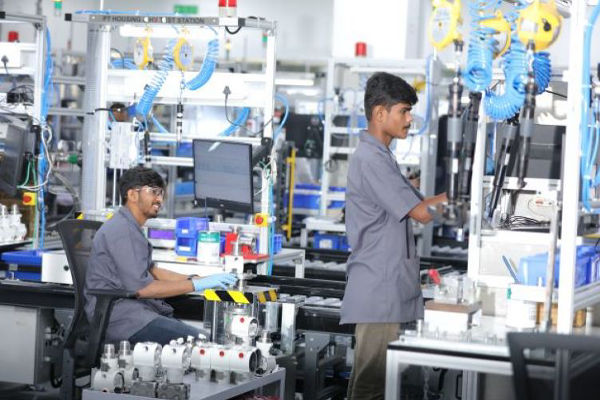
Factories across India are transitioning from semi-automated systems to digitally integrated plants. In this journey, instrumentation plays multiple roles, it acts as the eyes and ears of industrial automation, the nerve network of IIoT, and the foundation for AI-driven optimization.
Let’s take another example. This time of a modern automotive manufacturing line. Smart pressure and temperature sensors help maintain accuracy in paint shops. Flow meters aid to make sure consistent lubrication in assembly operations. Real-time data from hundreds of such devices flows into central dashboards, empowering operators to identify inefficiencies instantly and make proactive adjustments.
The same principle applies to sectors like renewable energy, where smart sensors monitor turbine performance or track heat transfer in solar plants. These capabilities point ways used by manufacturers to measure performance, predict reliability, and ensure sustainability in recent years.
Localization and Innovation: The Indian Advantage
What makes this revolution even more significant is India’s growing ability to design, manufacture, and export advanced measurement technology. Global leaders in instrumentation have set up full-fledged engineering, production, and calibration hubs in India, catering to both domestic and international markets.
These facilities are assembly units. They serve as centers of innovation where customized solutions take shape for diverse industrial needs. Indian engineers are contributing to global R&D initiatives in areas such as miniaturized sensors, digital manifolds, and integrated flow systems.
This shift toward local innovation redefines India’s self-reliance in high-precision manufacturing equipment. This leads to creation of skilled employment in engineering and metrology fields, aligning perfectly with the Atmanirbhar Bharat vision.
Challenges and the Road Ahead
While the adoption of smart instrumentation is accelerating, several challenges still pose a threat to India’s self-reliance. Many legacy plants still operate with analog systems and lack digital integration. Transitioning to smart devices requires investment in both technology and training.
Cyber security also becomes a crucial consideration, as connected instruments generate large volumes of sensitive operational data. Manufacturers must implement robust network security and data governance protocols to safeguard these systems.
Though challenges exist, the path is clear. The future of Indian manufacturing will be data-centric, automated, and connected. Smart instrumentation will continue to trigger this evolution.
Conclusion: The Measure of Progress
In manufacturing, if you can’t measure, you can’t improve. Measurement plays a pivotal role here. Smart instrumentation aids measurement enabling Indian manufacturers to achieve precision, efficiency, and global competitiveness like never before.
As industries evolve towards sustainable, digital, and high-performance ecosystems, the role of intelligent sensors, transmitters, and calibration systems will only grow in significance.
India’s journey toward becoming a global manufacturing leader will be measured not only in units produced, but in the accuracy, reliability, and intelligence with which those units are made.
And at the core of that transformation, smart instrumentation stands as the true measure of progress.