
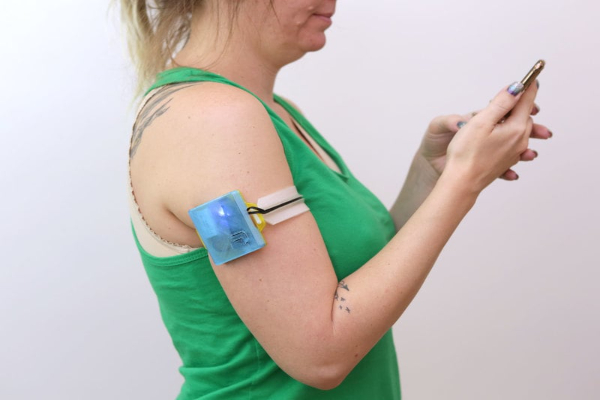
Wearable body temperature sensors are small devices that monitor body temperature while being worn on the skin or integrated into products such as smartwatches, patches, and smart clothing.
Unlike a conventional thermometer, they can collect temperature data continuously, helping users and healthcare professionals observe changes and patterns over time.
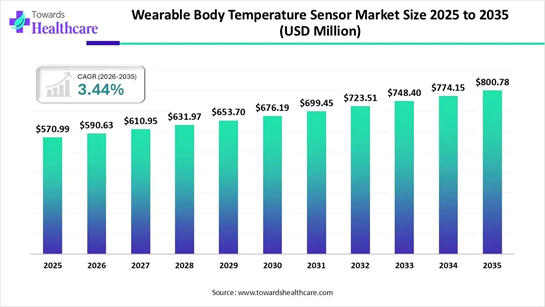
According to Towards Healthcare research and Consulting, the sector was valued at US$ 570.99 million in 2025, reached US$ 590.63 million in 2026, and is projected to reach around US$ 800.78 million by 2035, growing at a CAGR of 3.44% from 2026 to 2035.
What Are Wearable Body Temperature Sensors?
These sensors detect temperature changes from the body and convert them into signals that can be processed and stored digitally.
They are increasingly used in connected healthcare, fitness, wellness, clinical research, and remote monitoring because they reduce the need for repeated manual temperature measurements.
Most wearable devices measure skin temperature, which can differ from core body temperature due to factors such as environment, exercise, sweating, and blood circulation.
How Do Wearable Temperature Sensors Work?
The sensor detects a change in temperature and converts it into an electrical signal, which is then processed by the device.
The information can be stored locally or transmitted through Bluetooth and other wireless technologies to smartphones, cloud platforms, or healthcare systems.
Common technologies include thermistors, RTDs, thermocouples, infrared sensors, and flexible temperature-sensing materials.
For reliable performance, manufacturers need to consider accuracy, calibration, response time, sensor placement, power consumption, and stability during movement.
Types of Wearable Body Temperature Sensors
Wearable temperature sensors come in different forms depending on their design, placement, and intended application.
- Smartwatch and Fitness Band Sensors: Integrated into consumer wearables to monitor temperature alongside activity, heart rate, and sleep.
- Skin Patches: Thin and lightweight sensors designed for continuous temperature monitoring.
- Flexible Temperature Sensors: Bendable sensors that can conform closely to the skin and support comfortable long-term use.
- Textile-Based Sensors: Embedded into clothing or fabrics for less intrusive temperature monitoring.
- Medical Wearable Sensors: Designed for healthcare and research applications where accuracy, reliability, and validation are more important.
The right type depends on the required accuracy, duration of use, placement, comfort, and whether the device is intended for wellness or medical applications.
How Are Wearable Temperature Sensors Manufactured?
Manufacturing begins with selecting the sensing element and a suitable flexible or rigid substrate.
Materials can then be deposited, printed, coated, or fabricated into the required sensing structure before being connected with electronic components.
The finished system may include the sensor, processor, battery, wireless communication module, and protective layer.
Before use, manufacturers test the device for accuracy, response time, flexibility, durability, moisture resistance, calibration, and power consumption.
Materials and Technologies Used
Wearable temperature sensors can use flexible polymers, conductive polymers, metals, conductive inks, carbon-based materials, nanomaterials, and textile substrates.
Flexible and printed electronics are receiving attention because they can help create thinner, lighter, and more comfortable sensors.
Low-power electronics are equally important because continuous sensing and wireless data transmission can increase energy consumption and affect battery life.
Healthcare vs. Consumer Applications
In healthcare, wearable temperature sensors require greater attention to accuracy, reliability, calibration, clinical validation, safety, and applicable regulatory requirements.
They can support remote monitoring, clinical research, recovery tracking, and other applications where repeated temperature information is useful.
In consumer devices, the focus is often on comfort, convenience, battery life, design, connectivity, and integration with other wellness measurements.
This distinction matters because a consumer wearable’s temperature reading should not automatically be treated as equivalent to a clinically validated body-temperature measurement.
Pros of Wearable Body Temperature Sensors
- Continuous monitoring: Tracks temperature over extended periods.
- Convenience: Reduces the need for repeated manual measurements.
- Compact design: Can be integrated into small wearable devices.
- Remote monitoring: Enables data sharing with connected healthcare platforms.
- Multisensor integration: Can work alongside heart rate, motion, sleep, and respiratory sensors.
- Research value: Helps capture temperature patterns that occasional measurements may miss.
Cons and Challenges
- Skin vs. core temperature: Skin readings may not accurately represent internal body temperature.
- Environmental effects: Heat, cold, humidity, clothing, and activity can influence readings.
- Sensor placement: Poor contact or incorrect positioning can reduce accuracy.
- Calibration: Regular validation and calibration are important for reliable measurements.
- Battery limitations: Continuous sensing and connectivity can increase power requirements.
- Durability: Sweat, moisture, bending, and repeated movement can affect some sensor designs.
- Data privacy: Connected wearables generate physiological data that requires secure handling.
Source: https://www.towardshealthcare.com/insights/wearable-body-temperature-sensor-market-sizing
About Author
Payal Rabde is a Healthcare Market Research Analyst at Towards Healthcare Research & Consulting with over 4+ years of experience in pharmaceutical, biotechnology, medical device, and healthcare market research. She holds an MBA in Pharmaceutical-Biotechnology Management and a B.Pharm, specializing in market analysis, forecasting, competitive intelligence, and strategic healthcare insights.
About Towards Healthcare Research and Consulting
Towards Healthcare Research & Consulting is a global strategy consulting firm with a presence in both Canada and India. We provide innovative solutions customized to the healthcare sector, helping business leaders overcome challenges and accelerate growth. We specialize in delivering advanced technological solutions, clinical research services, and powerful data analytics. Our focus is on building meaningful partnerships that foster innovation and deliver actionable insights to drive success in healthcare.