

Overview
Sleep tracking has moved from clinical sleep laboratories to the wrist, finger, and even the forehead. Wearable sleep trackers use sensors, algorithms, and mobile applications to monitor sleep continuously and provide insights into sleep duration, sleep efficiency, awakenings, heart rate, and recovery.
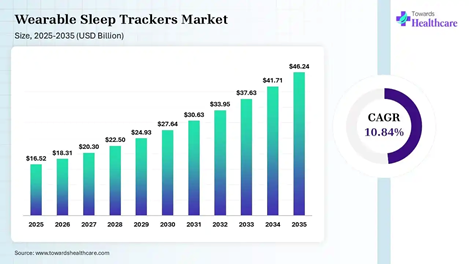
According to Towards Healthcare Research and Consulting, wearable sleep trackers market size is calculated at USD 16.52 in 2025, grew to USD 18.31 billion in 2026, and is projected to reach around USD 46.24 billion by 2035. The market is expanding at a CAGR of 10.84% between 2026 and 2035.
At the same time, the need for better sleep monitoring is significant. A 2025 review reported that 30%–45% of adults worldwide experience sleep disorders, highlighting the potential role of scalable wearable technologies in long-term monitoring.
How Wearable Sleep Trackers Work
Wearable sleep trackers combine several sensors to capture physiological signals while a person sleeps. Accelerometers measure movement and inactivity, while PPG sensors use light to detect blood-volume changes and estimate heart rate, respiratory rate, and related cardiovascular signals.
The device then sends this information to algorithms that estimate sleep and wake periods and, depending on the device, classify sleep into light, deep, and REM stages. Some systems also incorporate HRV, blood oxygen, skin temperature, and respiratory data to generate personalized sleep and recovery scores.
Advanced Technologies Driving Sleep Tracking
Artificial intelligence and machine learning are becoming central to next-generation sleep wearables. In a review of 46 AI-powered wearable studies, 98% used classification approaches, while CNNs were used in 37%, random forests in 30%, and support vector machines in 26%.
Multi-sensor technology is another major development. Wearables increasingly combine PPG, accelerometry, ECG, SpO₂, temperature sensing, and sometimes EEG to improve sleep analysis. A review of 90 studies identified 13 different sensing modalities, with EEG and PPG among the most commonly investigated approaches.
EEG remains particularly important because it directly captures brain activity and is the only sensing modality identified in the review as capable of distinguishing all sleep stages. PPG, meanwhile, is easier to integrate into consumer devices and is therefore highly suitable for continuous monitoring.
Types of Wearable Sleep Trackers
Smartwatches
Smartwatches combine sleep tracking with heart-rate, SpO₂, activity, stress, and other health measurements. They currently represent the largest product category in one market analysis, accounting for 48.6% of sleep-monitoring wearable revenue in 2025.
Fitness Bands
Fitness bands provide lightweight and relatively affordable monitoring, generally focusing on movement, heart rate, sleep duration, and sleep-stage estimates.
Smart Rings
Smart rings provide overnight monitoring in a smaller form factor. Their compact design and longer battery life make them particularly attractive for users who find wrist-based devices uncomfortable during sleep.
Smart Patches and Straps
Patches and specialized straps can support continuous physiological monitoring and may have applications in clinical research, remote monitoring, and digital health.
EEG-Based Wearables
EEG headbands and similar devices attempt to capture brain activity more directly, potentially providing more detailed sleep-stage information than movement-based consumer wearables.
Pros of Wearable Sleep Trackers
- Continuous monitoring: Enables sleep trends to be tracked over weeks and months.
- Convenient: Monitoring can happen at home without laboratory equipment.
- Multiple biomarkers: Devices can combine sleep with heart rate, HRV, SpO₂, movement, and temperature.
- Personalized insights: Algorithms can generate sleep scores, recovery trends, and behavioral recommendations.
- Large-scale potential: Wearables can collect longitudinal data from large populations at relatively low cost.
- Remote monitoring: Creates opportunities for digital health and research applications.
Cons and Limitations
- Accuracy varies: Results can differ substantially between devices and algorithms.
- Not a replacement for PSG: Polysomnography remains the clinical reference method for detailed sleep assessment.
- Sleep-stage limitations: Consumer devices may struggle to distinguish individual sleep stages accurately.
- False sleep detection: Devices can sometimes interpret periods of quiet wakefulness as sleep.
- Sensor interference: Movement, device fit, skin characteristics, and other factors can affect readings.
- Data privacy: Continuous collection of health-related information creates security and privacy considerations.
What Does the Data Say About Accuracy?
Real-world validation shows why wearable sleep data needs careful interpretation. A 2025 meta-analysis covering 24 studies and 798 participants found significant differences between consumer wrist-worn devices and polysomnography. Compared with PSG, devices showed an average difference of approximately 16.9 minutes in total sleep time, 4.7 percentage points in sleep efficiency, 2.6 minutes in sleep latency, and 13.3 minutes in wake after sleep onset.
Another 2025 validation study involving 62 adults compared six commercial devices, including Fitbit, Garmin, Withings, Whoop, and Apple Watch models. All devices detected more than 90% of sleep epochs, but specificity for distinguishing wakefulness was much lower, ranging from 29.39% to 52.15%. Agreement with PSG ranged from fair to moderate, with Cohen’s kappa values of 0.21–0.53.
These findings suggest that wearable trackers are increasingly useful for identifying overall sleep trends, but their sleep-stage and clinical measurements should not automatically be treated as equivalent to laboratory PSG.
Future Opportunity
The next phase of wearable sleep tracking will likely focus on AI-powered interpretation, sensor fusion, flexible electronics, improved sleep-stage classification, and personalized health recommendations.
The opportunity is therefore moving beyond simply measuring how many hours a person sleeps. The emerging goal is to connect sleep data with cardiovascular health, stress, recovery, physical activity, and long-term health outcomes, making wearable sleep trackers an increasingly important part of personalized digital healthcare.
Source: https://www.towardshealthcare.com/insights/wearable-sleep-trackers-market-sizing
About Author
Payal Rabde is a Healthcare Market Research Analyst at Towards Healthcare Research & Consulting with over 4+ years of experience in pharmaceutical, biotechnology, medical device, and healthcare market research. She holds an MBA in Pharmaceutical-Biotechnology Management and a B.Pharm, specializing in market analysis, forecasting, competitive intelligence, and strategic healthcare insights.
About Us
Towards Healthcare Research & Consulting is a global strategy consulting firm with a presence in both Canada and India. We provide innovative solutions tailored to the healthcare sector, helping business leaders overcome challenges and accelerate growth. We specialize in delivering advanced technological solutions, clinical research services, and powerful data analytics. Our focus is on building meaningful partnerships that foster innovation and deliver actionable insights to drive success in healthcare.